
TOPIC 1: Selected Surahs and Qur’anic Extracts
- Theme: Faith, Devotion, and Righteous Living in Islam
- Unit: Topic 1
- Sub-Topic Exactly as Listed: Sub-topic 1A: Surat al-Inshirah (The Solace) & Sub-topic 1B: The Concept of Tawheed (Monotheism) and its Practical Application
- Syllabus Objectives Addressed:
- “The learner recites, translates, and explains the historical context of Surat al-Inshirah.”
- “Extracts moral and spiritual lessons from the Surah regarding patience during hardships.”
- “Deepens understanding of the categories of Tawheed (Oneness of Allah).”
- “Appreciates how true belief in Tawheed protects an individual from shirk (polytheism) in daily life.”
- Prerequisite Knowledge: Basic memorization of short Surahs from Juz’ Amma and an introductory understanding of the Pillars of Iman (Faith).
1. TOPIC INTRODUCTION
- Definition: Surat al-Inshirah (Chapter 94) is a Makkan Surah revealed to Prophet Muhammad (S.A.W.) to comfort his heart and grant him solace during a period of intense persecution. Tawheed is the core Islamic doctrine of the absolute oneness, uniqueness, and sovereignty of Allah (S.W.T.).
- Real-Life Relevance in Uganda: P7 candidates often face intense anxiety and pressure as they prepare for national examinations. Surat al-Inshirah provides a spiritual anchor, reminding us that challenges are temporary and that hard work brings ease. Furthermore, practicing Tawheed keeps a student grounded—preventing them from consulting local witch doctors or using superstitious charms (voodoo/shirk) to pass exams, encouraging them instead to rely solely on Allah through prayer and dedicated study.
- Hook Scenario: “Imagine you are climbing a steep, rocky hill in Kapchorwa carrying a very heavy sack of maize on your back. Your chest feels tight, your muscles ache, and you feel like giving up. Suddenly, someone you trust lifts the load off your shoulders, hands you a glass of cool water, and shows you that the smooth, flat destination is just a few steps away. This is how Prophet Muhammad (S.A.W.) felt when Allah revealed Surat al-Inshirah during his hardest days in Makkah. Let us discover how Allah turns our heaviest burdens into open pathways of ease!”
2. LEARNING OBJECTIVES
By the end of this lesson, learners should be able to:
- Recite Surat al-Inshirah accurately with correct Tajweed and provide its English translation.
- Analyze the historical circumstances (Asbab al-Nuzul) that led to the revelation of this Surah.
- Classify the three primary categories of Tawheed (Tawheed ar-Rububiyyah, Tawheed al-Uluhiyyah, and Tawheed al-Asma was-Sifat).
- Identify and avoid actions that amount to Shirk (associating partners with Allah) in school and community environments.
3. KEY TERMS AND DEFINITIONS
- Al-Inshirah: Lit. “The Expansion” or “The Solace”—referring to the widening or comforting of the Prophet’s heart to receive divine revelation and endure trials.
- Tawheed: The foundational Islamic belief that Allah is One, without partners, equals, or intermediaries.
- Shirk: The sin of practicing polytheism or associating partners/equals with Allah. It is considered the unpardonable sin in Islam if one dies without repenting.
- Asbab al-Nuzul: The historical context, events, or reasons behind the revelation of specific Quranic verses.
- Analogy: Tawheed is like the heavy concrete foundation of a multi-story building in Kampala. If the foundation is cracked or mixed with poor materials (like shirk), the entire building will collapse, no matter how beautiful the roof or windows look.
4. DETAILED EXPLANATION OF CONCEPTS
Concept A: Text and Meaning of Surat al-Inshirah (Chapter 94)
This Surah consists of 8 verses (Ayat). It was revealed to reassure the Prophet (S.A.W.) that Allah had not abandoned him despite the mockery of the Quraysh.
- Arabic Text & Transliteration:
- أَلَمْ نَشْرَحْ لَكَ صَدْرَكَ (Alam nashrah laka sadrak)
- وَوَضَعْنَا عَنكَ وِزْرَكَ (Wa wa d’ana ‘anka wizrak)
- ٱلَّذِىٓ أَنقَضَ ظَهْرَكَ (Alladhee anqada zahrak)
- وَرَفَعْنَا لَكَ ذِكْرَكَ (Wa rafa’na laka dhikrak)
- فَإِنَّ مَعَ ٱلْعُسْرِ يُسْرًا (Fa inna ma’al ‘usri yusra)
- إِنَّ مَعَ ٱلْعُسْرِ يُسْرًا (Inna ma’al ‘usri yusra)
- فَإِذَا فرَغْتَ فَٱنصَبْ (Fa idha faraghta fansab)
- وَإِلَىٰ رَبِّكَ فَٱرْغَب (Wa ila Rabbika farghab)
- English Translation:
- Have We not expanded for you your breast?
- And We removed from you your burden,
- Which weighed down your back,
- And We raised high for you your repute.
- For indeed, with hardship [will be] ease.
- Indeed, with hardship [will be] ease.
- So when you have finished [your duties], labor hard [in worship].
- And to your Lord direct [your] longing.
- Core Theological Lessons:
- Divine Relief: Allah physically and spiritually purified the Prophet’s heart to withstand trials.
- The Law of Balance: Hardship and ease are intertwined. The verse repeats this twice (Ayat 5 & 6) to guarantee comfort to believers.
- Continuous Effort: When a Muslim finishes their daily secular tasks or studies, they should immediately dedicate their remaining time to acts of worship (Ibadah) and remembrance.
Concept B: The Three Dimensions of Tawheed
True belief in Allah is not vague; it is structured into three clear aspects:
- Tawheed ar-Rububiyyah (Oneness of Lordship): Believing that Allah alone is the Creator, Sustainer, Owner, and Ruler of everything that exists. No one else controls the universe.
- Tawheed al-Uluhiyyah (Oneness of Worship): Directing all acts of worship exclusively to Allah. This means our five daily prayers (Salah), fasting (Sawm), supplications (Du’a), and animal sacrifices are made for Allah alone.
- Tawheed al-Asma was-Sifat (Oneness of Names and Attributes): Believing in all the names and characteristics Allah used to describe Himself in the Quran and Sunnah, without altering their meanings or comparing them to human qualities (e.g., Al-Khaliq: The Creator, Al-Alem: The All-Knowing).
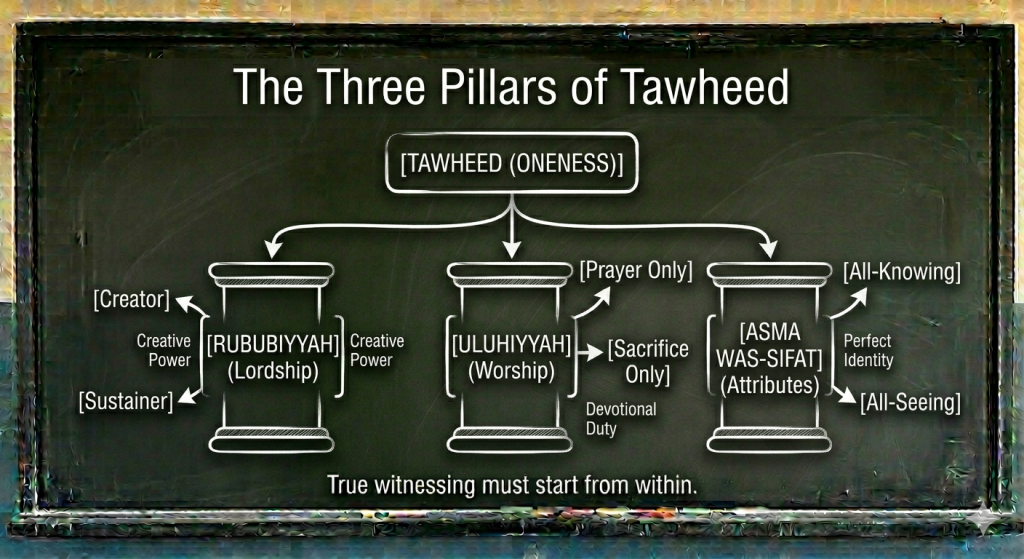
Comparison Table: Tawheed vs. Shirk Examples
| Category of Belief | Manifestation of Tawheed | Manifestation of Shirk (To Be Avoided) |
| Lordship (Rububiyyah) | Believing Allah alone grants healing, weather changes, and good health. | Believing a traditional healer or ancestral spirit controls rain or heals diseases. |
| Worship (Uluhiyyah) | Making Du’a directly to Allah when facing tough exams or illnesses. | Wearing black strings, rings, or amulets (Hirizi) for good luck or protection from evil spirits. |
| Names & Attributes | Affirming that only Allah knows the unseen future (Al-Ghaib). | Consulting fortune-tellers, palm readers, or astrologers to find out your future PLE results. |
─────────────────────────────────────────
5. TEACHER DEMONSTRATIONS / PRACTICAL ACTIVITIES
─────────────────────────────────────────
Activity: Tajweed and Meaning Recitation Circle
- Aim: To master the correct phonetic pronunciation of Surat al-Inshirah while embedding its textual meaning.
- Materials: Copies of Juz’ Amma, chalkboard.
- Procedure:
- Write Verse 5 and Verse 6 on the chalkboard in large, clear Arabic script, highlighting the words Al-Usr (Hardship) and Yusr (Ease) with distinct underlines.
- Recite the verses aloud, demonstrating the rules of Ghunnah (nasalization) and proper elongation.
- Have the class repeat after you three times.
- Call upon individual pupils to translate the verses and explain why they think Allah repeated the exact same phrase twice in a row.
- Expected Observations: Pupils will notice the poetic rhythm of the Surah. Use the repetition to emphasize that no matter how difficult a situation appears, Allah duplicates the avenues of relief for a believer.
─────────────────────────────────────────
6. LEARNER ACTIVITIES
─────────────────────────────────────────
Classroom Activity 1: Surah Textual Analysis (Group Task)
- Objective: Read the scriptural text of Surat al-Inshirah and extract practical behavioral applications.
- Task: Review the translation of verses 7 and 8 and answer the following questions:
- What instruction does Allah give when we finish our immediate daily chores or studies?
- To whom should a Muslim direct all their attention, hope, and longing?
- How does verse 5 comfort a primary seven pupil who is struggling to pass mathematics or science trial exams?
Classroom Activity 2: Conceptual Classification Drill
- Objective: Correctly categorize theological actions under Tawheed or Shirk.
- Task: Read the following real-life scenarios and classify them accurately:
- Jamil finishes his evening revision and says: “O Allah, I have done my best, please grant me understanding and success.” This is an act of Tawheed al-___________.
- A local merchant slaughters a goat at the base of a big tree to make the spirits bless his shop with customers. This acts runs directly against Tawheed ar-___________.
- Fix the misspelled Islamic vocabulary words: tawhid, shirki, inshirah.
Formative Assessment
- Short Answer: What is the meaning of the word Asbab al-Nuzul?
- True or False: Believing that a human leader can see the future and know hidden secrets falls under the category of perfect Tawheed.
- Application Essay: Your neighbor, Aisha, is afraid that envious people might cast an “evil eye” on her children. She wants to visit a local traditional doctor to get protective leather charms to tie around her children’s waists. Write a brief four-sentence advice note to Aisha explaining how this action compromises her Tawheed and what she should do instead using Islamic alternatives.
Marking Guide:
- The historical context or reasons behind the revelation of Quranic verses.
- False.
- Award full marks for advice that identifies the action as Shirk and provides correct prophetic alternatives (e.g., Tying charms or consulting traditional doctors is an act of Shirk because protection comes from Allah alone. This breaks your belief in Tawheed al-Uluhiyyah. Instead of charms, you should read Ayat al-Kursi and the last three Surahs of the Quran (Al-Ikhlas, Al-Falaq, An-Nas) over your children every morning and evening. Trust Allah completely to protect your family.)
Further Reading
- Fountain Islamic Religious Education Pupil’s Book 7, Unit 1.
- The Holy Qur’an: Surat al-Inshirah (94:1-8), Surat al-Ikhlas (112).
- Kitab at-Tawheed by Sheikh Muhammad ibn Abdul-Wahhab.
─────────────────────────────────────────
7. COMMON MISCONCEPTIONS
─────────────────────────────────────────
- Misconception: Thinking that Surat al-Inshirah means Muslims will never experience painful trials, financial loss, or sickness once they recite it.
- Correction: The Surah does not promise an absence of hardship. Instead, it promises that alongside every inevitable trial, Allah provides the strength, patience, and subsequent ease to overcome it.
- Misconception: Believing that Tawheed ar-Rububiyyah (believing Allah is the Creator) is enough to make someone a complete Muslim.
- Correction: Even the pagan Quraysh of Makkah believed that Allah was the ultimate Creator of the universe. To be a true Muslim, one must also practice Tawheed al-Uluhiyyah by directing all acts of worship to Him alone without intermediaries.
─────────────────────────────────────────
8. SUMMARY NOTES FOR PUPILS
─────────────────────────────────────────
- Divine Reassurance: Surat al-Inshirah reminds us that Allah lifts our heavy spiritual burdens and elevates the status of those who work for His sake.
- The Ultimate Formula: Hardship is always accompanied by divine ease. Our duty is to keep putting in effort and turning to Allah.
- Pure Faith: Tawheed requires total commitment to Allah’s Lordship, His exclusive right to be worshipped, and His beautiful, incomparable Names and Attributes. We must stay completely away from Shirk.
─────────────────────────────────────────
9. EXAMINATION FOCUS (UNEB-Style)
─────────────────────────────────────────
a) Section A: Short Answer Questions (1 Mark Each)
- What is the meaning of the Arabic word Al-Usr as used in Surat al-Inshirah?
- Name the city where Surat al-Inshirah was revealed to the Prophet (S.A.W.).
- Which category of Tawheed deals with directing all prayers and sacrifices to Allah alone?
- State one consequence of practicing Shirk in the life of a Muslim.
- Answers: 1. Hardship / Difficulty, 2. Makkah, 3. Tawheed al-Uluhiyyah, 4. It ruins a person’s good deeds / separates them from Islam / leads to punishment in the hereafter if they don’t repent.
b) Section B: Structural Essay Questions (4 Marks Each)
- “Tawheed is the foundational pillar upon which all Islamic practices rest.”
- a) Identify any two categories of Tawheed.
- b) Give two ways a primary school Muslim student can apply the lessons of Surat al-Inshirah when facing hard school subjects.
- Answers:
- a) (i) Tawheed ar-Rububiyyah (ii) Tawheed al-Uluhiyyah / Tawheed al-Asma was-Sifat.
- b) (i) By remaining patient, calm, and regular in their prayers during tough study weeks. (ii) By making intense effort (fansab) to revise hard, knowing that ease follows hardship.
─────────────────────────────────────────
10. HIGHER ORDER THINKING QUESTIONS
─────────────────────────────────────────
- Analyze: In Surat al-Inshirah, Allah says: “And We raised high for you your repute (fame).” Analyze how this prophecy has been fulfilled in modern times across the globe every single minute of the day. (Hint: Think about the Adhan / Call to Prayer).
- Evaluate: A student works exceptionally hard, scores aggregate 4 in their PLE mock exams, but brags to their friends saying: “My own sharp brain and high intelligence are the sole reasons I passed; nobody helped me.” Evaluate this statement in relation to the rules of Tawheed ar-Rububiyyah.
─────────────────────────────────────────
11. TEACHING TIPS
─────────────────────────────────────────
- Strategy: Use the “Chalkboard Split.” Divide the board into two sides: One labeled Pure Tawheed and the other labeled Hidden Shirk. Read out everyday actions (like reading horoscopes, trusting a rabbit’s foot, praying Tahajjud, making oaths by Allah) and have pupils run up to place them on the correct side of the board.
- Mnemonic Support: R.U.A. $\rightarrow$ Rububiyyah (Lordship), Uluhiyyah (Worship), Asma was-Sifat (Attributes)! Master these to guard your Iman.
─────────────────────────────────────────
12. GLOSSARY
─────────────────────────────────────────
- Amulet / Hirizi: A small charm or object inscribed with mystical symbols or words, worn to protect the user from evil or bring good fortune (forbidden in orthodox Islam).
- Ghaib: The unseen world, the future, or realities hidden from human senses, known completely and exclusively by Allah.
- Ibadah: All actions, words, and inward feelings that Allah loves and is pleased with, performed as acts of absolute submission and worship.
─────────────────────────────────────────
END: KEY TAKEAWAY FOR LEARNERS
─────────────────────────────────────────
Your journey through Primary Seven is a sacred path of effort, growth, and learning. Whenever your school workload feels overwhelming and your heart feels tight, find comfort in the verses of Surat al-Inshirah. Allah has promised that your difficulties will blossom into ease if you remain steadfast. Keep your faith pure, rely entirely on Allah through Tawheed, protect your mind from superstitious shortcuts, and give your very best effort. Allah is always with those who strive with sincere hearts!
 Introduction to Clothing and Textiles – Senior Five Learner’s Guide
 Introduction to Islamic Religious Education (IRE) – Senior Six Learner’s Guide
 PERFORMING ARTS SENIOR TWO LEARNERS’ GUIDEOrdinary Secondary level
 - PERFORMING ARTS SENIOR TWO TEACHERS’ GUIDEOrdinary Secondary level
 Introduction to Islamic Religious Education (IRE) – Senior Five Learners’ Guide
 NUTRITION AND FOOD TECHNOLOGY SENIOR TWO LEARNERS’ GUIDE
- NUTRITION AND FOOD TECHNOLOGY SENIOR TWO TEACHERS’ GUIDEOrdinary Secondary level
 MATHEMATICS SENIOR TWO LEARNERS’ GUIDEOrdinary Secondary level
 - MATHEMATICS SENIOR TWO TEACHERS’ GUIDEOrdinary Secondary level
 LITERATURE IN ENGLISH SENIOR TWO LEARNERS’ GUIDEOrdinary Secondary level
 Enjoy learning with Yaaka Digital NetworkUncategorized
 Why We Must Accelerate Digital Learning: A Shared Responsibility for Learners, Teachers, Schools, Development Partners and GovernmentUncategorized
 AD3: Three-Dimensional Arts: CarvingUncategorized
 AD3: Drawing and Painting: Still LifeUncategorized
 AD3: Drawing And Painting: PerspectiveUncategorized
- Enjoy learning with Yaaka Digital NetworkUncategorized
- Why We Must Accelerate Digital Learning: A Shared Responsibility for Learners, Teachers, Schools, Development Partners and GovernmentUncategorized
- AD3: Three-Dimensional Arts: CarvingUncategorized
- AD3: Drawing and Painting: Still LifeUncategorized
- AD3: Drawing And Painting: PerspectiveUncategorized
 AD3: Three-Dimensional Arts: Relief SculptureUncategorized
- Topic 2: Electricity and MagnetismUncategorized
- Topic 1: The Muscular-Skeletal SystemUncategorized
- TOPIC 4: ISLAMIC HISTORY AND MUSLIM ORGANISATIONS (UMSC/UMEA)Uncategorized
- TOPIC 3: FIQH (HIJJ AND FORBIDDEN PRACTICES)Uncategorized
Products
-
 Books & Novels
$ 79
Books & Novels
$ 79
-
Whole subject
$ 29
-
Ultimate Plus
$ 999
-
Ultimate
$ 299
-
Gold
$ 99

0 responses on "TOPIC 1: Selected Surahs and Qur'anic Extracts"