
TOPIC 3: FIQH (HIJJ AND FORBIDDEN PRACTICES)
- Theme: Fiqh (Islamic Jurisprudence) and Acts of Ibadah
- Unit: Topic 3
- Sub-Topic Exactly as Listed: Sub-topic 3A: The Rules and Fundamentals of Sawm (Fasting) & Sub-topic 3B: Advanced Taharah (Ritual Cleanliness and Purity)
- Syllabus Objectives Addressed:
- “The learner identifies the pillars (Arkan), conditions (Shuroot), and nullifiers of Fasting in the month of Ramadan.”
- “Distinguishes between obligatory (Fard) and voluntary (Sunnah) fasts.”
- “Demonstrates proper understanding and execution of Ghusl (ritual bath) and Tayammum (dry ablution).”
- “Appreciates the spiritual, health, and social benefits of maintaining physical and spiritual purity.”
- Prerequisite Knowledge: Basic practice of daily Wudu (ablution) and knowledge that Ramadan is the month of fasting.
─────────────────────────────────────────
1. TOPIC INTRODUCTION
─────────────────────────────────────────
- Definition: Sawm is the third pillar of Islam, defined as the deliberate abstention from food, drink, marital relations, and sinful behavior from dawn (Fajr) until sunset (Maghrib), with the explicit intention of pleasing Allah. Taharah is the state of ritual purity required before a Muslim can engage in key acts of worship like Salah or touching the Mus’haf.
- Real-Life Relevance in Uganda: Fasting teaches self-discipline and empathy. When we feel hunger during Ramadan, we understand what the less fortunate in our local communities experience every day, which encourages us to practice charity (Zakat-ul-Fitr). Additionally, the rigorous hygiene standards of Taharah protect students from common sanitation-related illnesses in boarding schools and crowded environments.
- Hook Scenario: “Imagine you are an elite athlete representing your school at a national championship. The rulebook states that if you take even one step outside the white boundary lines, or wear an unapproved jersey, you are immediately disqualified, no matter how fast you ran. Similarly, acts of worship in Islam have strict boundary lines. What are the specific rules that keep our fasts valid, and what do we do when clear water is completely unavailable but the time for prayer has arrived? Let us unlock the code of divine purity and discipline!”
─────────────────────────────────────────
2. LEARNING OBJECTIVES
─────────────────────────────────────────
By the end of this lesson, learners should be able to:
- List the five essential Pillars of Sawm and explain the conditions that make fasting compulsory for an individual.
- Identify at least four actions that completely break or nullify a fast (Mubtilat as-Sawm).
- Demonstrate the structural steps of performing Ghusl (the ritual obligatory bath) and Tayammum (dry purification).
- Categorize instances where a Muslim is permitted to skip the obligatory fast of Ramadan and describe how they must compensate for it.
─────────────────────────────────────────
3. KEY TERMS AND DEFINITIONS
─────────────────────────────────────────
- Niyyah: The internal intention made in the heart before starting an act of worship. Without it, the act is spiritually invalid.
- Suhoor: The pre-dawn meal consumed by Muslims before the call to Fajr prayer to gain strength for the day’s fast.
- Iftar: The evening meal eaten immediately at sunset to break the day’s fast.
- Ghusl: The full-body ritual bath required to cleanse oneself from major ritual impurity (Hadath al-Akbar), such as after a wet dream or post-menstruation.
- Tayammum: The alternative dry purification ritual using clean earth or dust when water is completely unavailable or dangerous to use due to severe illness.
- Analogy: Taharah is like a digital password for your smartphone. If you type the wrong password (or lack ritual purity), the phone remains locked and you cannot access your apps (Salah/Worship).
─────────────────────────────────────────
4. DETAILED EXPLANATION OF CONCEPTS
─────────────────────────────────────────
Concept A: The Fundamentals of Sawm (Ramadan)
Fasting is decreed in the Quran: “O you who believe! Fasting is prescribed for you as it was prescribed for those before you, that you may attain Taqwa (God-consciousness)” (Surat al-Baqarah 2:183).
The Conditions that Make Fasting Compulsory (Shuroot):
- Islam: Being a Muslim.
- Bulugh: Having reached puberty.
- Aql: Being mentally sound and sane.
- Sihhah: Being physically healthy and capable.
- Iqamah: Being a resident (not traveling on a long journey).
Actions that Nullify the Fast (Mubtilat):
- Deliberately eating or drinking anything through the mouth or nose.
- Vomiting intentionally.
- The onset of menstruation (Hayd) or post-childbirth bleeding.
- Losing one’s sanity or passing out for the entire duration of the day.
Concept B: Exemptions and Compensation
Allah is merciful and does not burden a soul beyond its capacity. Certain groups are permitted to break their fast during Ramadan, categorized by how they compensate:
- Those who must make up the days later (Qada): Travelers, the temporarily sick, pregnant or breastfeeding women who fear for their health, and menstruating women. They count the missed days and fast an equal number of days before the next Ramadan.
- Those who must pay a penalty (Fidyah): The elderly who are too frail to fast and those with chronic, incurable illnesses. They do not have to fast; instead, they feed a needy person for every day missed.
Concept C: Advanced Taharah — Ghusl and Tayammum
When minor impurity occurs, Wudu is sufficient. However, major impurity requires Ghusl.
Essential Steps of Ghusl (Fard Actions):
- Making the internal intention (Niyyah) to purify oneself.
- Washing the entire physical body with water, ensuring it reaches the roots of the hair, inside the ears, and every skin fold.
- Rinsing the mouth and sniffing water into the nose.
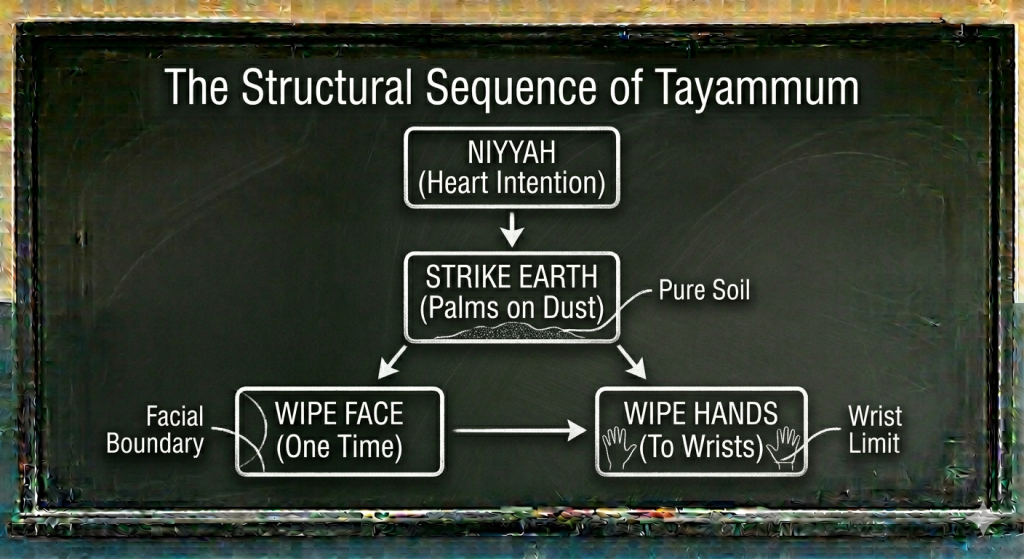
How to Perform Tayammum (Dry Purification):
When water is missing or dangerous to health, dry purification is permitted (Surat al-Ma’idah 5:6):
- Make the intention to perform Tayammum.
- Say “Bismillah” and strike clean, pure earth or dust gently with the palms of both hands.
- Blow off any excess dust from the hands.
- Wipe the entire face once with both palms.
- Wipe the back of the right hand with the left palm, and the back of the left hand with the right palm up to the wrists.
Comparison Table: Wudu vs. Tayammum
| Feature | Wudu (Minor Purification) | Tayammum (Dry Alternative) |
| Primary Element Used | Clean, pure, natural water. | Clean earth, soil, sand, or dust stone. |
| Body Parts Washed/Wiped | Face, arms to elbows, head (wiping), feet to ankles. | Face and hands up to the wrists only. |
| Primary Condition for Use | Standard daily purification for normal conditions. | Only used when water is unavailable, scarce, or harmful due to illness. |
| Nullifiers | Passing gas, using the restroom, deep sleep, fainting. | All nullifiers of Wudu, plus the moment water becomes accessible or usable. |
─────────────────────────────────────────
5. TEACHER DEMONSTRATIONS / PRACTICAL ACTIVITIES
─────────────────────────────────────────
Activity: Live Tayammum Practical Simulation
- Aim: To teach learners how to properly execute Tayammum without invalidating the process.
- Materials: A clean, flat concrete block or a tray containing a small amount of dry sand/dust.
- Procedure:
- Gather the pupils in a semi-circle around the demonstration desk.
- Explain the scenarios where this is necessary (e.g., a student in a desert area or a patient bedridden in a hospital with severe surgical wounds).
- Perform the actions slowly: State the Niyyah silently, tap the concrete block or sand tray with your palms open, blow gently on your hands to show that we do not plaster dirt on our faces, wipe your face, then wipe your hands to the wrists.
- Call upon three different pupils to come forward and repeat the process exactly, correcting their posture or hand coverage instantly.
- Expected Observations: Students often make the mistake of wiping their arms all the way up to the elbows like in Wudu. Correct them right away—Tayammum only goes up to the wrists.
─────────────────────────────────────────
6. LEARNER ACTIVITIES
─────────────────────────────────────────
Classroom Activity 1: Fiqh Scenario Analysis (Group Task)
- Objective: Apply Islamic legal rules to real-life daily situations.
- Task: Read the following cases and state the legal ruling (Hukm) and what the person must do:
- Zainab is fasting during Ramadan. At 11:00 AM, she accidentally swallows a mouthful of water while rinsing her mouth during standard Wudu. She suddenly remembers she is fasting. Is her fast broken?
- Musa is an old grandfather who is 93 years old. He gets dizzy and very weak if he goes without food for more than four hours. What is the ruling regarding his Ramadan fast?
- A student wakes up late for school and discovers they had a wet dream (Hadath al-Akbar). The school has plenty of water, but the student performs Tayammum instead because they are in a rush. Evaluate the validity of their subsequent morning Salah.
Classroom Activity 2: Structural Completion Drill
- Objective: Reinforce core classifications of Fiqh vocabulary.
- Task: Fill in the blanks with the correct words or phrases:
- The pre-dawn meal recommended by the Prophet (S.A.W.) which contains blessings and helps us sustain our energy is called ____________.
- The term used to describe the compensation of fasting a missed day at a later date, one-for-one, is called ____________.
- Fix the misspelled jurisprudence terms: tayamum, thaharah, niyah.
Formative Assessment
- Short Answer: State the two main pillars of Sawm without which a fast is invalid.
- Multiple Choice: Which of the following is a voluntary (Sunnah) day to fast?
- a) The 1st day of Eid-ul-Fitr
- b) Every Monday and Thursday
- c) The entire month of Ramadan
- Application Essay: Your classmate Yusuf says: “Fasting is just a spiritual practice. As long as I do not eat or drink, it doesn’t matter if I lie to the teacher, insult my friends, or cheat in games during Ramadan.” Write a short four-sentence correction to Yusuf explaining the true moral purpose of Sawm based on Islamic principles.
Marking Guide:
- (i) The Intention (Niyyah) made before Fajr. (ii) Complete abstention (Imsak) from all nullifiers from dawn to sunset.
- b) Every Monday and Thursday.
- Award full marks for arguments highlighting that moral character is essential to fasting (e.g., Fasting is meant to build your character and fear of Allah, not just to make you hungry. The Prophet taught that if a person does not stop lying and acting sinfully, Allah does not need them to leave their food and drink. Your bad behavior can ruin the spiritual rewards of your fast completely. True Sawm requires your tongue, eyes, and hands to fast from sin as well.)
Further Reading
- Fountain Islamic Religious Education Pupil’s Book 7, Unit 3.
- Bulugh al-Maram (Book of Purification and Book of Fasting) by Ibn Hajr al-Asqalani.
- The Fiqh of Worship (Fiqh al-Ibadat).
─────────────────────────────────────────
7. COMMON MISCONCEPTIONS
─────────────────────────────────────────
- Misconception: Believing that if a person forgets they are fasting and accidentally eats a full plate of food or drinks juice, their fast is completely ruined for that day.
- Correction: If it was completely accidental and done out of genuine forgetfulness, the fast remains 100% valid. The person should spit out any food left in the mouth the moment they remember, make intention to continue, and complete their fast. The Prophet said that was a meal provided to them by Allah.
- Misconception: Believing that you can perform Tayammum on any decorative plastic table or clean synthetic carpet simply because you do not feel like walking to the water tap.
- Correction: Tayammum is only valid when water is genuinely unavailable or medically dangerous, and it must be performed using natural, clean surface elements of the earth like soil, sand, or unpainted stone dust.
─────────────────────────────────────────
8. SUMMARY NOTES FOR PUPILS
─────────────────────────────────────────
- The Goal of Sawm: We fast to develop Taqwa (piety). It requires both physical hunger and high moral conduct.
- Exemptions are Merciful: Allah allows the sick, travelers, and frail elderly people to break their fast, provided they compensate via Qada (making up days) or Fidyah (feeding the poor).
- Purity is Paramount: Major impurities are washed away using Ghusl. When water is missing or harmful, Allah provides Tayammum as an accessible pathway to maintain our connection to prayer.
─────────────────────────────────────────
9. EXAMINATION FOCUS (UNEB-Style)
─────────────────────────────────────────
a) Section A: Short Answer Questions (1 Mark Each)
- Name the Islamic month during which fasting is compulsory for all mature, healthy Muslims.
- What is the meaning of the term Niyyah in Islamic worship?
- State one valid reason that allows a Muslim traveler to skip fasting during Ramadan.
- Name the dry alternative method of purification used when water is completely unavailable.
- Answers: 1. Ramadan, 2. Intention (made in the heart), 3. Hardship / long distance / exhaustion from traveling, 4. Tayammum.
b) Section B: Structural Essay Questions (4 Marks Each)
- “Taharah is an absolute requirement for the acceptance of major acts of worship.”
- a) Give two conditions that make full-body ritual bath (Ghusl) compulsory.
- b) Identify two body parts that must be wiped when performing Tayammum.
- Answers:
- a) (i) End of menstruation period (Hayd) or post-childbirth bleeding. (ii) After a wet dream / sexual impurity.
- b) (i) The face. (ii) Both hands up to the wrists.
─────────────────────────────────────────
10. HIGHER ORDER THINKING QUESTIONS
─────────────────────────────────────────
- Analyze: Analyze how the rules of fasting create social equality between wealthy property owners in Kampala and low-income workers in rural villages during the month of Ramadan.
- Evaluate: A student is suffering from severe skin eczema, and the medical doctor warns that letting water touch their arms will make the wounds worse and delay healing. Evaluate how the Islamic legal system resolves this conflict between public health safety and religious obligations.
─────────────────────────────────────────
11. TEACHING TIPS
─────────────────────────────────────────
- Strategy: Use a “Rule Matrix Grid” on the blackboard to clarify the operational differences between Qada and Fidyah. P7 candidates frequently mix these up in UNEB questions.
- Mnemonic Support: F.A.S.T. $\rightarrow$ Focus on devotion, Abstain from food, Stop sinful speech, Turn to Allah!
─────────────────────────────────────────
12. GLOSSARY
─────────────────────────────────────────
- Bulugh: The attainment of physical maturity or adolescence (puberty), marking the stage where a individual becomes legally responsible for their religious duties in Islam.
- Fidyah: A mandatory compensation material or payment (usually feeding a poor person) made by a Muslim who is permanently unable to fast due to old age or chronic illness.
- Taqwa: An Islamic term for a state of heart awareness that prompts a person to love and fulfill what Allah commands and stay away from what He forbids.
─────────────────────────────────────────
END: KEY TAKEAWAY FOR LEARNERS
─────────────────────────────────────────
Islam is a religion that perfectly balances deep spiritual goals with clean, orderly discipline. Through Sawm, your body learns patience, your heart learns self-control, and your soul connects with the struggles of the poor. Through the laws of Taharah, Allah ensures that you remain physically clean and spiritually prepared to stand before Him in prayer at any time. Take these lessons of purity and integrity into your exam revision and home routines, protect your character, and shine brightly across Uganda!
 Introduction to Islamic Religious Education (IRE) – Senior Six Learner’s Guide
 PERFORMING ARTS SENIOR TWO LEARNERS’ GUIDEOrdinary Secondary level
 - PERFORMING ARTS SENIOR TWO TEACHERS’ GUIDEOrdinary Secondary level
 Introduction to Islamic Religious Education (IRE) – Senior Five Learners’ Guide
 NUTRITION AND FOOD TECHNOLOGY SENIOR TWO LEARNERS’ GUIDE
- NUTRITION AND FOOD TECHNOLOGY SENIOR TWO TEACHERS’ GUIDEOrdinary Secondary level
 MATHEMATICS SENIOR TWO LEARNERS’ GUIDEOrdinary Secondary level
 - MATHEMATICS SENIOR TWO TEACHERS’ GUIDEOrdinary Secondary level
 LITERATURE IN ENGLISH SENIOR TWO LEARNERS’ GUIDEOrdinary Secondary level
 - LITERATURE IN ENGLISH SENIOR TWO TEACHERS’ GUIDEOrdinary Secondary level
 Enjoy learning with Yaaka Digital NetworkUncategorized
 Why We Must Accelerate Digital Learning: A Shared Responsibility for Learners, Teachers, Schools, Development Partners and GovernmentUncategorized
 AD3: Three-Dimensional Arts: CarvingUncategorized
 AD3: Drawing and Painting: Still LifeUncategorized
 AD3: Drawing And Painting: PerspectiveUncategorized
- Enjoy learning with Yaaka Digital NetworkUncategorized
- Why We Must Accelerate Digital Learning: A Shared Responsibility for Learners, Teachers, Schools, Development Partners and GovernmentUncategorized
- AD3: Three-Dimensional Arts: CarvingUncategorized
- AD3: Drawing and Painting: Still LifeUncategorized
- AD3: Drawing And Painting: PerspectiveUncategorized
 AD3: Three-Dimensional Arts: Relief SculptureUncategorized
- Topic 2: Electricity and MagnetismUncategorized
- Topic 1: The Muscular-Skeletal SystemUncategorized
- TOPIC 4: ISLAMIC HISTORY AND MUSLIM ORGANISATIONS (UMSC/UMEA)Uncategorized
- TOPIC 3: FIQH (HIJJ AND FORBIDDEN PRACTICES)Uncategorized
Products
-
 Books & Novels
$ 79
Books & Novels
$ 79
-
Whole subject
$ 29
-
Ultimate Plus
$ 999
-
Ultimate
$ 299
-
Gold
$ 99

0 responses on "TOPIC 3: FIQH (HIJJ AND FORBIDDEN PRACTICES)"