
TOPIC 4: ISLAMIC HISTORY AND MUSLIM ORGANISATIONS (UMSC/UMEA)
- Theme: Sirah (Prophetic History) and Akhlaq (Islamic Character)
- Unit: Topic 4
- Sub-Topic Exactly as Listed: Sub-topic 4A: The Treaty of Hudaibiyah & Sub-topic 4B: Islamic Manners (Akhlaq) in Speech and Social Interaction
- Syllabus Objectives Addressed:
- “The learner narrates the events leading to the Treaty of Hudaibiyah and explains its historical terms.”
- “Analyzes the strategic diplomatic wisdom of Prophet Muhammad (S.A.W.) and its long-term benefits for Islam.”
- “Identifies and demonstrates specific Islamic etiquettes regarding speech, greeting, and respecting elders.”
- “Appreciates the value of peaceful conflict resolution, patience, and humility in community life.”
- Prerequisite Knowledge: Prior lessons on the establishment of the Islamic state in Madinah and the major defensive battles (Badr, Uhud, and Khandaq).
─────────────────────────────────────────
1. TOPIC INTRODUCTION
─────────────────────────────────────────
- Definition: The Treaty of Hudaibiyah (6 A.H. / 628 C.E.) was a pivotal ten-year peace agreement signed between Prophet Muhammad (S.A.W.) representing the Muslims of Madinah, and the Quraysh tribe of Makkah. Akhlaq refers to the system of moral values, virtues, and practical manners that govern a Muslim’s behavior toward Allah, themselves, and society.
- Real-Life Relevance in Uganda: Land conflicts, family disputes, and school disagreements happen everywhere. The Treaty of Hudaibiyah teaches us that dialogue, compromise, and peaceful mediation are far superior to physical violence and endless revenge. Furthermore, practicing high standards of Akhlaq—such as speaking truthfully, greeting people properly, and caring for elders—helps P7 candidates build respect and strong networks in their Ugandan neighborhoods.
- Hook Scenario: “Imagine you and your school football team walk for five hours to play a major tournament match. When you reach the stadium gates, the rival team blocks the entrance with sticks, completely refusing to let you in. Your players are furious and want to fight. Instead, your captain steps forward, remains totally calm, and signs a piece of paper agreeing not to play today, but to return peacefully next term. Many of your teammates think your captain is weak. Yet, within one year, that single piece of paper causes the rival team to dismantle their wall and willingly invite your entire school to run the stadium! This is the exact genius of the Prophet at Hudaibiyah. Let us look at how patience wins the ultimate victory!”
─────────────────────────────────────────
2. LEARNING OBJECTIVES
─────────────────────────────────────────
By the end of this lesson, learners should be able to:
- Recount the historical events that led the Muslims to journey toward Makkah in the 6th year of Hijrah.
- Evaluate at least three major clauses of the Treaty of Hudaibiyah and explain why many companions initially found them difficult to accept.
- Analyze how this peace treaty directly paved the way for the bloodless Conquest of Makkah (Fath Makkah).
- Demonstrate proper Islamic etiquettes of greeting (As-Salamu Alaykum), speech control, and intergenerational respect according to the Sunnah.
─────────────────────────────────────────
3. KEY TERMS AND DEFINITIONS
─────────────────────────────────────────
- Bay’at-ur-Ridwan (Pledge of Pleasure): The solemn oath taken by the companions under a tree at Hudaibiyah, promising to stand by the Prophet to the death after a false rumor spread that their diplomat, Uthman (R.A.), had been murdered by the Quraysh.
- Suhayl ibn Amr: The clever chief diplomat sent by the Quraysh to negotiate and draft the final terms of the peace treaty with the Prophet.
- Akhlaq: The plural form of Khuluq, meaning character, ethics, deep-seated moral traits, or manners.
- Hilm: The noble Islamic virtue of forbearance, emotional self-control, and calmness when provoked to anger.
- Analogy: Good manners (Akhlaq) are like the sweet scent of a ripe jackfruit. You don’t need to see the fruit inside the thick green skin to know it is good; its pleasant fragrance fills the air around it immediately.
─────────────────────────────────────────
4. DETAILED EXPLANATION OF CONCEPTS
─────────────────────────────────────────
Concept A: The Journey to Hudaibiyah (6 A.H.)
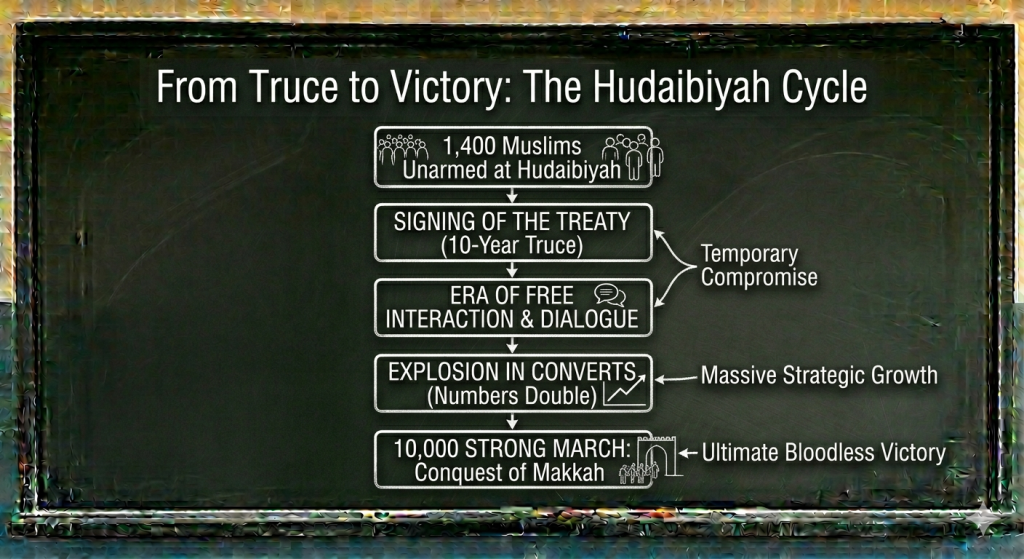
Prophet Muhammad (S.A.W.) had a vision in a dream that he and his companions were entering Makkah peacefully to perform Umrah (the lesser pilgrimage). Inspired by this, he traveled with 1,400 unarmed companions dressed in the simple white garments of Ihram, taking sacrificial cattle along to prove they had no military intentions.
When they reached a valley called Hudaibiyah just outside Makkah, the Quraysh blocked their path, refusing them entry. The Prophet sent Uthman ibn Affan (R.A.) into Makkah as an envoy to negotiate. When Uthman’s return was delayed, rumors spread that he was killed. This prompted the historic Bay’at-ur-Ridwan, where the 1,400 believers held the Prophet’s hand and swore total loyalty to the cause.
Concept B: The Strict Terms of the Treaty
Moved by the unity of the Muslims, the Quraysh sent Suhayl ibn Amr to draft a truce. The terms looked heavily biased against the Muslims:
- No Umrah This Year: The Muslims had to return to Madinah immediately and could only return the following year for just three days.
- The Ten-Year Truce: There would be absolute peace between both sides for ten years; no secret warfare or tribal raids.
- The Refugee Rule (Asymmetrical Clause): If anyone from the Quraysh escaped to Madinah to join Islam without their guardian’s permission, the Prophet must send them back to Makkah. However, if a Muslim left Madinah to rejoin the Quraysh, they would not be returned.
- Freedom of Alliance: Any other Arab tribe was completely free to form a political alliance with either the Muslims or the Quraysh.
Why the Companions Were Sad: Leaders like Umar ibn al-Khattab (R.A.) felt the terms were deeply humiliating. However, the Prophet’s supreme diplomatic foresight recognized the real victory: The Quraysh had officially recognized the Islamic State of Madinah as an equal political power for the first time.
The Long-Term Divine Outcome:
With the war halted, peaceful trade and open discussions flourished. In the next two years of peace, more people accepted Islam than in the entire previous 15 years combined, including brilliant military strategists like Khalid ibn al-Waleed. This massive growth in numbers led directly to the peaceful liberation of Makkah two years later. Allah called this treaty a “Manifest Victory” in Surat al-Fath.
Concept C: Islamic Character (Akhlaq) in Everyday Interaction
The Prophet said: “I have only been sent to perfect good character.” True faith must express itself through exceptional manners:
- Etiquette of Speech:
- A Muslim must speak gently, avoid vulgar insults, and stay away from backbiting (Gheebah).
- The Prophet said: “Whoever believes in Allah and the Last Day should speak good words or remain silent.”
- Etiquette of Greetings:
- Initiating the greeting of peace: “As-Salamu Alaykum wa Rahmatullahi wa Barakatuh” (Peace, mercy, and blessings of Allah be upon you).
- The Sunnah rule of traffic: The riding person greets the walking person, the walking person greets the sitting person, and the smaller group greets the larger group.
- Respecting Elders and Caring for the Young:
- Giving up your seat on a local public taxi (matatu) or bench for an elderly citizen.
- Serving parents and elders meals first before eating.
Comparison Table: Core Differences in Hudaibiyah Perspectives
| Negotiation Point | Immediate View of the Companions | Strategic Vision of the Prophet (S.A.W.) |
| Returning to Madinah without Umrah | Felt like a spiritual defeat, disappointment, and loss of face. | Proved to the world that Muslims respect holy sites and seek peace over blood. |
| Returning Makkah refugees back | Deemed unfair, unjust, and a betrayal of new vulnerable converts. | New converts established a camp outside Makkah, disrupting Quraysh trade routes independently. |
| The 10-Year Ceasefire Line | Feared it restricted their forward movement against the enemy. | Provided an era of safe travel, turning enemies into trading partners and converts. |
5. TEACHER DEMONSTRATIONS / PRACTICAL ACTIVITIES
─────────────────────────────────────────
Activity: The “Sunnah Greeting” Passing Drill
- Aim: To practically correct and normalize the pronunciation and behavioral rules of Islamic greetings among learners.
- Materials: None.
- Procedure:
- Have two pupils stand up at opposite corners of the classroom. Pupil A acts as a “Prefect walking down the corridor,” and Pupil B acts as a “Student sitting down reading a book.”
- Have Pupil A walk past Pupil B. According to the Sunnah, the walking person must initiate the greeting. Pupil A must look Pupil B in the eye, smile, and say clearly: “As-Salamu Alaykum.”
- Pupil B must respond with a superior or equal blessing: “Wa Alaykumus-Salam wa Rahmatullah.”
- Run the drill again, reversing the roles to simulate different groups (e.g., a young student greeting an elderly teacher).
- Expected Observations: Students often mumble or shorten the greeting into slang. Correct them immediately, reminding them that each added segment (wa Rahmatullah / wa Barakatuh) adds ten extra spiritual rewards (Hasanat) to their record.
─────────────────────────────────────────
6. LEARNER ACTIVITIES
─────────────────────────────────────────
Classroom Activity 1: Historical Text Analysis (Group Task)
- Objective: Read historical accounts of early treaties and extract leadership principles.
- Task: Read the summary of the refugee return clause in Section 5 and answer the following questions:
- Identify the name of the pagan chief diplomat who insisted that the name “Muhammad, Messenger of Allah” be erased from the treaty and replaced with “Muhammad, son of Abdullah”.
- Why did the Prophet willingly agree to erase his title during the drafting process? What character trait does this display?
- Mention the names of any two famous Arab leaders who voluntarily embraced Islam during the peaceful era created by this treaty.
Classroom Activity 2: Akhlaq Application Drill
- Objective: Identify and correct behavioral errors in daily school communications.
- Task: Rewrite the following statements to conform with proper Islamic manners (Akhlaq):
- A pupil runs past an old woman struggling to carry a heavy water jerrycan, shouting: “Get out of my way, I am late for my class!” (Correct this action).
- Write down the complete Arabic phrase used to seek forgiveness from Allah when we accidentally utter a bad word or lie: ____________.
- Fix the misspelled historical and moral words: hudaibiya, ahlaq, baiah.
Formative Assessment
- Short Answer: Under what historic tree did the companions take the oath known as Bay’at-ur-Ridwan?
- True or False: The Treaty of Hudaibiyah caused a massive drop in the number of people entering Islam because it banned fighting.
- Application Essay: A group of students in your class wants to start a massive shouting riot against the school canteen workers because the lunchtime porridge was late. Write a brief four-sentence advisory statement using the diplomatic lessons of the Treaty of Hudaibiyah and the concept of Hilm (forbearance) to change their minds.
Marking Guide:
- The tree of Acacia (or simply “The Tree at Hudaibiyah”).
- False.
- Award full marks for advice highlighting patience, dialogue, and calm conflict resolution over shouting and riots (e.g., Starting a riot brings destruction and shame, running completely against the manners of a Muslim. At Hudaibiyah, the Prophet chose calm dialogue over fighting, even when provoked. We should practice Hilm (self-control) and send our class prefect to talk peacefully with the administration about the porridge. Peaceful discussion always brings a lasting solution without regrets.)
Further Reading
- Fountain Islamic Religious Education Pupil’s Book 7, Unit 4.
- Ar-Raheeq Al-Makhtum (The Sealed Nectar – Chapter on the Hudaibiyah Treaty) by Safiur-Rahman Al-Mubarakpuri.
- Riyadh as-Salihin (Book of Good Manners).
─────────────────────────────────────────
7. COMMON MISCONCEPTIONS
─────────────────────────────────────────
- Misconception: Believing that the Treaty of Hudaibiyah was a sign of military weakness or fear on the part of the Prophet (S.A.W.).
- Correction: It was signed from a position of immense spiritual strength. The 1,400 companions had just pledged to fight to the death at Bay’at-ur-Ridwan. The Prophet chose peace because he valued strategic long-term da’wah and human life over immediate conflict.
- Misconception: Thinking that Akhlaq (good manners) is only necessary when interacting with wealthy people, religious leaders, or your own close relatives.
- Correction: High Islamic character must be displayed consistently to everyone, regardless of their wealth, social standing, age, or religious background.
─────────────────────────────────────────
8. SUMMARY NOTES FOR PUPILS
─────────────────────────────────────────
- The Power of Peace: The Treaty of Hudaibiyah proved that diplomatic patience and strategic compromise can achieve far greater victories than swords and warfare.
- Recognized Status: This treaty brought stability, allowed Islam to spread rapidly across Arabia, and laid the groundwork for the bloodless Conquest of Makkah.
- The Muslim Identity: Excellent Akhlaq in speech, respect for elders, and spreading peace through proper greetings are the true measurements of complete faith.
─────────────────────────────────────────
9. EXAMINATION FOCUS (UNEB-Style)
─────────────────────────────────────────
a) Section A: Short Answer Questions (1 Mark Each)
- In which Islamic year (A.H.) was the Treaty of Hudaibiyah signed?
- Name the representative of the Quraysh who negotiated the terms of the treaty at Hudaibiyah.
- Give any one reason why the companions took the pledge of Bay’at-ur-Ridwan.
- Translate the standard Islamic greeting: As-Salamu Alaykum.
- Answers: 1. 6 A.H. (6th Year of Hijrah), 2. Suhayl ibn Amr, 3. Because a false rumor spread that Uthman (R.A.) had been murdered by the Quraysh, 4. Peace be upon you.
b) Section B: Structural Essay Questions (4 Marks Each)
- “The terms of the Hudaibiyah agreement initially appeared harmful to the Muslims, but they yielded immense fruits.”
- a) State any two clauses included in the Treaty of Hudaibiyah.
- b) Identify two positive long-term results that the Muslims achieved because of this treaty.
- Answers:
- a) (i) A ceasefire/peace between both sides for ten years. (ii) The Muslims must return to Madinah without performing Umrah this year / Free choice for tribes to align with either side.
- b) (i) It allowed a massive, peaceful expansion of Islam as numbers of converts exploded. (ii) It directly paved the way for the peaceful and bloodless entry into Makkah two years later.
─────────────────────────────────────────
10. HIGHER ORDER THINKING QUESTIONS
─────────────────────────────────────────
- Analyze: Analyze how erasing his own title “Messenger of Allah” from a legal document demonstrates the difference between an arrogant political ruler and a humble, divinely guided Prophet.
- Evaluate: Suppose a highly educated person scores aggregate 4 in their PLE exams but regularly insults school cooks, uses abusive language on social media, and ignores their grandparents at home. Evaluate the true worth of this individual’s education based on the Islamic standards of Akhlaq.
─────────────────────────────────────────
11. TEACHING TIPS
─────────────────────────────────────────
- Strategy: Use the “Two-Side Debate Layout.” Have one side of the classroom argue from the emotional viewpoint of the companions at the moment of signing (feeling humiliated). Have the other side argue from the viewpoint of Surat al-Fath (celebrating the victory). This embeds higher-order analytical skills for UNEB preparation.
- Mnemonic Support: T.A.L.K. $\rightarrow$ Treat people fairly, Always greet properly, Listen to elders, Keep quiet when angry!
─────────────────────────────────────────
12. GLOSSARY
─────────────────────────────────────────
- Asb-al-Hilm: The state of possessing an accommodating, patient nature that restrains anger and avoids hasty, aggressive reactions.
- Fath Makkah: The triumphant, peaceful liberation of the holy city of Makkah by the Prophet (S.A.W.) and 10,000 companions in the 8th year of Hijrah, which destroyed idolatry without revenge.
- Ihram: The sacred state of spiritual purity and the simple two-piece unstitched white clothing worn by pilgrims entering the holy boundaries of Makkah.
─────────────────────────────────────────
END: KEY TAKEAWAY FOR LEARNERS
─────────────────────────────────────────
True strength does not lie in loud voices, clenched fists, or refusing to listen to others. At Hudaibiyah, the Prophet showed us that real power is found in tactical patience, emotional discipline, and a willingness to compromise for long-term success. Combine this profound wisdom with a life full of beautiful Akhlaq—by speaking words that heal rather than hurt, honoring your elders, and radiating peace through your greetings. Let these noble prophetic traits guide your studies, your home life, and your bright future across Uganda!
 Introduction to Islamic Religious Education (IRE) – Senior Six Learner’s Guide
 PERFORMING ARTS SENIOR TWO LEARNERS’ GUIDEOrdinary Secondary level
 - PERFORMING ARTS SENIOR TWO TEACHERS’ GUIDEOrdinary Secondary level
 Introduction to Islamic Religious Education (IRE) – Senior Five Learners’ Guide
 NUTRITION AND FOOD TECHNOLOGY SENIOR TWO LEARNERS’ GUIDE
- NUTRITION AND FOOD TECHNOLOGY SENIOR TWO TEACHERS’ GUIDEOrdinary Secondary level
 MATHEMATICS SENIOR TWO LEARNERS’ GUIDEOrdinary Secondary level
 - MATHEMATICS SENIOR TWO TEACHERS’ GUIDEOrdinary Secondary level
 LITERATURE IN ENGLISH SENIOR TWO LEARNERS’ GUIDEOrdinary Secondary level
 - LITERATURE IN ENGLISH SENIOR TWO TEACHERS’ GUIDEOrdinary Secondary level
 Enjoy learning with Yaaka Digital NetworkUncategorized
 Why We Must Accelerate Digital Learning: A Shared Responsibility for Learners, Teachers, Schools, Development Partners and GovernmentUncategorized
 AD3: Three-Dimensional Arts: CarvingUncategorized
 AD3: Drawing and Painting: Still LifeUncategorized
 AD3: Drawing And Painting: PerspectiveUncategorized
- Enjoy learning with Yaaka Digital NetworkUncategorized
- Why We Must Accelerate Digital Learning: A Shared Responsibility for Learners, Teachers, Schools, Development Partners and GovernmentUncategorized
- AD3: Three-Dimensional Arts: CarvingUncategorized
- AD3: Drawing and Painting: Still LifeUncategorized
- AD3: Drawing And Painting: PerspectiveUncategorized
 AD3: Three-Dimensional Arts: Relief SculptureUncategorized
- Topic 2: Electricity and MagnetismUncategorized
- Topic 1: The Muscular-Skeletal SystemUncategorized
- TOPIC 4: ISLAMIC HISTORY AND MUSLIM ORGANISATIONS (UMSC/UMEA)Uncategorized
- TOPIC 3: FIQH (HIJJ AND FORBIDDEN PRACTICES)Uncategorized
Products
-
 Books & Novels
$ 79
Books & Novels
$ 79
-
Whole subject
$ 29
-
Ultimate Plus
$ 999
-
Ultimate
$ 299
-
Gold
$ 99

0 responses on "TOPIC 4: ISLAMIC HISTORY AND MUSLIM ORGANISATIONS (UMSC/UMEA)"