
Topic 1: The Muscular-Skeletal System
- Theme: Human Body
- Unit: Topic 1
- Sub-Topic Exactly as Listed: Muscular–Skeletal System
- Syllabus Objectives Addressed:
- “The learner identifies different bones and muscles of the human body and different joints found in the human body.”
- “Discusses functions of the muscular-skeletal system and states diseases and disorders of bones, muscles and the system.”
- “Demonstrates correct body postures and describes good health habits for the system.”
- Prerequisite Knowledge: Basic naming of external parts of the body and major internal organs taught in lower primary classes (P2 and P4).
─────────────────────────────────────────
1. TOPIC INTRODUCTION
─────────────────────────────────────────
- Definition: The Muscular-Skeletal System is an organ system composed of bones, muscles, cartilage, tendons, and ligaments that provides a framework for the body, protects delicate internal organs, and enables movement.
- Real-Life Relevance in Uganda: From digging in the gardens of western Uganda to fetching water with heavy jerrycans or playing school netball matches, every single physical activity relies on this system. Proper understanding helps primary candidates protect themselves from spinal injuries caused by lifting objects incorrectly or sitting badly at school desks.
- Hook Scenario: “Imagine trying to construct a brick house without setting up an iron or timber frame first. If you just pile the cement and mud on top of each other, what happens? The entire house collapses into a flat, shapeless pile on the ground! In the exact same way, without our internal bony frame, our bodies would just be a soft, wobbly lump of flesh sitting on the classroom floor, unable to lift a pencil or walk. Let us explore the magnificent architecture inside us!”
─────────────────────────────────────────
2. LEARNING OBJECTIVES
─────────────────────────────────────────
By the end of this lesson, learners should be able to:
- Identify and name the major bones of the human skeleton (including the skull, ribs, spine, humerus, femur).
- Differentiate between movable joints (hinge, ball and socket, pivot, gliding) and immovable joints.
- Distinguish between voluntary and involuntary muscles with clear real-life examples.
- Demonstrate correct sitting, standing, and lifting postures to prevent long-term skeletal disorders.
─────────────────────────────────────────
3. KEY TERMS AND DEFINITIONS
─────────────────────────────────────────
- Skeleton: The rigid framework of bones that supports and protects the human body.
- Joint: A point or place in the body where two or more bones meet.
- Tendons: Tough, non-elastic bands of tissue that attach muscles firmly to bones.
- Ligaments: Strong, elastic bands of tissue that connect one bone to another bone at a joint.
- Analogy: Bones and muscles work together like a bicycle. The bones are the metal frame that holds the bike upright, while the muscles act like the chain and pedals providing the raw force to make the wheels move.
─────────────────────────────────────────
4. DETAILED EXPLANATION OF CONCEPTS
─────────────────────────────────────────
Concept A: The Structure and Functions of the Human Skeleton
The human skeleton is divided into two main parts: the axial skeleton (skull, spine, rib cage) and the appendicular skeleton (limbs and girdles).
Key functions of the skeletal system include:
- Support: It forms a rigid framework that keeps the body upright.
- Protection: It shields delicate internal organs. For example, the skull protects the brain, and the rib cage safeguards the heart and lungs.
- Movement: It serves as levers that skeletal muscles pull against to create motion.
- Production of Blood Cells: Red and white blood cells are manufactured inside the soft tissue of large bones known as bone marrow.
- Storage: It stores vital minerals like calcium and phosphorus.
Concept B: Types of Body Joints
Joints are classified according to the amount of movement they allow:
- Immovable (Fixed) Joints: These joints allow no movement at all. The plates of the skull are held together by fixed joints called sutures.
- Movable Joints: These allow various degrees of movement and are lubricated by a fluid called synovial fluid:
- Hinge Joint: Allows movement in only one direction (like a door hinge). Examples: Elbow and knee joints.
- Ball and Socket Joint: Allows movement in all directions (360 degrees). The round head of one bone fits into a cup-like cavity of another. Examples: Shoulder and hip joints.
- Pivot Joint: Allows rotation or turning from side to side. Example: The joint between the first two neck vertebrae (atlas and axis).
- Gliding Joint: Allows bones to slide smoothly over one another. Examples: Wrist and ankle joints.
Concept C: Voluntary vs. Involuntary Muscles
Muscles are tissues that contract and relax to cause movement. They are divided into:
- Voluntary Muscles: These are muscles whose movement is controlled by our conscious will. They are attached to bones (skeletal muscles). Example: The biceps and triceps in your arm which move when you want to write or walk.
- Involuntary Muscles: These are muscles that work automatically without our conscious control. Example: Smooth muscles of the stomach and intestines that push food along, and cardiac muscles of the heart that pump blood continuously.
Concept D: Diseases, Disorders, and Correct Postures
Our everyday habits heavily impact the system’s efficiency.
- Common Diseases/Disorders: * Rickets: Bone weakening in children due to lack of Vitamin D or calcium.
- Tuberculosis of the bone: A bacterial infection affecting skeletal structure.
- Sprains and Strains: Injuries caused by tearing ligaments or overstretching muscles.
- Importance of Correct Posture: Posture is the position in which we hold our bodies while standing, sitting, or lying down. Slouching over school desks puts uneven pressure on the vertebral column, leading to abnormal spinal curvatures like scoliosis or kyphosis (hunchback).
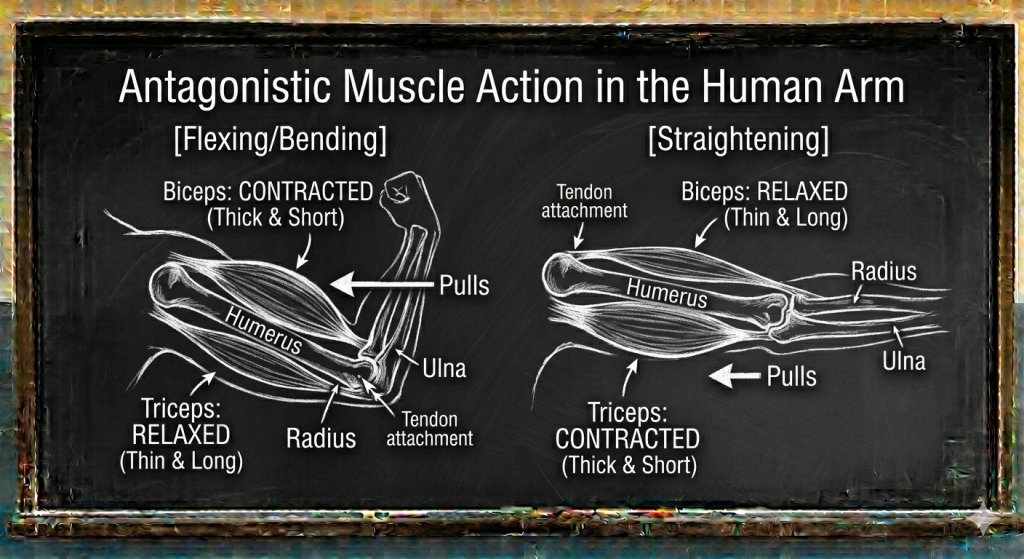
Comparison Table: Action of Antagonistic Muscles (Arm Movement)
| Movement | Biceps Muscle (Front of Upper Arm) | Triceps Muscle (Back of Upper Arm) |
| Bending the Arm (Flexion) | Contracts (shortens and becomes thicker) | Relaxes (extends and elongates) |
| Straightening the Arm (Extension) | Relaxes (extends and elongates) | Contracts (shortens and becomes thicker) |
─────────────────────────────────────────
5. TEACHER DEMONSTRATIONS / PRACTICAL ACTIVITIES
─────────────────────────────────────────
Activity: Observing Muscle Action and Joint Movement
- Aim: To observe and identify how the hinge joint and voluntary antagonistic muscles operate in pairs.
- Materials: None (uses the learner’s own arm structures).
- Procedure:
- Instruct all learners to lay their left arm flat on top of their school desks.
- Ask them to place their right hand firmly over the front muscle of their upper left arm (the biceps).
- Tell them to slowly lift their left forearm toward their shoulder while squeezing tightly with the right hand.
- Next, instruct them to place their right hand on the back of their upper arm (triceps) and straighten the arm out flat again.
- Expected Observations: Learners will feel the front muscle swelling and hardening during flexion (contraction) while the back muscle goes soft, and vice versa during extension. This perfectly demonstrates antagonistic muscle action.
─────────────────────────────────────────
6. LEARNER ACTIVITIES
─────────────────────────────────────────
Classroom Activity 1: Identification and Posture Practical
- Objective: Practice identifying bone locations and adjusting poor posture.
- Task: Work in pairs to observe your partner’s sitting posture.
- Is your partner slouching over the desk or keeping their back straight against the chair?
- Write down two long-term dangers of poor sitting habits to the vertebral column.
- Touch your lower leg and identify the prominent shinbone. What is its scientific name?
Classroom Activity 2: Vocabulary and Spelling Drill
- Objective: Master scientific definitions and terms from the official P7 word list.
- Task: Correct the spelling mistakes and write down the definitions for the following words:
- skeliton $\rightarrow$ ______________
- hinj joint $\rightarrow$ ______________
- voluntury $\rightarrow$ ______________
Formative Assessment
- Short Answer: Name the specific movable joint found at the hip and shoulder that allows movement in all directions.
- True or False: Cardiac muscles found in the walls of the human heart are examples of voluntary muscles.
- Application Scenario: A primary seven boy regularly carries his heavy school backpack using only one shoulder strap on his left side. Over time, he starts complaining of severe back pains. Explain the scientific effect of this habit on his spine and suggest the correct advice to give him.
Marking Guide:
- Ball and socket joint.
- False (They are involuntary muscles).
- Award marks for explaining that carrying weight on one side forces the spine to bend abnormally to balance the load, leading to spinal misalignment or scoliosis. The advice should be to always wear both shoulder straps to distribute the weight evenly across the back.
Further Reading
- Fountain Integrated Science Pupil’s Book 7, Term I Topic 1.
- Macmillan Integrated Science for Uganda Pupil’s Book 7.
─────────────────────────────────────────
7. COMMON MISCONCEPTIONS
─────────────────────────────────────────
- Misconception: Believing that bones are dead, dry, and static structures inside the body.
- Correction: Bones are living organs containing active blood vessels, nerves, and cellular tissues that grow, self-repair when fractured, and continuously manufacture blood cells.
- Misconception: Confusing tendons with ligaments.
- Correction: Tendons link Muscle to Bone, whereas ligaments link Bone to Bone at a joint cavity.
─────────────────────────────────────────
8. SUMMARY NOTES FOR PUPILS
─────────────────────────────────────────
- The Body Framework: The skeletal system consists of bones and joints that provide shape, support, and protection to vital body organs.
- Joint Categories: Joints are either immovable (like the skull sutures) or movable (hinge, ball and socket, pivot, gliding).
- Muscle Movement: Muscles create movement by pulling on bones. They work in antagonistic pairs, meaning when one muscle contracts, its partner relaxes.
- System Care: To keep our bones and muscles healthy, we must exercise regularly, eat foods rich in calcium and Vitamin D, and maintain correct postures.
─────────────────────────────────────────
9. EXAMINATION FOCUS (UNEB-Style)
─────────────────────────────────────────
a) Section A: Short Answer Questions (1 Mark Each)
- Which mineral is primarily stored in human bones to maintain their strength?
- Give one function of the human skull.
- What type of joint is found at the human elbow?
- Name the fluid that lubricates movable joints to reduce friction during movement.
- Answers: 1. Calcium (or Phosphorus), 2. To protect the brain, 3. Hinge joint, 4. Synovial fluid.
b) Section B: Structural Essay Questions (4 Marks Each)
- “The diagram below shows a human arm mechanism.” (Assume standard arm diagram showing biceps/triceps) .
- a) Name the muscle that contracts to bend the arm.
- b) What type of muscle is mentioned in (a) above?
- c) State what happens to the triceps muscle when the arm is straightened.
- d) Give any one health habit that keeps the muscular-skeletal system in a good working condition.
- Answers:
- a) Biceps muscle.
- b) Voluntary muscle.
- c) It contracts (shortens and thickens).
- d) Eating foods rich in calcium / Doing regular physical exercises / Maintaining a correct body posture.
─────────────────────────────────────────
10. HIGHER ORDER THINKING QUESTIONS
─────────────────────────────────────────
- Analyze: Why do you think a child’s broken bone heals much faster than an elderly grandparent’s broken bone after an accident? (Link your answer to bone composition).
- Evaluate: If all involuntary muscles in the human digestive system suddenly changed and became voluntary muscles, evaluate the practical challenges a person would face after eating a meal of matooke and beans.
─────────────────────────────────────────
11. TEACHING TIPS
─────────────────────────────────────────
- Strategy: Use low-cost local materials (like banana fibers, sticks, or clay) to guide learners in building a basic model of the human skeleton during group projects. This cements tactile learning and fulfills practical curriculum targets.
- Mnemonic Support: B-B-L $\rightarrow$ Bone to Bone is a Ligament! M-B-T $\rightarrow$ Muscle to Bone is a Tendon!
─────────────────────────────────────────
12. GLOSSARY
─────────────────────────────────────────
- Antagonistic Muscles: Pairs of muscles that produce opposite movements at a joint; when one contracts, the other relaxes.
- Synovial Fluid: A thick, clear fluid secreted by membranes surrounding movable joints to reduce friction and wear during movement.
- Vertebral Column: The series of small interconnected bones (vertebrae) that forms the backbone, protecting the spinal cord.
─────────────────────────────────────────
END: KEY TAKEAWAY FOR LEARNERS
─────────────────────────────────────────
Your skeletal and muscular systems are the active engines behind every step you take around your school compound! Protect this beautiful framework by feeding it well with calcium-rich foods, exercising your voluntary muscles safely, and protecting your backbone by sitting up straight during long revision hours. A healthy body framework leads to a sharp, successful mind in your final PLE examinations!
 Introduction to Islamic Religious Education (IRE) – Senior Six Learner’s Guide
 PERFORMING ARTS SENIOR TWO LEARNERS’ GUIDEOrdinary Secondary level
 - PERFORMING ARTS SENIOR TWO TEACHERS’ GUIDEOrdinary Secondary level
 Introduction to Islamic Religious Education (IRE) – Senior Five Learners’ Guide
 NUTRITION AND FOOD TECHNOLOGY SENIOR TWO LEARNERS’ GUIDE
- NUTRITION AND FOOD TECHNOLOGY SENIOR TWO TEACHERS’ GUIDEOrdinary Secondary level
 MATHEMATICS SENIOR TWO LEARNERS’ GUIDEOrdinary Secondary level
 - MATHEMATICS SENIOR TWO TEACHERS’ GUIDEOrdinary Secondary level
 LITERATURE IN ENGLISH SENIOR TWO LEARNERS’ GUIDEOrdinary Secondary level
 - LITERATURE IN ENGLISH SENIOR TWO TEACHERS’ GUIDEOrdinary Secondary level
 Enjoy learning with Yaaka Digital NetworkUncategorized
 Why We Must Accelerate Digital Learning: A Shared Responsibility for Learners, Teachers, Schools, Development Partners and GovernmentUncategorized
 AD3: Three-Dimensional Arts: CarvingUncategorized
 AD3: Drawing and Painting: Still LifeUncategorized
 AD3: Drawing And Painting: PerspectiveUncategorized
- Enjoy learning with Yaaka Digital NetworkUncategorized
- Why We Must Accelerate Digital Learning: A Shared Responsibility for Learners, Teachers, Schools, Development Partners and GovernmentUncategorized
- AD3: Three-Dimensional Arts: CarvingUncategorized
- AD3: Drawing and Painting: Still LifeUncategorized
- AD3: Drawing And Painting: PerspectiveUncategorized
 AD3: Three-Dimensional Arts: Relief SculptureUncategorized
- Topic 2: Electricity and MagnetismUncategorized
- Topic 1: The Muscular-Skeletal SystemUncategorized
- TOPIC 4: ISLAMIC HISTORY AND MUSLIM ORGANISATIONS (UMSC/UMEA)Uncategorized
- TOPIC 3: FIQH (HIJJ AND FORBIDDEN PRACTICES)Uncategorized
Products
-
 Books & Novels
$ 79
Books & Novels
$ 79
-
Whole subject
$ 29
-
Ultimate Plus
$ 999
-
Ultimate
$ 299
-
Gold
$ 99

0 responses on "Topic 1: The Muscular-Skeletal System"