
TOPIC 2: FAITH (TAWHEED/IMAN)
- Theme: Hadith (Prophetic Traditions) and the Golden Era of Islam
- Unit: Topic 2
- Sub-Topic Exactly as Listed: Sub-topic 2A: Hadith on Kindness and Brotherhood & Sub-topic 2B: The Period of the Khulafah ar-Rashidoon (The Rightly Guided Caliphs)
- Syllabus Objectives Addressed:
- “The learner recites, translates, and applies prophetic Hadiths concerning Islamic brotherhood and communal kindness.”
- “Identifies the roles, achievements, and challenges faced by the first two Rightly Guided Caliphs: Abu Bakr as-Siddiq and Umar ibn al-Khattab.”
- “Draws leadership lessons from the early Islamic administration to model integrity and justice.”
- Prerequisite Knowledge: Basic understanding of what a Hadith is (sayings/actions of Prophet Muhammad S.A.W.) and historical knowledge of the Prophet’s migration (Hijrah) from Makkah to Madinah.
─────────────────────────────────────────
1. TOPIC INTRODUCTION
─────────────────────────────────────────
- Definition: Hadith refers to the recorded sayings, actions, or tacit approvals of the Prophet Muhammad (S.A.W.), serving as the second source of Islamic law (Shari’ah). The Khulafah ar-Rashidoon are the first four Islamic leaders (Caliphs) who ruled the Muslim Ummah sequentially after the death of the Prophet, strictly following his divine guidance and footsteps.
- Real-Life Relevance in Uganda: The Hadiths on brotherhood teach us how to live peacefully in a multi-cultural and multi-religious society like Uganda. They instruct us to protect our neighbors, share food, and eliminate envy. Furthermore, looking at the leadership of the early Caliphs provides a powerful blueprint for corruption-free governance, illustrating how public resources should be managed with strict accountability.
- Hook Scenario: “Imagine a massive national sports team where the head coach unexpectedly passes away just days before a historic tournament. The players are confused, rivals are trying to split the team apart, and some members are threatening to walk away. Who stands up to steady the ship? How do they keep everyone united without changing the original rules of the game? This was the exact crisis the Muslim community faced in Madinah when the Prophet (S.A.W.) died. Let us explore the incredible stories of the leaders who saved the community from collapsing!”
─────────────────────────────────────────
2. LEARNING OBJECTIVES
─────────────────────────────────────────
By the end of this lesson, learners should be able to:
- Memorize and translate the prophetic Hadith on brotherhood (“None of you truly believes until he loves for his brother…”).
- Explain the historical process through which Abu Bakr as-Siddiq (R.A.) was chosen as the first Caliph of Islam.
- Analyze the major achievements of Caliph Umar ibn al-Khattab (R.A.), specifically regarding judicial and structural reforms.
- Formulate a list of leadership values observed in the Khulafah ar-Rashidoon that can be applied by school prefects and monitors today.
─────────────────────────────────────────
3. KEY TERMS AND DEFINITIONS
─────────────────────────────────────────
- Caliph (Khalifah): A spiritual and political successor or ruler of the Islamic state, governing according to the Quran and Sunnah.
- Ar-Rashidoon: The “Rightly Guided” ones—a title specifically given to Abu Bakr, Umar, Uthman, and Ali due to their righteous governance.
- Murtaddoon (Apostates): Those individuals or tribes who abandoned Islam or refused to pay Zakat immediately after the Prophet’s death.
- Diwan: The state treasury and administrative register established during the reign of Umar (R.A.) to organize public funds, pensions, and salaries.
- Analogy: A prophetic Hadith is like a clear street sign on a dark highway. The Quran gives us the ultimate destination, but the Hadith shows us exactly how fast to drive, when to turn, and how to avoid bumping into others along the journey.
─────────────────────────────────────────
4. DETAILED EXPLANATION OF CONCEPTS
─────────────────────────────────────────
Concept A: Prophetic Hadith on Brotherhood and Kindness
Islamic society is built on structural compassion. A famous Hadith collected by Imam al-Bukhari and Imam Muslim highlights this standard:
- Arabic Text: “لاَ يُؤْمِنُ أَحَدُكُمْ حَتَّى يُحِبَّ لأَخِيهِ مَا يُحِبُّ لِنَفْسِهِ”
- Transliteration: La yu’minu ahadukum hatta yuhibba li-akheehi ma yuhibbu li-nafsihi.
- English Translation: “None of you [truly] believes until he loves for his brother what he loves for himself.”
Practical Implications of this Hadith:
- True Faith involves Empathy: True Iman (faith) is not just about praying in the mosque; it requires wanting your classmate to pass their exams, eat well, and be safe, just as you desire those things for yourself.
- Uprooting Social Vices: If you love for your brother what you love for yourself, you cannot steal their mathematical set, spread malicious rumors about them, or treat them unfairly based on tribal backgrounds.
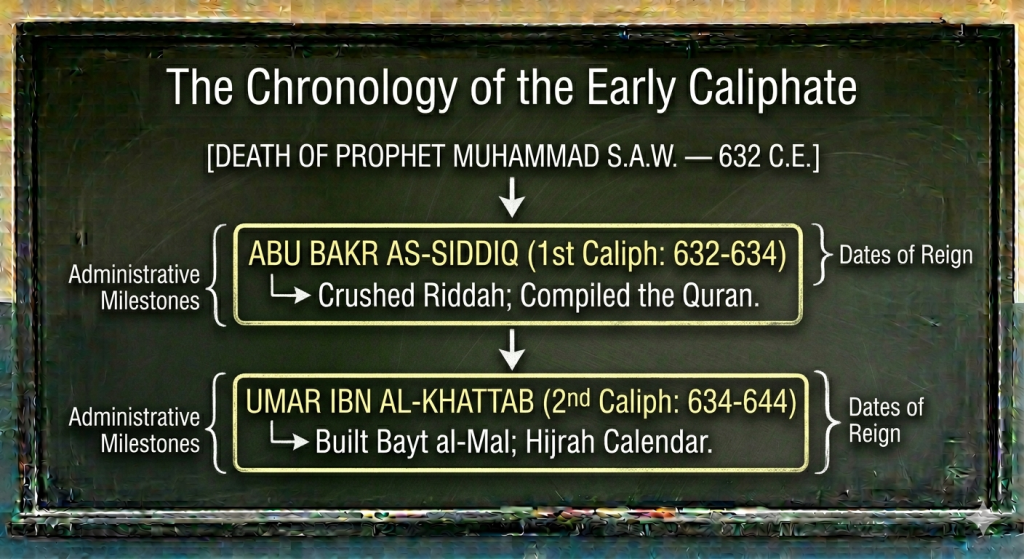
Concept B: The First Caliph — Abu Bakr as-Siddiq (632 – 634 C.E.)
Following the raw grief of the Prophet’s death, the companions met at Saqifah and selected Abu Bakr due to his wisdom, seniority, and close companionship with the Prophet.
Major Challenges and Achievements:
- The Riddah Wars (Apostasy Wars): Several rebellious Arab tribes refused to pay Zakat (obligatory charity) or followed false prophets (like Musaylimah the Liar). Abu Bakr defended the capital of Madinah and defeated the rebels to preserve the unity of Islam.
- Compilation of the Holy Quran: During the bloody battle of Yamamah, many companions who had memorized the Quran were killed. Prompted by Umar (R.A.), Abu Bakr ordered Zayd ibn Thabit to gather and compile all written pieces of the Quran into one single, official master volume (Mus’haf) for safety.
Concept C: The Second Caliph — Umar ibn al-Khattab (634 – 644 C.E.)
Umar (R.A.), known as Al-Farooq (the differentiator between right and wrong), expanded the administrative infrastructure of the state significantly.
Major Administrative Milestones:
- The Islamic Calendar: He officially established the Hijrah calendar, tracking time from the year the Prophet migrated to Madinah.
- Public Infrastructure: He set up the Bayt al-Mal (Public Treasury) to manage state revenue transparently and introduced regular salaries for soldiers and teachers.
- Judicial Separation: He appointed independent judges (Qadis) across provinces to ensure that legal matters were decided strictly on merits without political interference.
Comparison Table: The First Two Rightly Guided Caliphs
| Dimension | Caliph Abu Bakr as-Siddiq (R.A.) | Caliph Umar ibn al-Khattab (R.A.) |
| Title Given | As-Siddiq (The Truthful / Confirmer of Truth) | Al-Farooq (The Divider of Right & Wrong) / Amir al-Mu’minin |
| Primary Challenge | Rebellions of false prophets and Zakat refusers (Riddah). | Managing rapid expansion and creating structures for large territories. |
| Key Historic Deed | Initiated the compilation of the Quran into one single volume. | Created the Hijrah calendar and organized the Bayt al-Mal. |
| Length of Reign | Approximately 2 Years (632 – 634 C.E.) | Approximately 10 Years (634 – 644 C.E.) |
─────────────────────────────────────────
5. TEACHER DEMONSTRATIONS / PRACTICAL ACTIVITIES
─────────────────────────────────────────
Activity: The Prefect Accountability Simulation
- Aim: To demonstrate the values of financial transparency and justice modeled by Caliph Umar (R.A.).
- Materials: A notebook labeled “School Treasury Ledger”, 10 play-money paper tokens or counters.
- Procedure:
- Appoint one pupil as the “School Storekeeper” (representing the Bayt al-Mal) and hand them the 10 tokens intended for purchasing extra sports chalk or classroom brooms.
- Have two students approach the storekeeper with demands: Student A is the storekeeper’s close best friend asking for 3 tokens to buy private snacks, while Student B is a quiet classmate asking for 2 tokens to replace a broken sweeping broom.
- The storekeeper must demonstrate the justice of Umar (R.A.) by refusing their friend’s private request, allocating the tokens strictly to the public school asset, and recording the transaction openly on the chalkboard.
- Expected Observations: Pupils quickly grasp that public funds are a trust (Amanah). Use this scenario to discuss how Umar (R.A.) used to extinguish the state-funded candle when handling personal family conversations at night, saving public oil resources.
─────────────────────────────────────────
6. LEARNER ACTIVITIES
─────────────────────────────────────────
Classroom Activity 1: Hadith Exegesis (Group Task)
- Objective: Unpack textual references of prophetic statements regarding community care.
- Task: Read the Hadith on brotherhood covered in Section 5 and answer the following questions:
- According to the text, what is the ultimate condition for a Muslim’s faith (Iman) to reach completion?
- If a student deliberately hides their revision notes so that their struggling friend fails a mock test, analyze how this action breaches this Hadith.
- Formulate one way a pupil can practically fulfill this Hadith during school lunchtime.
Classroom Activity 2: Historical Identification Drill
- Objective: Match early Islamic figures to their specific operational actions.
- Task: Fill in the blanks with the correct historical term or name:
- The scribe appointed by Abu Bakr to lead the historic task of gathering scattered verses of the Quran was named ____________.
- The Islamic calendar tracks time starting from the milestone historical event known as the ____________.
- State one major reason why some tribes refused to pay Zakat to Abu Bakr after the Prophet passed away.
Formative Assessment
- Spelling Rectification: Fix the misspelled historical terms: khalifah, rashidun, murtad.
- Short Answer: Name the second Rightly Guided Caliph of Islam.
- Application Essay: A school sports captain prefers to select only players from his own home village to play in a competitive soccer match, leaving more talented players on the bench. Write a short four-sentence advisory statement explaining how the universal justice of Caliph Umar (R.A.) and the Hadith on brotherhood condemn this bias.
Marking Guide:
- Khalifah / Caliph, Rashidoon, Murtadd.
- Umar ibn al-Khattab.
- Award full marks for advice highlighting universal justice and brotherhood over tribal favoritism (e.g., True Islamic leadership rejects favoritism and tribal bias. The Hadith on brotherhood demands that you treat all students fairly and give them equal chances based on their skills. Caliph Umar taught that merit and justice are the foundations of good governance. You should select players based on their talent, not their home village, to ensure fairness and victory.)
Further Reading
- Fountain Islamic Religious Education Pupil’s Book 7, Unit 2.
- Sahih al-Bukhari, Book of Faith (Kitab al-Iman).
- The History of the Khalifahs by Jalaluddin as-Suyuti.
─────────────────────────────────────────
7. COMMON MISCONCEPTIONS
─────────────────────────────────────────
- Misconception: Believing that Abu Bakr (R.A.) compiled the Quran because he wanted to introduce new verses or alter the original message left by the Prophet.
- Correction: He did not alter a single letter. The compilation was strictly a preservation effort to collect identical existing written records from palm leaves, leather pieces, and flat stones into a single volume for safekeeping.
- Misconception: Thinking that the Hadith on loving for your brother what you love for yourself applies exclusively to your biological siblings from the same parents.
- Correction: The term “brother” in this Hadith refers universally to your brother in faith, and by extension, guides proper ethical behavior towards all members of the human family.
─────────────────────────────────────────
8. SUMMARY NOTES FOR PUPILS
─────────────────────────────────────────
- The Compassion Compass: True faith is directly linked to how much you love, support, and wish well for your fellow human beings without envy.
- Preservation under Pressure: Abu Bakr (R.A.) protected the young Islamic state from internal rebellions and successfully safeguarded the text of the Holy Quran.
- Structural Excellence: Umar (R.A.) built a transparent government by introducing the Islamic calendar, independent judiciaries, and public financial registers.
─────────────────────────────────────────
9. EXAMINATION FOCUS (UNEB-Style)
─────────────────────────────────────────
a) Section A: Short Answer Questions (1 Mark Each)
- Complete the missing part of the Hadith: “None of you truly believes until he loves for his brother…”
- Name the battle during which many memorizers of the Quran died, leading to its compilation.
- State the title given to Caliph Umar ibn al-Khattab due to his ability to separate truth from falsehood.
- From which historic event does the Islamic calendar begin counting its years?
- Answers: 1. …what he loves for himself, 2. The Battle of Yamamah, 3. Al-Farooq, 4. The Hijrah (Migration of the Prophet from Makkah to Madinah).
b) Section B: Structural Essay Questions (4 Marks Each)
- “The Khulafah ar-Rashidoon faced intense political and social trials, yet they maintained stable leadership.”
- a) State any two achievements of Caliph Abu Bakr as-Siddiq during his rule.
- b) Give two reasons why the administrative reforms of Caliph Umar are useful blueprints for leaders today.
- Answers:
- a) (i) He defeated the false prophets and stabilized the state during the Riddah wars. (ii) He ordered the first collection and compilation of the Holy Quran into a single volume.
- b) (i) He separated the judiciary from political leadership to ensure unbiased court judgements. (ii) He established the Bayt al-Mal to manage public taxes and state funds with absolute transparency.
─────────────────────────────────────────
10. HIGHER ORDER THINKING QUESTIONS
─────────────────────────────────────────
- Analyze: Why do you think Abu Bakr (R.A.) was so firm against those tribes who wanted to practice Salat but refused to give Zakat? Analyze how separating the pillars of Islam would have fundamentally damaged the economic security of the vulnerable community.
- Evaluate: Consider a class monitor who uses school chalk to draw caricatures on the wall for fun when the teacher is away. Evaluate this action against Caliph Umar’s strict discipline regarding the division between public property and personal use.
─────────────────────────────────────────
11. TEACHING TIPS
─────────────────────────────────────────
- Strategy: Use “Mnemonic Anchors” on the blackboard to keep dates and names highly scannable for P7 UNEB preparation. Emphasize that Abu Bakr represents Preservation and Umar represents Administration.
- Mnemonic Support: L.I.F.E. $\rightarrow$ Love In Fellowship Everywhere! This summarizes the Prophetic Hadith on brotherhood.
─────────────────────────────────────────
12. GLOSSARY
─────────────────────────────────────────
- Apostasy: The conscious abandonment, renunciation, or dropping of a religious faith or political allegiance by an individual or group.
- Mus’haf: A physical, bound manuscript or written copy of the Quranic text compiled structurally in book form.
- Ummah: The collective global community of Muslim believers bound together by shared spiritual ties across national boundaries.
─────────────────────────────────────────
END: KEY TAKEAWAY FOR LEARNERS
─────────────────────────────────────────
A beautiful community is built on mutual care and selfless leadership. Through the Hadith of the Prophet (S.A.W.), we learn that our personal faith remains incomplete until we actively wish well for those around us. By looking at the stellar examples of Abu Bakr and Umar, we see that true power is a sacred trust meant to serve the public, defend truth, and establish justice. Let us carry these noble values into our classrooms, reject selfishness, and lead with honest hearts across Uganda!
 Introduction to Islamic Religious Education (IRE) – Senior Six Learner’s Guide
 PERFORMING ARTS SENIOR TWO LEARNERS’ GUIDEOrdinary Secondary level
 - PERFORMING ARTS SENIOR TWO TEACHERS’ GUIDEOrdinary Secondary level
 Introduction to Islamic Religious Education (IRE) – Senior Five Learners’ Guide
 NUTRITION AND FOOD TECHNOLOGY SENIOR TWO LEARNERS’ GUIDE
- NUTRITION AND FOOD TECHNOLOGY SENIOR TWO TEACHERS’ GUIDEOrdinary Secondary level
 MATHEMATICS SENIOR TWO LEARNERS’ GUIDEOrdinary Secondary level
 - MATHEMATICS SENIOR TWO TEACHERS’ GUIDEOrdinary Secondary level
 LITERATURE IN ENGLISH SENIOR TWO LEARNERS’ GUIDEOrdinary Secondary level
 - LITERATURE IN ENGLISH SENIOR TWO TEACHERS’ GUIDEOrdinary Secondary level
 Enjoy learning with Yaaka Digital NetworkUncategorized
 Why We Must Accelerate Digital Learning: A Shared Responsibility for Learners, Teachers, Schools, Development Partners and GovernmentUncategorized
 AD3: Three-Dimensional Arts: CarvingUncategorized
 AD3: Drawing and Painting: Still LifeUncategorized
 AD3: Drawing And Painting: PerspectiveUncategorized
- Enjoy learning with Yaaka Digital NetworkUncategorized
- Why We Must Accelerate Digital Learning: A Shared Responsibility for Learners, Teachers, Schools, Development Partners and GovernmentUncategorized
- AD3: Three-Dimensional Arts: CarvingUncategorized
- AD3: Drawing and Painting: Still LifeUncategorized
- AD3: Drawing And Painting: PerspectiveUncategorized
 AD3: Three-Dimensional Arts: Relief SculptureUncategorized
- Topic 2: Electricity and MagnetismUncategorized
- Topic 1: The Muscular-Skeletal SystemUncategorized
- TOPIC 4: ISLAMIC HISTORY AND MUSLIM ORGANISATIONS (UMSC/UMEA)Uncategorized
- TOPIC 3: FIQH (HIJJ AND FORBIDDEN PRACTICES)Uncategorized
Products
-
 Books & Novels
$ 79
Books & Novels
$ 79
-
Whole subject
$ 29
-
Ultimate Plus
$ 999
-
Ultimate
$ 299
-
Gold
$ 99

0 responses on "TOPIC 2: FAITH (TAWHEED/IMAN)"