
Topic 2: Electricity and Magnetism
- Theme: Matter and Energy
- Unit/Topic: Topic 2: Electricity and Magnetism
- Sub-Topics Covered: * Electricity: Sources, types (current and static), conductors, insulators, and electric circuits
- Magnetism: Natural and artificial magnets, permanent and temporary magnets
- Generating electricity using a dynamo
- Uses of magnets and the electric bell
- Syllabus Objectives Addressed:
- Identify sources and types of electricity.
- Experiment with static electricity.
- Draw and label the parts of an electric circuit and an electric bell.
- Demonstrate ways of making temporary magnets.
- Discuss the process involved in generating electricity using a dynamo.
- Prerequisite Knowledge: Learners should know basic energy forms from Primary Five and primary weather observations (like lightning).
2. TOPIC INTRODUCTION
Every time you see a mobile phone charging in a solar shop, a lightbulb lighting up your classroom, or hear a security bell ring at a school gate, you are witnessing the power of Electricity and Magnetism.
Electricity is a vital form of energy that powers our homes, industries, and the modern world of work in Uganda. Magnetism is a closely related natural force. Together, they form an unshakeable partnership: electricity can be used to create powerful magnets, and magnets can be used to generate electricity! In this topic, we will explore how these forces operate, how to build working circuits, and how devices like dynamos and electric bells change the way we live and work.
3. LEARNING OBJECTIVES
By the end of this lesson, learners should be able to:
- Identify the main sources and types of electricity used in Uganda.
- Distinguish between electrical conductors and insulators.
- Draw, label, and assemble a complete, functional electric circuit.
- Explain how temporary magnets are created using electricity and mechanical methods.
- Describe the structure and step-by-step operation of an electric bell and a bicycle dynamo.
4. KEY TERMS AND DEFINITIONS
- Electricity: A form of energy resulting from the flow of tiny charged particles called electrons.
- Electric Circuit: A complete, unbroken pathway through which an electric current flows.
- Short Circuit: A fault that occurs when an electric current flows along an unintended, shorter path of very low resistance, often leading to sparks or fires.
- Magnet: Any material or object that produces a magnetic field and can attract magnetic materials like iron and steel.
- Conductor: A material that easily allows electric current or heat to pass through it.
- Insulator: A material that does not allow electric current or heat to pass through it.
5. DETAILED EXPLANATION OF CONCEPTS
5.1 Types and Sources of Electricity
Electricity is divided into two primary types depending on whether the electrical charges are moving or staying in one place:
- Static Electricity: This is electricity produced when charges accumulate on the surface of an object, usually due to friction (rubbing two surfaces together). It does not flow.
- Ugandan Example: Lightning during a thunderstorm over Lake Victoria is a massive discharge of static electricity built up in clouds.
- Current Electricity: This is electricity that consists of a continuous flow of electrical charges through a path called a conductor. This is the electricity we use to power devices daily.
Major Sources of Electricity in Uganda:
- Hydro-electric Power (HEP): Electricity generated using the force of rushing water.
- Local Context: Power stations along the River Nile, such as the Nalubaale, Kiira, and Karuma dams.
- Chemical Cells (Batteries): Dry cells (used in torches and wall clocks) and wet cells (car batteries) convert stored chemical energy directly into electrical energy.
- Solar Energy Panels: Photovoltaic cells convert light energy from the sun directly into electrical energy.
- Generators and Dynamos: Machines that convert mechanical motion into electricity using magnets.
5.2 Conductors and Insulators
Materials behave differently when exposed to an electric current:
| Category | Description | Common Local Examples |
| Conductors | Materials that allow electricity to flow through them freely due to free moving charges. | Copper wires, aluminum pots, iron nails, dirty water, and the human body. |
| Insulators | Materials that block the flow of electricity tightly because their charges cannot move easily. | Dry wood, plastic coatings, rubber slippers, glass, and dry paper. |
5.3 Electric Circuits and Safety Precautions
A complete electric circuit requires a source of electrical energy (like a dry cell), a pathway (conducting wires), and a load (like a small bulb) to consume the energy. A switch is added to break or complete the path safely.
Components of an Electric Circuit:
- Dry Cell: The power source providing electrical energy. It has a positive (+) cap and a negative (-) flat base.
- Connecting Wires: Made of copper, wrapped in plastic insulation to safely transport electrons.
- Switch: A device used to intentionally interrupt (open) or close the circuit path.
- Bulb: Converts electrical energy into light and heat energy.
- Fuse: A safety device containing a thin wire with a low melting point. If the current becomes too high, the fuse wire melts and breaks the circuit to prevent fire or damage.
Short Circuits and Safety:
A short circuit happens if a bare live wire touches a neutral wire directly before reaching the appliance bulb. The current bypasses the load, surges dangerously, creates heat, and can spark a fire.
Crucial Safety Precautions:
- Never touch electrical switches or sockets with wet hands, as water lowers your skin’s electrical resistance.
- Do not insert metallic objects like nails or wires into wall sockets.
- Avoid overloading a single multi-plug extension cable with too many heavy appliances.
5.4 Magnetism: Properties and Types
A magnet is a material that creates an invisible pulling force called a magnetic force. It attracts magnetic metals like iron, nickel, and steel. Non-magnetic materials like copper, wood, and plastic are unaffected.
Fundamental Laws of Magnetism:
- Every magnet has two distinct poles: a North Pole (N) and a South Pole (S).
- Like poles repel (push away) each other (N pushes N, S pushes S).
- Unlike poles attract (pull together) each other (N pulls S).
Natural vs. Artificial Magnets:
- Natural Magnets: Found naturally in the earth. They have weak magnetic properties. Examples include Lodestone and Magnetite.
- Artificial Magnets: Man-made magnets created using magnetic alloys. They can be shaped into bar magnets, horseshoe magnets, or magnetic needles.
5.5 Methods of Making Temporary Magnets
Temporary magnets lose their magnetism easily once the magnetizing force is removed. We can create them using two primary methods:
1. Mechanical Stroke Method (Single or Double Stroke)
By rubbing a permanent magnet along an unmagnetized iron nail repeatedly in one direction only, you align the tiny magnetic paths inside the nail, turning it into a temporary magnet.
2. Electrical Method (Creating an Electromagnet)
By wrapping insulated copper wire tightly around a soft iron nail many times and connecting the wire ends to a dry cell battery, the nail becomes a powerful magnet. When you disconnect the cell, the nail immediately loses its magnetism. This is an electromagnet.
5.6 Practical Applications: The Electric Bell and Bicycle Dynamo
The dynamic interaction between electricity and magnetism is applied in two major devices studied at this level:
A. The Electric Bell
An electric bell relies completely on an internal electromagnet to create continuous sound.
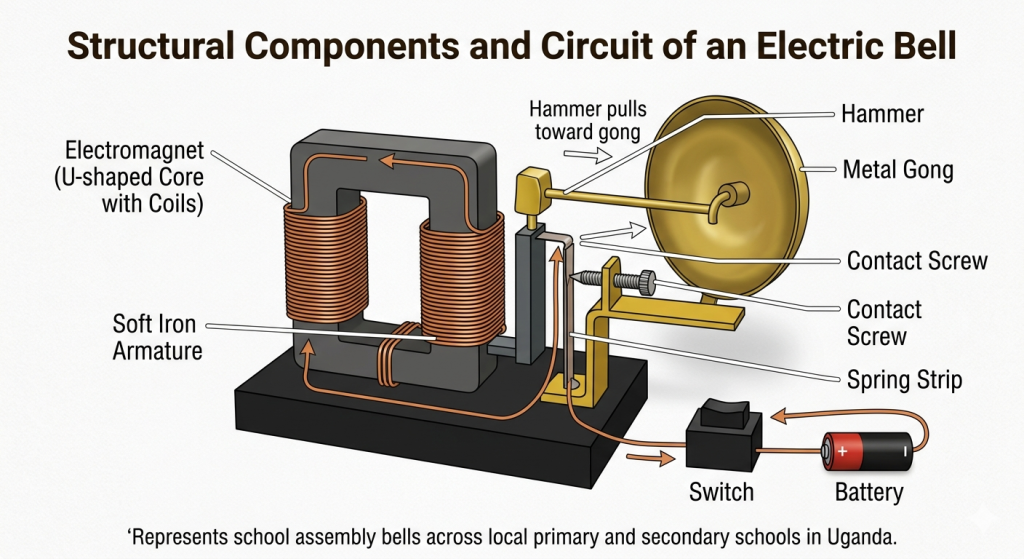
- How it works: 1. When the bell switch is pressed, current flows through the coils, turning the soft iron core into an electromagnet. 2. The electromagnet pulls a flexible iron strip called the armature toward it. 3. As the armature moves, a small hammer (gong hit) attached to it strikes the metal gong, making a ringing sound. 4. At that exact moment, the contact point behind the armature separates from the contact screw, breaking the circuit loop. 5. The electric current stops flowing, the electromagnet loses its magnetism, and the spring pulls the armature back to touch the contact screw again. 6. This closes the loop once more, and the cycle repeats rapidly, making a continuous ringing sound.
B. The Bicycle Dynamo
A dynamo is a small machine that converts mechanical spinning into electrical current to light up a bicycle lamp.
- How it works: 1. The ribbed roller head of the dynamo presses against the moving rubber bicycle tyre. 2. As the tyre spins, it turns the roller head, which spins a permanent magnet inside the dynamo housing. 3. The spinning magnet cuts through a fixed coil of copper wire surrounding it. 4. Moving a magnetic field near a wire coil induces (creates) an electric current inside the wire. 5. This current flows out through a wire directly to power the bicycle headlight lamp.
6. VISUAL LEARNING SUPPORT
7. TEACHER DEMONSTRATIONS AND PRACTICAL ACTIVITIES
Demonstration 1: Generating Static Electricity Using Friction
- Aim: To demonstrate the production and effects of static electricity using simple materials.
- Materials: A plastic ruler or plastic bic pen, a clean dry piece of school cloth (or wool), and small dry pieces of scrap notebook paper.
- Step-by-step Procedure:
- Tear the scrap paper into tiny bits and scatter them flat on a wooden classroom desk.
- Bring the plastic ruler close to the papers without touching them. Observe if anything happens.
- Rub the plastic ruler vigorously against your dry hair or a dry wool uniform sweater for about 30 seconds.
- Immediately lower the rubbed edge of the ruler close to the bits of paper and watch closely.
- Expected Observations: Initially, nothing happens. After rubbing, the tiny pieces of paper jump upward off the desk and stick tightly to the plastic ruler surface.
- Conclusion: Friction causes electrical charges to accumulate on the surface of the plastic ruler (static electricity), creating a temporary attractive force that pulls the neutral paper bits up.
8. LEARNER ACTIVITIES
8.1 Classroom Inquiry Activity: Assembling an Electromagnet
- Objective: Construct a functional temporary electromagnet and discover what changes its structural strength.
- Materials Needed: One large 4-inch iron nail, 1.5 meters of thin insulated copper wire, two dry cells (1.5V D-size), and a handful of small steel office paperclips or iron filings.
- Procedure: 1. Wrap the insulated copper wire tightly around the iron nail from one end to the other, leaving 10 cm of loose wire at both ends. Ensure you wrap it exactly 20 times. 2. Connect the bare ends of the loose wire to the positive and negative terminals of one dry cell battery. 3. Bring the tip of the nail close to the steel paperclips and count how many clips it can pick up. 4. Disconnect one wire end from the battery terminal and observe what happens to the picked-up clips. 5. Reconnect the wire, but this time wrap the wire 40 times around the nail and use two dry cells connected in a line. Count the clips again.
- Expected Outcome: Learners will discover that when current flows, the nail behaves like a magnet. Increasing the number of wire turns and increasing battery power drastically increases the magnetic strength (picks up more clips). Disconnecting the battery cause the clips to drop instantly as magnetism disappears.
8.2 Formative Assessment
- Define the term short circuit and state one common danger it causes.
- Identify two distinct electrical conductors and two electrical insulators found inside your classroom.
- What energy transformation takes place inside a running bicycle dynamo?
- State the main law of magnetism concerning how magnetic poles interact.
- Why is copper wire used for electrical pathways inside a house instead of iron wire?
- Application Question: A local welder in your trading center wants to lift heavy scrap metal plates using an artificial magnet. Advise him on why an electromagnet is much better for this job than a large permanent bar magnet.
Answer Key and Marking Guide
- A short circuit is a fault where current takes an unintended short path of low resistance bypassing the load. Danger: It can cause electrical fires or damage devices. (2 marks)
- Conductors: Iron nails, copper wiring, metal window frames. Insulators: Wooden desks, plastic rulers, rubber shoe soles. (2 marks)
- It transforms mechanical energy (spinning motion) into electrical energy. (2 marks)
- Like magnetic poles repel each other, while unlike magnetic poles attract each other. (2 marks)
- Copper is an excellent conductor with low electrical resistance, meaning it transports electricity efficiently without losing too much energy as heat. (1 mark)
- An electromagnet’s magnetic force can be turned on and off instantly by controlling the electrical current. This allows the welder to pick up the scrap metal, move it, and drop it easily by switching off the power, which is impossible with a permanent magnet. (2 marks)
9. COMMON MISCONCEPTIONS
- Misconception: Insulators block electricity because they are completely dead or have no electrical charges inside them.
- Correction: Insulators contain just as many atomic charges as conductors. However, their charges are tightly bound and cannot move freely from atom to atom, which prevents electricity from flowing.
- Misconception: A bicycle dynamo stores electricity like a car battery cell.
- Correction: A dynamo has no chemical storage capacity. It generates current through induction only when its roller head is actively spinning against the moving wheel.
10. SUMMARY NOTES (For copying into exercise books)
- Electricity is a form of energy divided into static (stationary charges from friction) and current (flowing charges through a conductor).
- Main sources of current electricity include hydro-electric power dams, chemical dry/wet cells, solar panels, and mechanical generators.
- Conductors (metals, water) allow current to pass easily, while insulators (rubber, plastic, wood) block its flow.
- A complete circuit must contain a source, an insulated pathway, a switch, and a load device. Fuses act as safety cut-offs.
- Magnets have a North and South pole. Like poles repel; unlike poles attract.
- Temporary magnets can be made mechanically by stroking or electrically by wrapping current-carrying coils around soft iron (electromagnet).
- Electric bells use electromagnets to pull a hammer to hit a gong repeatedly in a self-breaking loop circuit.
- Bicycle dynamos convert spinning motion into current using a permanent magnet rotating inside a fixed wire coil.
11. EXAMINATION FOCUS (UNEB-Style)
Part A: Multiple Choice Questions
- Which of the following devices is designed to melt and break a circuit when there is a dangerous current surge?
- A) A switch
- B) A dry cell
- C) A fuse
- D) An electromagnet
- Answer: C
- What type of electricity is responsible for the lightning flashes seen during local storms?
- A) Current electricity
- B) Static electricity
- C) Chemical electricity
- D) Magnetic electricity
- Answer: B
- Which pair of items contains ONLY electrical insulators?
- A) Aluminum foil and copper wire
- B) Iron nail and dirty water
- C) Plastic bottle and rubber band
- D) Silver coin and dry wood
- Answer: C
- Which type of magnet is naturally mined from the earth’s crust?
- A) Bar magnet
- B) Electromagnet
- C) Lodestone
- D) Horseshoe magnet
- Answer: C
- How can the magnetic strength of a school project electromagnet be increased effectively?
- A) By using a plastic nail core instead of iron
- B) By decreasing the number of dry cells used
- C) By increasing the number of wire turns wound around the core
- D) By stripping all insulation off the wire entirely
- Answer: C
Part B: Structured Questions
- State one major factor that causes a short circuit to occur in residential house wiring.
- Answer: Damaged or worn-out plastic insulation that allows bare live and neutral wires to touch directly. (1 mark)
- What role does the contact screw play inside an electric bell circuit?
- Answer: It completes the circuit by touching the armature and automatically breaks it when the armature pulls away to ring the bell. (1 mark)
- Name the power station along the River Nile that serves as a primary source of hydro-electric power in Uganda.
- Answer: Nalubaale Power Station (or Kiira / Karuma / Isimba). (1 mark)
Part C: Diagram Interpretation Question
- Study the simple circuit diagram below carefully and answer the questions that follow:
[Diagram of an electric circuit with a dry cell battery, a closed switch, a fuse wire, and a glowing lightbulb]
a) Name the component that provides electrical energy to this circuit.
- Answer: The dry cell (or battery). (1 mark) b) What will happen to the lightbulb if the fuse wire melts and breaks?
- Answer: The lightbulb will stop glowing because the circuit loop is broken. (1 mark)
c) Using arrows ($\rightarrow$), draw directly on your map path the direction of conventional current flow from the cell to the bulb.
- Answer: Arrows must point out from the positive (+) long terminal cap, pass through the switch/fuse, and return to the negative (-) flat terminal base. (1 mark)
Part D: Essay Question
- Describe how a bicycle dynamo generates electricity to light a headlamp when a person rides a bicycle at night. Your answer must include the internal parts and the energetic transitions involved. (10 marks)
Full Essay Marking Guide (Total: 10 Marks)
- Physical Contact and Input (3 marks): The dynamo is mounted near the bicycle wheel so its ribbed roller head presses against the rubber tyre. When the rider pedals, the spinning tyre spins the roller head mechanically.
- Internal Magnetic Operation (4 marks): The turning roller head directly rotates an internal axle carrying a permanent magnet. This spinning magnet rotates inside a fixed outer coil of copper wire, causing its magnetic field lines to continuously cut across the wire loops.
- Induction and Energy Output (3 marks): This continuous magnetic cutting induces an electrical current within the copper wire coils. The mechanical energy of pedaling is successfully transformed into current electrical energy, which flows out through terminal wires to light up the headlamp.
12. HIGHER ORDER THINKING QUESTIONS
- An old bar magnet was accidentally dropped into a hot charcoal cooking stove (sigiri) for an hour. Predict what will happen to its ability to attract iron filings once it is removed and cooled down. Explain your reasoning.
- If you are constructing a high-power industrial electromagnet, explain why using a soft iron core is much better than using a hard steel core, based on how they lose their magnetism.
13. TEACHING TIPS
- Interactive Strategy: Use the classroom door hinges to explain a hinge joint, and then use the concept of a simple electrical switch to show how breaking a path stops all motion downstream.
- Mnemonic Aid: To remember magnetic pole behavior: “Same Strengthens Separation” (Like poles repel) and “Unlike Unites Us” (Unlike poles attract).
- Low-Resource Approach: Teachers can salvage copper coils from old broken radio speakers or scrap television sets to build electromagnets in class for free.
14. GLOSSARY
- Armature: A soft iron bar or strip placed across the poles of an electromagnet that moves physically when attracted by magnetic forces.
- Dynamo: A small mechanical generator that creates electrical current from rotating kinetic energy via a spinning magnet.
- Electromagnet: A temporary magnet made by passing an electrical current through a wire coil wrapped around a magnetic core material.
- Static Charge: An imbalance of electric charges on the surface of a material, usually generated by friction.
END: KEY TAKEAWAY FOR LEARNERS
Electricity and magnetism are a powerful team that keeps the modern world running smoothly. From massive dams on the River Nile generating power to small bicycle dynamos lighting paths, changing motion into electrical energy relies on these natural laws. Handle electricity with respect and caution, follow circuit safety guidelines, and explore how these forces can solve everyday problems in Uganda
 Introduction to Islamic Religious Education (IRE) – Senior Six Learner’s Guide
 PERFORMING ARTS SENIOR TWO LEARNERS’ GUIDEOrdinary Secondary level
 - PERFORMING ARTS SENIOR TWO TEACHERS’ GUIDEOrdinary Secondary level
 Introduction to Islamic Religious Education (IRE) – Senior Five Learners’ Guide
 NUTRITION AND FOOD TECHNOLOGY SENIOR TWO LEARNERS’ GUIDE
- NUTRITION AND FOOD TECHNOLOGY SENIOR TWO TEACHERS’ GUIDEOrdinary Secondary level
 MATHEMATICS SENIOR TWO LEARNERS’ GUIDEOrdinary Secondary level
 - MATHEMATICS SENIOR TWO TEACHERS’ GUIDEOrdinary Secondary level
 LITERATURE IN ENGLISH SENIOR TWO LEARNERS’ GUIDEOrdinary Secondary level
 - LITERATURE IN ENGLISH SENIOR TWO TEACHERS’ GUIDEOrdinary Secondary level
 Enjoy learning with Yaaka Digital NetworkUncategorized
 Why We Must Accelerate Digital Learning: A Shared Responsibility for Learners, Teachers, Schools, Development Partners and GovernmentUncategorized
 AD3: Three-Dimensional Arts: CarvingUncategorized
 AD3: Drawing and Painting: Still LifeUncategorized
 AD3: Drawing And Painting: PerspectiveUncategorized
- Enjoy learning with Yaaka Digital NetworkUncategorized
- Why We Must Accelerate Digital Learning: A Shared Responsibility for Learners, Teachers, Schools, Development Partners and GovernmentUncategorized
- AD3: Three-Dimensional Arts: CarvingUncategorized
- AD3: Drawing and Painting: Still LifeUncategorized
- AD3: Drawing And Painting: PerspectiveUncategorized
 AD3: Three-Dimensional Arts: Relief SculptureUncategorized
- Topic 2: Electricity and MagnetismUncategorized
- Topic 1: The Muscular-Skeletal SystemUncategorized
- TOPIC 4: ISLAMIC HISTORY AND MUSLIM ORGANISATIONS (UMSC/UMEA)Uncategorized
- TOPIC 3: FIQH (HIJJ AND FORBIDDEN PRACTICES)Uncategorized
Products
-
 Books & Novels
$ 79
Books & Novels
$ 79
-
Whole subject
$ 29
-
Ultimate Plus
$ 999
-
Ultimate
$ 299
-
Gold
$ 99

0 responses on "Topic 2: Electricity and Magnetism"