
Building a Generation That Can Learn, Create and Thrive in a Digital World
Education is changing.
The classroom is no longer defined only by a teacher, a chalkboard and printed textbooks. Today, learners can access information, multimedia resources, simulations, practice exercises, digital libraries and learning communities through computers, tablets, smartphones and other technologies.
But simply putting technology in a classroom does not create digital learning.
Meaningful digital learning happens when technology is deliberately used to improve what learners know, what teachers can do, how schools operate and how communities access educational opportunities.
For countries such as Uganda, embracing practical digital learning is no longer a luxury. It is an important part of preparing young people for a world in which digital skills increasingly influence education, employment, entrepreneurship, communication, innovation and participation in society.
The question is therefore no longer whether we should adopt digital learning.
The more important question is:
How can we make digital learning practical, inclusive, affordable, sustainable and genuinely beneficial to learners and teachers?
This responsibility belongs to all of us.
1. Why Learners Need Digital Learning
Today’s learner needs more than the ability to memorise information for an examination.
Learners need to become independent thinkers, problem-solvers, creators, researchers, communicators and lifelong learners.
Digital learning can help make this possible.
With appropriate digital resources, learners can:
- Explore concepts beyond what is available in a textbook.
- Learn through video, audio, animation, illustrations and interactive activities.
- Revise difficult topics repeatedly.
- Learn at their own pace.
- Conduct guided research.
- Practise skills and receive feedback.
- Develop digital literacy.
- Discover new areas of knowledge and interest.
- Collaborate and communicate.
- Connect classroom knowledge to real-world problems.
- Develop confidence in using technology productively.
- Get modern AI supported learning gudiance
However, learners must not become passive consumers of digital content.
The goal should be to move learners from watching and reading to doing, creating, questioning, solving and applying.
The learner’s role
Learners should take responsibility for using technology purposefully.
They should learn to:
Explore → Understand → Practise → Apply → Create → Share.
Digital devices should not simply become entertainment machines. They should become tools for discovery, creativity and personal development.
2. Why Teachers Need Digital Learning
Technology does not make teachers less important.
In fact, effective digital learning makes the teacher’s role even more important.
The internet and digital resources can provide enormous amounts of information, but learners still need someone to help them understand what matters, distinguish reliable information from misinformation, connect knowledge to their context and apply what they learn.
The teacher therefore moves from being only a transmitter of information to becoming a:
- Facilitator.
- Learning designer.
- Mentor.
- Coach.
- Digital learning guide.
- Critical-thinking developer.
- Assessor.
- Creator and curator of learning resources.
A digitally empowered teacher can use technology to prepare lessons, demonstrate difficult concepts, provide additional learning materials, support different learning abilities and give learners opportunities to practise beyond classroom hours.
The teacher’s role
Teachers should not be expected simply to “use technology.”
They need appropriate training in digital pedagogy.
A teacher should be able to answer:
What learning problem am I trying to solve with this technology?
If a digital tool does not improve understanding, participation, practice, assessment or access, its use should be reconsidered.
Pedagogy must lead technology — not technology lead pedagogy.
3. Why Schools Need to Adopt Digital Learning
Schools are the environments in which digital learning can become a sustainable part of everyday education.
A school does not necessarily need a sophisticated technology laboratory or expensive one-to-one devices for every learner to begin.
It can start with what it has and progressively build its digital learning ecosystem.
A school can establish:
- A digital learning strategy.
- A computer laboratory or digital learning centre.
- Local offline learning resources.
- Shared devices.
- School-based digital content.
- Teacher digital skills programmes.
- Digital assessment and revision resources.
- Appropriate connectivity where available.
- Local technical support.
- Policies for responsible technology use.
- Monitoring systems to determine whether technology is actually improving learning.
Most importantly, schools should avoid purchasing technology simply because it is fashionable.
The starting point should be the learning need.
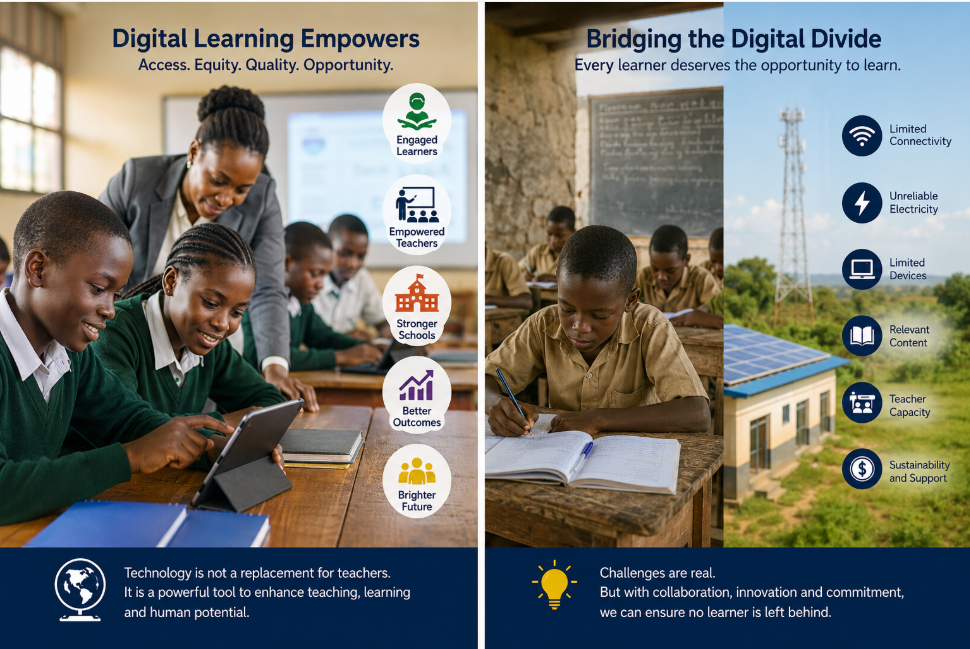
If internet connectivity is unreliable or expensive, for example, schools can combine online and offline technologies.
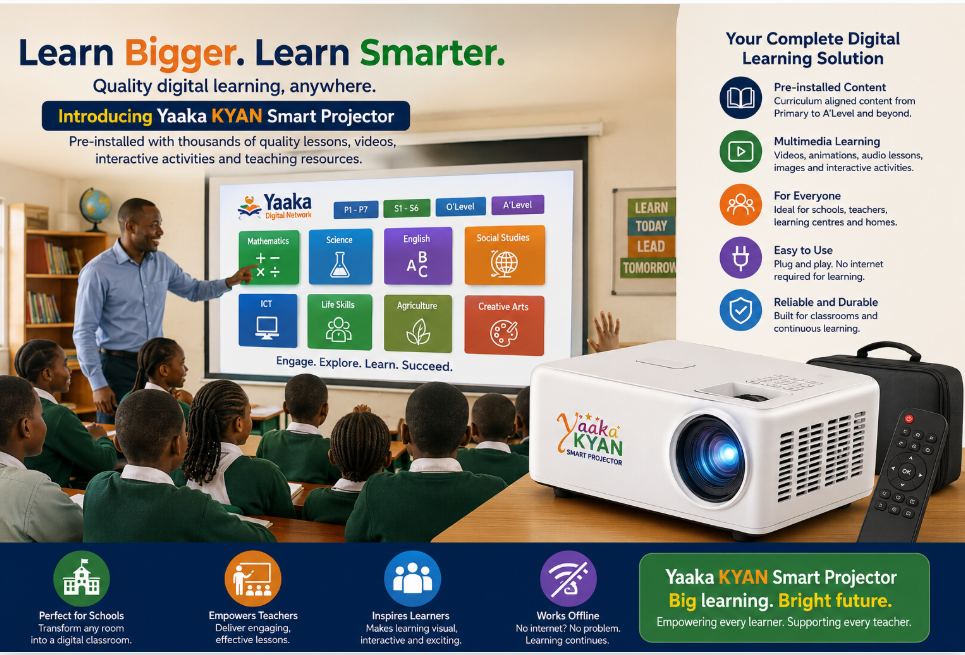
This is where solutions such as Yaaka Digital Network Offline can play an important role.
Yaaka can provide schools with a structured digital learning environment that can be accessed locally, helping schools bring multimedia educational resources closer to learners and teachers without making continuous internet connectivity a prerequisite for every learning activity.
This creates an important principle:
A school should not have to wait for perfect connectivity before it begins digital learning.
4. Why Development Agencies Need to Support Digital Learning
Development agencies, NGOs and development partners have an important role in helping education systems move from isolated technology projects to sustainable digital learning ecosystems.
Too many technology interventions can become short-lived projects:
A project provides devices.
The devices are distributed.
Training takes place.
The project ends.
The equipment eventually becomes underused.
A more sustainable approach is to invest in the entire ecosystem.
Development partners should support:
- Digital teacher training.
- Locally relevant digital content.
- Open and accessible educational resources.
- Offline-first solutions for underserved communities.
- Digital infrastructure.
- Local technical capacity.
- School leadership and digital transformation.
- Monitoring and evaluation.
- Accessibility for learners with different needs.
- Local innovation and technology enterprises.
- Research into what actually improves learning outcomes.
- Sustainable models for maintaining equipment and content.
Development agencies should also work with local innovators rather than assuming that every solution must come from outside the country.
African education systems need African solutions designed around African realities.
Ugandan learners should be able to access content that reflects their curriculum, environment, culture, language, communities and everyday experiences.
5. Why Government Must Lead and Enable Digital Learning
Government has a unique responsibility because education is not simply an individual or institutional concern.
It is a national development priority.
Government can create the enabling environment through:
Policy
Develop clear national policies for digital education, digital literacy, responsible AI use, data protection, accessibility and technology integration.
Infrastructure
Expand electricity, broadband, mobile connectivity and other infrastructure while recognising that offline technologies remain important where connectivity is limited.
Curriculum
Integrate meaningful digital competencies into education rather than treating ICT as an isolated subject.
Teacher development
Make digital pedagogy part of both initial teacher education and continuous professional development.
Public investment
Invest in sustainable digital learning infrastructure and locally developed educational technologies.
Standards and quality assurance
Ensure that digital educational content meets appropriate curriculum, pedagogical, accessibility and quality standards.
Local innovation
Create opportunities for Ugandan technology companies, educators, publishers and innovators to develop solutions for local education challenges.
Equity
Ensure that digital transformation does not widen the gap between learners who have access to technology and those who do not.
Government’s goal should therefore not simply be:
“Put every school online.”
It should be:
“Ensure every learner can benefit from meaningful digital learning.”
Those are not necessarily the same thing.
6. The Internet Is Important — But Digital Learning Must Go Beyond the Internet
One of the biggest misconceptions about digital education is that digital learning means putting everything online.
Internet connectivity is extremely valuable, but an effective national digital learning strategy should recognise the realities of schools and households where connectivity may be limited, unreliable or unaffordable.
This is why offline-first and hybrid approaches are important.
A school can combine:
Online learning + Offline learning + Classroom teaching + Printed resources + Practical activities.
This blended approach is often more resilient than depending entirely on one technology.
Yaaka Digital Network’s offline model is an example of this approach: educational resources can be made available locally on computers and school systems, allowing learning to continue even when internet access is unavailable.
The objective is not to eliminate the internet.
The objective is to ensure that the absence of the internet does not automatically mean the absence of digital learning.
7. Best Practices for Practical and Beneficial Digital LearningDigital transformation should be guided by principles rather than technology enthusiasm.
1. Start With Learning Objectives
Before selecting an app, platform or device, ask:
What should the learner be able to understand or do?
Technology should serve the learning objective.
2. Put the Teacher at the Centre
Teachers should be trained, supported and involved in selecting and developing digital resources.
Technology should strengthen teachers rather than attempt to remove them from the learning process.
3. Make Learning Interactive
Good digital learning should encourage learners to:
- Think.
- Practise.
- Solve problems.
- Experiment.
- Create.
- Discuss.
- Reflect.
- Apply knowledge.
A five-minute interactive activity can sometimes be more valuable than a one-hour video.
4. Make Content Locally Relevant
Digital content should reflect the curriculum and learners’ environment.
A learner should be able to see how what they are learning relates to their community, country and everyday life. Just like we have done with our Yaaka content offered here and online or even on our Youtube Channel
5. Design for Low Connectivity
Digital education programmes should consider:
- Offline access.
- Downloadable resources.
- Local school servers.
- Lightweight content.
- Shared devices.
- Local networks.
- Solar or alternative power solutions where appropriate.
6. Combine Digital and Physical Learning
Learners should not spend all their learning time looking at screens.
Digital learning should complement:
- Books.
- Writing.
- Discussion.
- Experiments.
- Fieldwork.
- Art.
- Physical activity.
- Practical skills.
- Human interaction.
The best digital classroom is not necessarily the one with the most screens. It is the one where technology contributes meaningfully to learning.
7. Teach Digital Citizenship
Learners must understand responsible technology use.
This includes:
- Online safety.
- Privacy.
- Cybersecurity.
- Copyright.
- Responsible communication.
- Misinformation.
- Artificial intelligence.
- Digital footprints.
- Ethical use of technology.
8. Measure Learning — Not Device Usage
A school should not celebrate success simply because learners spent many hours using computers.
The important questions are:
Are learners understanding more?
Are teachers teaching more effectively?
Are learners developing useful skills?
Are learning gaps reducing?
Are educational opportunities becoming more accessible?
These are better measures of digital transformation. We shall therefore appreciate if you can share your experiences on using digital technologies in learning for learning and sharing purposes to yaakadn@gmail.com Many development partners, including the MasterCard EdTech Fellowship managed by Hive Colab that Yaaka is part of, would appreciate insights from such.
8. Yaaka as Part of the Solution
The challenge before education systems is enormous, but we do not have to begin from zero.
Yaaka Digital Network is one example of a locally relevant digital learning ecosystem designed to bring educational content and digital learning opportunities closer to learners and teachers.
Through its digital learning environment and offline approach, Yaaka can support:
Learners — with structured learning resources, multimedia lessons, revision and independent learning.
Teachers — with resources that support lesson preparation, teaching and learner engagement.
Schools — with a practical digital learning environment that can operate even where continuous internet access is difficult.
Parents and individual learners — by extending learning beyond the classroom.
Education programmes and development partners — by providing an avenue through which relevant digital educational content and learning interventions can reach schools and communities.
The bigger vision, however, is not simply to put Yaaka on computers.
The vision is to help create a culture in which technology becomes a practical instrument for learning, teaching, creativity and human development.
9. A Shared Responsibility
Digital education cannot succeed through the efforts of one institution.
Every stakeholder has a role.
| Stakeholder | Key Responsibility |
|---|---|
| Learners | Use technology to learn, practise, create and solve problems |
| Teachers | Integrate technology into effective pedagogy and guide learners |
| Schools | Build supportive digital learning environments and policies |
| Parents | Encourage responsible and purposeful technology use |
| Development agencies | Invest in sustainable, inclusive digital learning ecosystems |
| Technology providers | Build relevant, affordable, accessible and sustainable solutions |
| Government | Provide policy, infrastructure, standards, financing and equity |
| Communities | Support local ownership and sustainability |
| Researchers | Generate evidence about what actually improves learning |
When these roles work together, technology becomes much more than a collection of devices.
It becomes an education ecosystem.
10. The Future We Should Build
Imagine a learner in a rural school being able to access high-quality multimedia learning resources even when the internet is unavailable.
Imagine a teacher entering a classroom with digital resources that help explain difficult concepts.
Imagine a school using a local digital learning system to support hundreds of learners.
Imagine development programmes measuring not only how many devices they distributed, but how many learners actually improved.
Imagine government policies that encourage local education technology innovation.
Imagine learners leaving school not only knowing what they studied, but knowing how to learn, how to use technology, how to solve problems and how to create value.
That is the real promise of digital learning.
Digital Learning Is Not About Technology. It Is About Possibility.
The greatest mistake we can make is to think that digital transformation means simply buying computers, installing internet or putting textbooks into PDF format.
True digital learning is about changing how people access knowledge, how teachers facilitate learning, how learners practise and create, and how education systems respond to the needs of a changing world.
The responsibility belongs to all of us.
Learners must embrace it.
Teachers must facilitate it.
Schools must enable it.
Development partners must support it.
Technology innovators must build it.
Government must create the environment for it to thrive.
And together, we must ensure that digital learning does not become another source of inequality, but instead becomes a powerful instrument for educational inclusion, opportunity and human development.
Yaaka Digital Network: Part of the Journey
Yaaka believes that every learner deserves the opportunity to learn, every teacher deserves the tools to teach effectively, and every school should have a practical pathway into the digital learning era.
Whether online or offline, at home or at school, through a computer, local network or other digital device, the goal remains the same:
Make learning more accessible. Make teaching more effective. Make technology more useful.
Learn. Teach. Create. Discover. Grow.
The digital learning journey has already begun.
The question is not whether we will participate.
The question is whether we will build it well — and ensure that everyone can benefit. We have built Yaaka online and offline with careful heart and mind, and trust your will find it useful and help us make it even better.
 SUBSIDIARY MATHEMATICS SENIOR SIX LEARNERS’S GUIDEAdvanced Secondary Level,Senior Six
  SUBSIDIARY MATHEMATICS SENIOR FIVE LEARNERS’ GUIDEAdvanced Secondary Level,Senior Five
  ADVANCED GEOGRAPHY SENIOR SIX TEACHER’S GUIDEAdvanced Secondary Level,Senior Six
  ADVANCED GEOGRAPHY SENIOR FIVE TEACHER’S GUIDEAdvanced Secondary Level,Senior Five
  METAL WORK SENIOR SIX LEARNERS’ GUIDEAdvanced Secondary Level,Senior Six
 - METAL WORK SENIOR SIX TEACHERS’ GUIDEAdvanced Secondary Level,Senior Six
 LITERATURE IN ENGLISH SENIOR FOUR LEARNERS’ GUIDEOrdinary Secondary level,Senior Four
 - LITERATURE IN ENGLISH SENIOR FOUR TEACHERS’ GUIDEOrdinary Secondary level,Senior Four
- LIT4: LITERATURE IN ENGLISH SENIOR FOUROrdinary Secondary level,Senior Four
 ENGLISH PRIMARY FOUR LEARNERS’ GUIDEPrimary,Primary Four
 Enjoy learning with Yaaka Digital NetworkUncategorized
 Why We Must Accelerate Digital Learning: A Shared Responsibility for Learners, Teachers, Schools, Development Partners and GovernmentUncategorized
 AD3: Three-Dimensional Arts: CarvingUncategorized
 AD3: Drawing and Painting: Still LifeUncategorized
 AD3: Drawing And Painting: PerspectiveUncategorized
- Enjoy learning with Yaaka Digital NetworkUncategorized
- Why We Must Accelerate Digital Learning: A Shared Responsibility for Learners, Teachers, Schools, Development Partners and GovernmentUncategorized
- AD3: Three-Dimensional Arts: CarvingUncategorized
- AD3: Drawing and Painting: Still LifeUncategorized
- AD3: Drawing And Painting: PerspectiveUncategorized
 AD3: Three-Dimensional Arts: Relief SculptureUncategorized
- Hello world!Uncategorized
- Test PostUncategorized
Products
-
 Books & Novels
$ 79
Books & Novels
$ 79
-
Whole subject
$ 29
-
Ultimate Plus
$ 999
-
Ultimate
$ 299
-
Gold
$ 99

0 responses on "Why We Must Accelerate Digital Learning: A Shared Responsibility for Learners, Teachers, Schools, Development Partners and Government"