Basic
Basic subscription for premium downloads, upto 24 premium downloads per month
20 / day · 24 / week · 24 / month
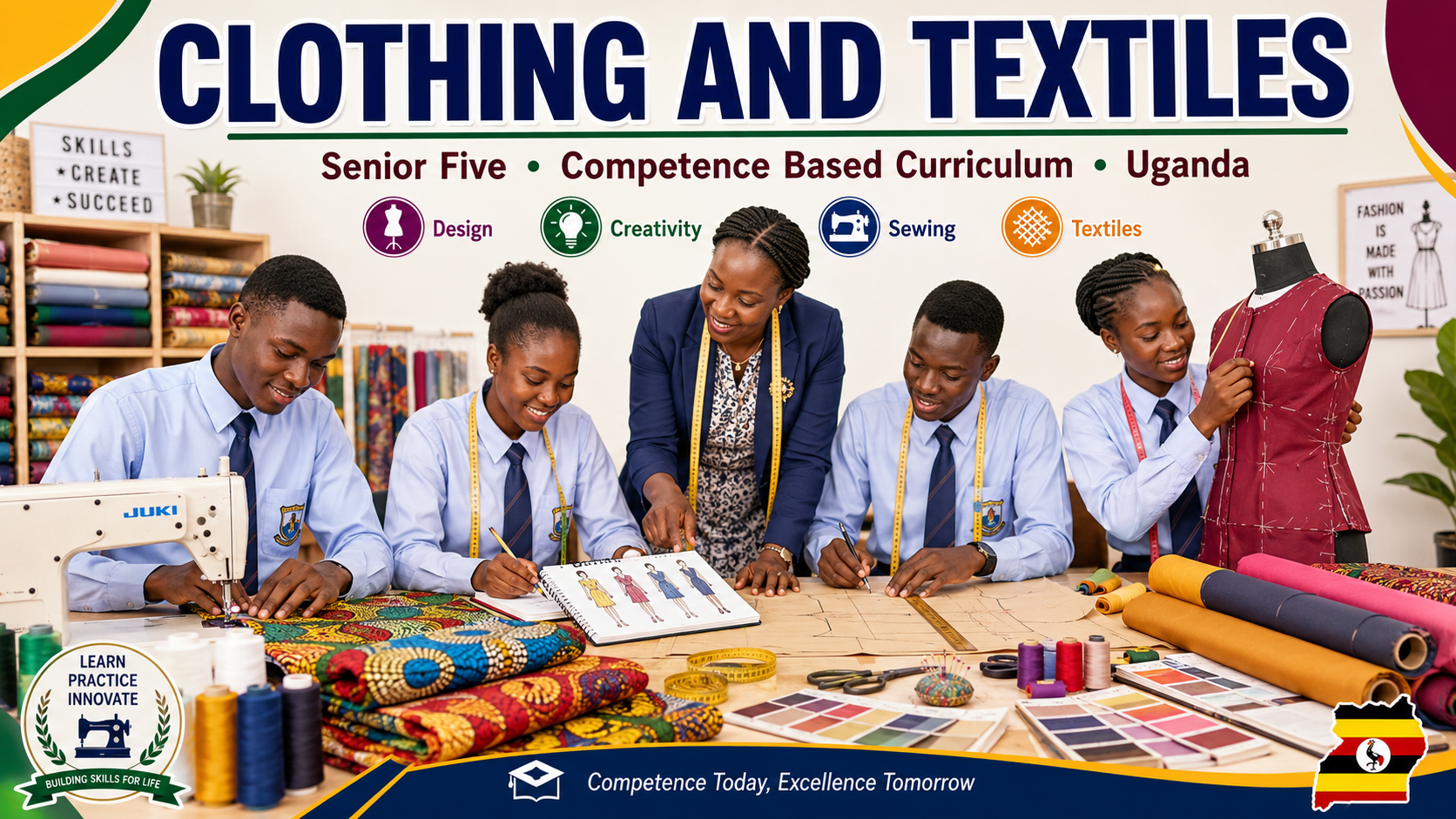
Welcome to Senior Five Clothing and Textiles under Uganda’s Advanced Secondary Competence Based Curriculum.
Clothing and Textiles is a practical subject that equips learners with knowledge, skills and attitudes needed to work confidently with fibres, yarns, fabrics and garments. The syllabus combines theory with practical experiences in garment construction, textile value addition and the use of locally available materials to create functional textile products. It also develops creativity, innovation, decision-making, critical thinking and problem-solving skills.
The subject follows a learner-centred and competency-based approach in which learners develop skills through practical activities, projects, investigation, observation and reflection. Classroom learning is expected to be experiential and activity-based, with learners demonstrating what they can do rather than simply recalling information.
Throughout Senior Five, learners progressively explore the major processes involved in producing and working with textiles. In Term One, they study Fibre to Yarn and Fabric Construction and Decoration. They learn to identify and classify fibres, examine yarn types and formation methods, explore principles of design, and investigate methods used to construct and decorate fabrics.
In Term Two, learners develop practical competence in fabric finishes, fabric care and basic sewing processes. These include the use of garment-construction tools and equipment, construction of stitches and seams, disposal of fullness, openings and fastenings, pockets, sleeves, collars, edge finishes and aesthetic designs for garments and household furnishings.
Term Three introduces pattern making and garment construction. Learners study style interpretation, body measurements, commercial and drafted patterns, pattern adaptation, children’s wear, garment fitting and finishing. These activities provide opportunities for learners to transform ideas and patterns into completed textile products.
The course strongly emphasises learning by doing. Learners are encouraged to research, experiment, solve practical problems, work on projects and apply their knowledge to real-life situations. Independent practice is particularly important because it helps learners build confidence, proficiency and creativity in producing clothing and textile articles.
Clothing and Textiles also prepares learners for life beyond school. It develops scientific, technological and commercial skills that can support self-employment, while encouraging appreciation of Uganda’s cultural heritage, productive work and the dignity of labour.
By the end of Senior Five, learners should be increasingly able to identify and select textile materials, construct and decorate fabrics, use sewing tools correctly, create patterns, construct garments and make informed decisions about clothing and textiles.
Welcome to Senior Five Clothing and Textiles — where creativity, practical skill and innovation are transformed into useful products for everyday life.


Sign in without leaving this document. You will return here automatically.

Yaaka Digital Network Prime
https://soma.yaaka.cc
Basic subscription for premium downloads, upto 24 premium downloads per month
20 / day · 24 / week · 24 / month
Subscription to download books and novels upto 200 downloads per month/ per year
40 / day · 80 / week · 160 / month · 200 / year
Gold subscription for premium downloads, upto 500 premium downloads per year
120 / day · 180 / week · 250 / month · 500 / year
Platinum subscription for premium downloads, upto 240 premium downloads per year
58 / day · 98 / week · 120 / month · 240 / year
Pro subscription for premium downloads, upto 78 premium downloads per quarter
24 / day · 48 / week · 78 / month
Ultimate subscription for unlimited premium downloads for a year
Unlimited downloads
Ultimate plus subscription for unlimited premium downloads for lifetime
Unlimited downloads
Whole subject content downloads for utpo 12 subjects i.e per class full subject downloads
12 / day · 12 / week · 12 / month · 12 / year
Yaaka Digital Network Prime
https://soma.yaaka.cc
Continue directly to this store’s secure WooCommerce checkout.
Earn direct and team commission with personal links, campaign creatives, discount coupons and transparent reporting.