
TOPIC 9: GENDER
- Theme: Language in Use / Human Rights and Social Awareness
- Unit: Topic 9
- Sub-Topic Exactly as Listed: Sub-topic 9A: Gender Roles & Sub-topic 9B: Gender Equality
- Syllabus Objectives Addressed:
- “The learner uses appropriate vocabulary and language structures to talk about gender roles and equality.”
- “Identifies and describes different roles played by males and females in society.”
- “Expresses opinions on gender fairness, balance, and opportunities.”
- “Reads and interprets texts, articles, and poems concerning gender issues.”
- Prerequisite Knowledge: Basic family vocabulary (brother, sister, mother, father) and foundational knowledge of community duties from lower primary social studies.
─────────────────────────────────────────
1. TOPIC INTRODUCTION
─────────────────────────────────────────
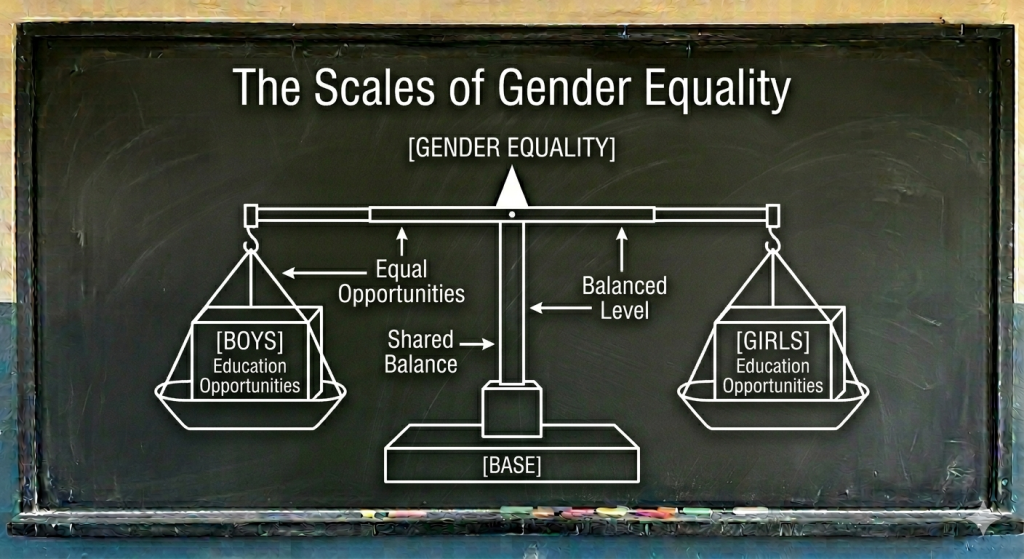
- Definition: Gender refers to the socially constructed roles, behaviors, activities, and attributes that a given society considers appropriate for men and women, boys and girls. Gender equality means providing equal rights, responsibilities, and structural opportunities to all individuals regardless of their biological sex.
- Real-Life Relevance in Uganda: Promoting gender balance ensures that both boys and girls in Uganda stay in school, complete their Primary Leaving Examinations (PLE), and share equal access to professional careers like medicine, engineering, leadership, and farming development.
- Hook Scenario: “Have you ever heard someone say, ‘Cooking is only for girls, and fixing a bicycle is only for boys’? Or have you noticed that in some village leadership meetings, only the men are called up to make big decisions? What would happen if we gave a brilliant girl a chance to become a lead mechanical engineer, or encouraged a boy to become a world-class professional chef? Let us explore how the language we use can break old stereotypes and build a fair society where everyone can succeed!”
─────────────────────────────────────────
2. LEARNING OBJECTIVES
─────────────────────────────────────────
By the end of this lesson, learners should be able to:
- Identify and define key vocabulary terms related to gender roles, stereotypes, and equity.
- Construct accurate sentences using the structural patterns “…whereas…” and “…while…” to compare social roles.
- Apply the structure “…both…and…” to express equal capabilities and shared responsibilities.
- Analyze short texts or case studies to differentiate between fair treatment and gender discrimination.
─────────────────────────────────────────
3. KEY TERMS AND DEFINITIONS
─────────────────────────────────────────
- Gender Roles: The social expectations and duties assigned to individuals based on whether they are male or female.
- Gender Equality: The state in which all genders have completely equal rights, opportunities, and status in society.
- Stereotype: A fixed, oversimplified, and often unfair belief that all individuals with a certain characteristic or gender behave in the exact same way.
- Analogy: A stereotype is like a rigid cage; it tries to lock a person into one box without looking at their individual talents.
- Discrimination: Unfair or prejudicial treatment of a person or group based on their gender or identity.
- Empowerment: The process of giving people the tools, education, and authority to take control of their lives and achieve their dreams.
- Equity: Fairness in treatment according to individual needs, which may include equal treatment or treatment that is different but considered equivalent in terms of rights and benefits.
─────────────────────────────────────────
4. DETAILED EXPLANATION OF CONCEPTS
─────────────────────────────────────────
Concept A: Traditional vs. Modern Gender Dynamics
Historically, societies assigned distinct, rigid duties to males and females. Traditional roles often limited girls to domestic chores (cooking, fetching water, babysitting) and boys to outdoor tasks (herding cattle, building houses). Modern gender dynamics recognize that capability is not determined by sex. In a modern Uganda, shared responsibilities are vital for development.
Concept B: Language Structure — “…whereas…” / “…while…”
These subordinating conjunctions are used to contrast two different ideas or show a clear distinction between two situations in the same sentence. A comma is required before the conjunction.
- Formula: First Statement + , + whereas / while + Contrasting Statement.
- Example 1: In the past, only boys were encouraged to study science, whereas girls were steered toward domestic science.
- Example 2: Some traditional families prefer to educate male children, while progressive parents educate all children equally.
Concept C: Language Structure — “…both…and…”
This correlative conjunction is used to join two matching grammatical items (nouns, verbs, adjectives) to show that a statement applies to two entities simultaneously. It emphasizes equality.
- Formula: Both + Noun 1 + and + Noun 2 + Plural Verb Form.
- Example 1: Both boys and girls have the right to complete their primary education in Uganda.
- Example 2: Both men and women can occupy high ministerial positions in our government.
Comparison Table: Shifting Stereotypes
| Outdated Stereotype | Modern Reality / Equity Principle |
| Only boys are strong enough to manage complex mathematics and engineering jobs. | Leadership, spatial, and analytical skills depend on training and hard work, not gender. |
| Domestic housework and child care are exclusive duties for women and girls. | Managing a household is a shared family skill that fosters cooperation and survival. |
| Girls do not need a higher education because they will join another family through marriage. | Educating a girl empowers an entire nation, improves public health, and boosts household income. |
─────────────────────────────────────────
5. TEACHER DEMONSTRATIONS / PRACTICAL ACTIVITIES
─────────────────────────────────────────
Activity: The Career Stereotype Smash
- Aim: To use the structure “…both…and…” dynamically to challenge occupational stereotypes.
- Materials: Flashcards with professional titles: Doctor, Nurse, Pilot, Teacher, Farmer, Engineer, Chef, Mechanic.
- Procedure:
- Stick the flashcards face down on the board.
- Pick two learners (one boy, one girl) to flip a card together (e.g., Pilot).
- The chosen learners must step forward and instantly lead the class in reciting a target sentence structure: “Both men and women can become professional pilots in Uganda!”
- Expected Observations: At first, learners might laugh when pairing cards like Nurse with men or Mechanic with women. Take this opportunity to emphasize that skill and intelligence have no gender boundaries.
─────────────────────────────────────────
6. LEARNER ACTIVITIES
─────────────────────────────────────────
Classroom Activity 1: Comprehension Reading Passage (Group Task)
- Objective: Extract structural data and interpret comparative statements.
- Task: Read the short text below and answer the inquiry tasks:
At Nakasero Primary School, the administration actively promotes gender fairness. In the past, boys used to dominate sports leadership roles, while girls were relegated to cleaning the classrooms. Today, both boys and girls are given equal opportunities to lead debates, captain sports teams, and manage student government assemblies.
- According to the text, what traditional roles were given to girls in the past?
- Rewrite the second sentence of the passage using the word: …whereas…
- Construct a single sentence with …both…and… summarizing leadership at the school today.
Classroom Activity 2: Structural Transformation Drills
- Objective: Apply contrasting and additive conjunction structures without grammatical failure.
- Task: Rewrite the sentences according to the instructions in brackets:
- Men can drive commercial heavy-duty trucks. Women can also drive them successfully. (Combine into one sentence using: Both…)
- In old traditions, a brother went to school. His sister stayed home to peel bananas. (Combine using: …whereas…)
- Joan wanted to become a mechanic. Her classmates thought it was a job for boys. (Combine using: …while…)
Formative Assessment
- Spelling Integrity: Correct the misspelled words: genda, equallity, stereotaip.
- Grammar Fill: Both the head boy and the head girl __________ (be) expected to attend the national leadership briefing tomorrow. (is / are).
- Application Thinking: Write a three-line paragraph advising a young boy who refuses to clean his bedroom because he believes it is his sister’s job. Use the structure “…both…and…” at least once.
Marking Guide:
- Gender, Equality, Stereotype.
- are (Remember that both…and… always requires a plural verb form because the subject is plural).
- Award full marks if the paragraph gives positive, respectful advice using correct grammar (e.g., You should clean your room because both boys and girls need to maintain good hygiene. Housework is a shared family responsibility.)
Further Reading
- Fountain Primary English Pupil’s Book 7, Pages 185-198.
- Mk Primary English Pupil’s Book 7, Unit 9: Gender.
─────────────────────────────────────────
7. COMMON MISCONCEPTIONS
─────────────────────────────────────────
- Misconception: Using a singular verb after a “both…and…” compound subject (e.g., “Both Kato and Babirye likes reading”).
- Correction: When both connects two singular nouns, the subject becomes plural and requires a plural verb (“Both Kato and Babirye like reading”).
- Misconception: Confusing “Gender” with biological “Sex”.
- Correction: Sex refers to biological differences between males and females. Gender refers to social roles and expectations created by human societies, which can change over time.
─────────────────────────────────────────
9. SUMMARY NOTES FOR PUPILS
─────────────────────────────────────────
- Core Concepts: Gender Roles, Equality, Discrimination, Empowerment, Equity, Stereotype.
- Contrasting Rules: Use , whereas or , while to display a clear difference between two social paradigms. Always place a comma before the conjunction.
- Equality Rules: Both + Noun 1 + and + Noun 2 requires a plural verb form (are / have / do / run).
─────────────────────────────────────────
10. EXAMINATION FOCUS (UNEB-Style)
─────────────────────────────────────────
a) Sentence Completion Items
- The class teacher shared the cleaning duties equally _________ the boys and the girls.
- Both the headteacher and her deputy _________ (support) the girls’ soccer initiative.
- Answers: 1. between, 2. support
b) Sentence Transformation Questions (2 Marks Each)
- Nangobi can solve complex algebra puzzles. Mukasa can also solve them easily.
- Begin your sentence with: Both…
- Answer: Both Nangobi and Mukasa can solve complex algebra puzzles easily.
c) Contextual Reading Analysis
- Look at a list of school prefects: [Head Boy: Okello John | Head Girl: Akello Sarah | Sanitation Prefect: Juma Ali]
- Question: Identify the term that describes giving equal leadership representation to both males and females on a school council.
- Answer: Gender balance / Gender equality.
d) Composition / Essay Writing Question (10 Marks)
- Write an argumentative composition (80–120 words) on the topic: “Why both boys and girls should be given equal access to education in Uganda.” Use contrasting structures like “whereas” or “while” to compare old traditional beliefs with modern reality, and support your points with clear examples of how educated women contribute to national growth.
─────────────────────────────────────────
12. HIGHER ORDER THINKING QUESTIONS
─────────────────────────────────────────
- Analyze: How do rigid gender stereotypes in a community hurt the economy of an entire district if half of the population is discouraged from working or starting businesses?
- Evaluate: If your local school discovers that more girls drop out before reaching Primary Seven due to financial constraints at home, evaluate what specific equity steps the community should take to resolve the imbalance.
─────────────────────────────────────────
13. TEACHING TIPS
─────────────────────────────────────────
- Strategy: Use an “Equality Box” in class. Have pupils drop in anonymous notes reporting anytime they notice unfair language or stereotypes being used in school. Read them out on Friday afternoons to discuss corrections together.
- Mnemonic Clue: B.A.P. $\rightarrow$ Both And demands a Plural verb form!
─────────────────────────────────────────
14. GLOSSARY
─────────────────────────────────────────
- Equilibrium: A state of physical or social balance where opposing forces or groups enjoy equal status.
- Progressive: Favoring social reform, modern ideas, and continuous improvement in the community.
- Relegate: To dismiss or assign someone to a lower, less important position or duty.
─────────────────────────────────────────
END: KEY TAKEAWAY FOR LEARNERS
─────────────────────────────────────────
Building a fair and prosperous Uganda requires the talents, intelligence, and hard work of all citizens. By mastering the language of equality and using structures like both…and…, you can promote justice and respect in your school and community. Remember, true leadership and capability are defined by your character and effort, not your gender!
 Introduction to Clothing and Textiles – Senior Five Learner’s Guide
 Introduction to Islamic Religious Education (IRE) – Senior Six Learner’s Guide
 PERFORMING ARTS SENIOR TWO LEARNERS’ GUIDEOrdinary Secondary level
 - PERFORMING ARTS SENIOR TWO TEACHERS’ GUIDEOrdinary Secondary level
 Introduction to Islamic Religious Education (IRE) – Senior Five Learners’ Guide
 NUTRITION AND FOOD TECHNOLOGY SENIOR TWO LEARNERS’ GUIDE
- NUTRITION AND FOOD TECHNOLOGY SENIOR TWO TEACHERS’ GUIDEOrdinary Secondary level
 MATHEMATICS SENIOR TWO LEARNERS’ GUIDEOrdinary Secondary level
 - MATHEMATICS SENIOR TWO TEACHERS’ GUIDEOrdinary Secondary level
 LITERATURE IN ENGLISH SENIOR TWO LEARNERS’ GUIDEOrdinary Secondary level
 Enjoy learning with Yaaka Digital NetworkUncategorized
 Why We Must Accelerate Digital Learning: A Shared Responsibility for Learners, Teachers, Schools, Development Partners and GovernmentUncategorized
 AD3: Three-Dimensional Arts: CarvingUncategorized
 AD3: Drawing and Painting: Still LifeUncategorized
 AD3: Drawing And Painting: PerspectiveUncategorized
- Enjoy learning with Yaaka Digital NetworkUncategorized
- Why We Must Accelerate Digital Learning: A Shared Responsibility for Learners, Teachers, Schools, Development Partners and GovernmentUncategorized
- AD3: Three-Dimensional Arts: CarvingUncategorized
- AD3: Drawing and Painting: Still LifeUncategorized
- AD3: Drawing And Painting: PerspectiveUncategorized
 AD3: Three-Dimensional Arts: Relief SculptureUncategorized
- Topic 2: Electricity and MagnetismUncategorized
- Topic 1: The Muscular-Skeletal SystemUncategorized
- TOPIC 4: ISLAMIC HISTORY AND MUSLIM ORGANISATIONS (UMSC/UMEA)Uncategorized
- TOPIC 3: FIQH (HIJJ AND FORBIDDEN PRACTICES)Uncategorized
Products
-
 Books & Novels
$ 79
Books & Novels
$ 79
-
Whole subject
$ 29
-
Ultimate Plus
$ 999
-
Ultimate
$ 299
-
Gold
$ 99

0 responses on "TOPIC NINE: GENDER"