
TOPIC EIGHT: NATIONALITIES
- Theme: Language in Use / Citizenship and Global Community
- Unit: Topic 8
- Sub-Topic Exactly as Listed: Sub-topic 8A: Nationalities & Sub-topic 8B: Countries and Continents
- Syllabus Objectives Addressed:
- “The learner uses appropriate vocabulary and language structures to talk about nationalities, countries, and continents.”
- “Identifies various countries, continents, and nationalities.”
- “Reads texts, dialogues, and travel profiles related to international citizenship.”
- “Fills in passport application forms, arrival cards, and travel documents accurately.”
- Prerequisite Knowledge: Prior exposure to the map of Africa and regional neighboring countries in lower-class Social Studies, alongside basic capitalization rules for proper nouns.
─────────────────────────────────────────
1. TOPIC INTRODUCTION
─────────────────────────────────────────
- Definition: Nationality is the legal status of belonging to a specific nation or country by birth or naturalization. Countries are distinct geopolitical land regions, and continents are the world’s seven main continuous expanses of land.
- Real-Life Relevance in Uganda: Understanding nationalities enables Primary Seven learners to navigate immigration entry points, complete international travel arrival cards, read international news, and understand the origins of foreign sports players, investors, and tourists who visit Uganda’s national parks.
- Hook Scenario: “Have you ever watched the opening ceremony of the Olympic Games or a World Cup match on television? You see athletes marching proudly behind different flags. A runner from Uganda is called a Ugandan, but what do you call a person who comes from France, Togo, Cyprus, or the Netherlands? If you fill out an immigration card at Entebbe International Airport and mix up your country of origin with your nationality, you could face long delays! Let us master the global language of nations and citizens.”
─────────────────────────────────────────
2. LEARNING OBJECTIVES
─────────────────────────────────────────
By the end of this lesson, learners should be able to:
- Identify and correctly match various countries to their corresponding suffixes for nationalities.
- Construct accurate sentences using the structural pattern “…from…” versus individual nationality adjectives.
- Apply the relative pronoun structure “…whose…” to describe citizens and their belongings or origins.
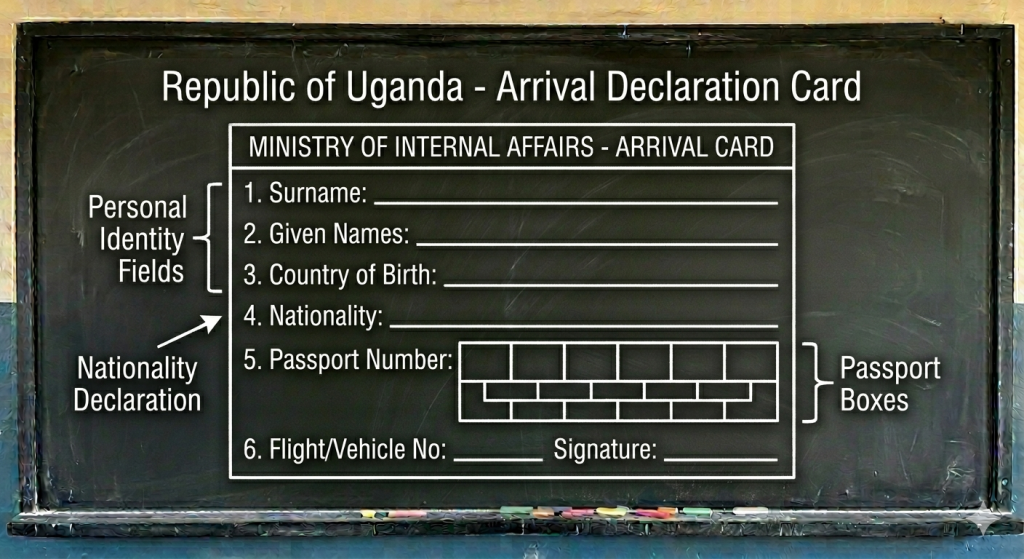
- Complete an official standard immigration arrival/departure card template using block letters.
─────────────────────────────────────────
3. KEY TERMS AND DEFINITIONS
─────────────────────────────────────────
- Nationality: The status of belonging to a particular nation by origin or legal citizenship.
- Continent: One of the seven largest single masses of land on the earth (e.g., Africa, Asia, Europe).
- Citizen: A legally recognized subject or national of a state or commonwealth, either native or naturalized.
- Immigration Officer: An official responsible for checking travelers’ passports, visas, and arrival cards at borders or airports.
- Passport: An official government document certifying the holder’s identity and nationality, used for international travel.
- Analogy: A passport is like a global school identity card; without it, the international school compound gates will not open for you.
─────────────────────────────────────────
4. DETAILED EXPLANATION OF CONCEPTS
─────────────────────────────────────────
Concept A: Suffix Patterns for Nationalities
Nationalities are proper adjectives derived from country nouns. They must always begin with a Capital Letter. They generally follow specific suffix patterns:
- The “-an” / “-ian” Suffix:
- Uganda $\rightarrow$ Ugandan
- Kenya $\rightarrow$ Kenyan
- Nigeria $\rightarrow$ Nigerian
- Egypt $\rightarrow$ Egyptian
- The “-ese” Suffix:
- China $\rightarrow$ Chinese
- Japan $\rightarrow$ Japanese
- The “-ish” Suffix:
- Britain $\rightarrow$ British
- England $\rightarrow$ English
- Irregular Nationalities:
- France $\rightarrow$ French
- Netherlands $\rightarrow$ Dutch
- Greece $\rightarrow$ Greek
Concept B: Language Structure — “Country of Origin” vs. “Nationality”
Learners frequently confuse the prepositions used when defining where someone comes from versus what they are.
- Pattern 1 (Using the Country Noun): Subject + verb (come/is) + from + Country.
- Example: Kiprotich comes from Uganda.
- Pattern 2 (Using the Nationality Adjective): Subject + verb (is) + Nationality.
- Example: Kiprotich is Ugandan. (Never say: Kiprotich is from Ugandan).
Concept C: Relative Clause Structure — “…whose…”
The word “whose” is a possessive relative pronoun used to show that the object or quality mentioned belongs to the person described.
- Formula: Person + whose + Noun + Action.
- Example 1: That is the tourist whose passport was stamped by the immigration officer.
- Example 2: We met a traveler whose nationality is Sudanese.
Comparison Table: Geopolitical Breakdown
| Country Name | Continent | Nationality Adjective | Language Commonly Spoken |
| Uganda | Africa | Ugandan | English / Swahili / Local Languages |
| China | Asia | Chinese | Mandarin |
| Germany | Europe | German | German |
| Brazil | South America | Brazilian | Portuguese |
| United States | North America | American | English |
5. TEACHER DEMONSTRATIONS / PRACTICAL ACTIVITIES
─────────────────────────────────────────
Activity: The International Airport Border Simulation
- Aim: To practice using relative clauses (whose) and identifying nationalities dynamically.
- Materials: Mock paper passports, a table acting as the “Immigration Counter,” and chalk-drawn lines on the floor labeled Arrival Lane.
- Procedure:
- Assign 3 learners to act as Immigration Officers sitting at the counter.
- Give other learners identity slips with varying country backgrounds (e.g., Name: Pierre, Country: France).
- As a traveler steps forward, the officer checks the paper and states to the class: “This is Pierre, whose nationality is French.” 4. If the traveler says “I am from French,” the officer sends them back to correct their structure.
- Expected Observations: Learners will initially say “I am from Kenyan” or write nationalities in lowercase. Stop the line immediately to model correct capitalization and preposition rules.
─────────────────────────────────────────
6. LEARNER ACTIVITIES
─────────────────────────────────────────
Classroom Activity 1: Profile Scans (Group Work)
- Objective: Read biographical profiles and extract national classifications.
- Task: Study the international travel manifest log below and answer the inquiry tasks:
Passenger Flight Manifest Log:
- Passenger A: John Smith | Origin: London, Britain | Destination: Entebbe
- Passenger B: Li Na | Origin: Beijing, China | Destination: Entebbe
- Passenger C: Sarah Namoto | Origin: Kampala, Uganda | Destination: Nairobi
- What is Passenger B’s nationality?
- Rewrite the profile of Passenger A using the relative pronoun …whose….
- Fill in the blank logically: Passenger C will need an international ____________ to clear customs when entering Kenya.
Classroom Activity 2: Structural Grammar Transformations
- Objective: Manipulate target relative pronouns and prepositions without structural failure.
- Task: Rewrite the following sentences according to instructions:
- That is the Congolese musician. His guitar was broken at the airport. (Combine into one sentence using: …whose…)
- She comes from Germany. (Rewrite the sentence using the word: …German…)
- The Dutch lady missed her flight. Her passport was lost in the taxi park. (Combine using: …whose…)
Formative Assessment
- Spelling Integrity: Fix the broken proper adjectives: chinesse, egyptian, french.
- Grammar Fill: The traveler __________ passport had expired was denied entry into the country. (who / whom / whose).
- Application Thinking: An immigration officer stops a traveler because their passport says “Country of Origin: Japanese.” Write two sentences explaining the error and how the traveler should correct the phrasing.
Marking Guide:
- Chinese, Egyptian, French. (Ensure initial letters are capitalized).
- whose
- The country name should be used instead of the nationality adjective. The sentence should read “Country of Origin: Japan” or change the sentence to “Nationality: Japanese.”
Further Reading
- Fountain Primary English Pupil’s Book 7, Pages 165-178.
- Mk Primary English Pupil’s Book 7, Unit 8: Nationalities.
─────────────────────────────────────────
7. COMMON MISCONCEPTIONS
─────────────────────────────────────────
- Misconception: Writing nationalities with lowercase starting letters (e.g., ugandan, british).
- Correction: Nationalities are proper adjectives derived from proper nouns and must always be capitalized (Ugandan, British), regardless of where they appear in a sentence.
- Misconception: Combining ‘from’ with the nationality adjective (e.g., “I am from Ugandan”).
- Correction: ‘From’ pairs with the country name (“I am from Uganda”), while the identity adjective stands alone (“I am Ugandan”).
─────────────────────────────────────────
8. SUMMARY NOTES FOR PUPILS
─────────────────────────────────────────
- Proper Suffix Extraction: Match nations to identity suffixes carefully (-an, -ese, -ish).
- Capitalization Law: All countries, continents, and nationalities must start with a Capital Letter.
- Relative Pronoun Rule: Use whose to replace possessive determiners (his, her, its, their) when combining tracking descriptions.
─────────────────────────────────────────
9. EXAMINATION FOCUS (UNEB-Style)
─────────────────────────────────────────
a) Sentence Completion and Structural Items
- The young boy is proud of being _________ (Uganda) because of our beautiful environment.
- We traveled across three different _________ (continent) during our long school holidays.
- Answers: 1. Ugandan, 2. continents
b) Sentence Transformation Questions (2 Marks Each)
- Mr. Okello met the Dutch tourist. The tourist’s luggage had been left behind in London.
- Combine using: …whose…
- Answer: Mr. Okello met the Dutch tourist whose luggage had been left behind in London.
c) Functional Form Management
- Study the Arrival Card layout from Section 6.
- Question: Which field requires the candidate to write their family name or last name in full block styling?
- Answer: Field 1 (Surname).
d) Composition / Dialogue Drafting (10 Marks)
- Write a composition describing an international cultural day hosted at your school. Mention representatives who arrived from various countries (include at least one African, one Asian, and one European nation), describe their distinct traditional dresses, and use the structure “…whose…” to highlight key participants. (Use 80–120 words).
─────────────────────────────────────────
10. HIGHER ORDER THINKING QUESTIONS
─────────────────────────────────────────
- Analyze: Why do countries across the globe enforce strict passport and visa checks at borders instead of letting people travel freely between continents?
- Evaluate: If a person is born in Uganda to parents who are both nationals of the Netherlands, look into how identity definitions might vary depending on whether you look at it from a cultural viewpoint versus a legal passport viewpoint.
─────────────────────────────────────────
11. TEACHING TIPS
─────────────────────────────────────────
- Strategy: Use flashcard games where side A has the country name (e.g., Japan) and side B has the identity suffix adjective (Japanese). Run speed matching loops to build fast mental associations.
- Mnemonic Support: W.P. $\rightarrow$ Whose tracks Possession. (Never use who’s, which means who is).
─────────────────────────────────────────
12. GLOSSARY
─────────────────────────────────────────
- Geopolitical: Relating to politics, especially international relations, as influenced by geographical factors.
- Manifest: An official, comprehensive list of passengers or cargo carried on a commercial vehicle, ship, or aircraft.
- Naturalization: The legal process by which a non-citizen of a country may acquire citizenship or nationality of that country.
─────────────────────────────────────────
END: KEY TAKEAWAY FOR LEARNERS
─────────────────────────────────────────
Learning about countries, continents, and nationalities broadens our view from our local villages to the wider global community. By mastering the correct prepositions, capitalization laws, and terms used in travel documentation, you gain the skills needed to express your global citizenship confidently. Always remember that while we are citizens of the world, our unique national identity is a heritage to carry with pride!
 Introduction to Clothing and Textiles – Senior Five Learner’s Guide
 Introduction to Islamic Religious Education (IRE) – Senior Six Learner’s Guide
 PERFORMING ARTS SENIOR TWO LEARNERS’ GUIDEOrdinary Secondary level
 - PERFORMING ARTS SENIOR TWO TEACHERS’ GUIDEOrdinary Secondary level
 Introduction to Islamic Religious Education (IRE) – Senior Five Learners’ Guide
 NUTRITION AND FOOD TECHNOLOGY SENIOR TWO LEARNERS’ GUIDE
- NUTRITION AND FOOD TECHNOLOGY SENIOR TWO TEACHERS’ GUIDEOrdinary Secondary level
 MATHEMATICS SENIOR TWO LEARNERS’ GUIDEOrdinary Secondary level
 - MATHEMATICS SENIOR TWO TEACHERS’ GUIDEOrdinary Secondary level
 LITERATURE IN ENGLISH SENIOR TWO LEARNERS’ GUIDEOrdinary Secondary level
 Enjoy learning with Yaaka Digital NetworkUncategorized
 Why We Must Accelerate Digital Learning: A Shared Responsibility for Learners, Teachers, Schools, Development Partners and GovernmentUncategorized
 AD3: Three-Dimensional Arts: CarvingUncategorized
 AD3: Drawing and Painting: Still LifeUncategorized
 AD3: Drawing And Painting: PerspectiveUncategorized
- Enjoy learning with Yaaka Digital NetworkUncategorized
- Why We Must Accelerate Digital Learning: A Shared Responsibility for Learners, Teachers, Schools, Development Partners and GovernmentUncategorized
- AD3: Three-Dimensional Arts: CarvingUncategorized
- AD3: Drawing and Painting: Still LifeUncategorized
- AD3: Drawing And Painting: PerspectiveUncategorized
 AD3: Three-Dimensional Arts: Relief SculptureUncategorized
- Topic 2: Electricity and MagnetismUncategorized
- Topic 1: The Muscular-Skeletal SystemUncategorized
- TOPIC 4: ISLAMIC HISTORY AND MUSLIM ORGANISATIONS (UMSC/UMEA)Uncategorized
- TOPIC 3: FIQH (HIJJ AND FORBIDDEN PRACTICES)Uncategorized
Products
-
 Books & Novels
$ 79
Books & Novels
$ 79
-
Whole subject
$ 29
-
Ultimate Plus
$ 999
-
Ultimate
$ 299
-
Gold
$ 99

0 responses on "TOPIC EIGHT: NATIONALITIES"