
- Theme: Language in Use / Environment and Community Responsibility
- Unit: Topic 7
- Sub-Topic Exactly as Listed: Sub-topic 7A: Environmental Protection & Sub-topic 7B: Degradation
- Syllabus Objectives Addressed:
- “The learner uses appropriate vocabulary and grammar structures to talk about environmental protection and degradation.”
- “Describes human activities that damage or preserve the environment.”
- “Reads texts, poems, and reports on environmental issues in Uganda.”
- “Writes simple rules, posters, and compositions advising the community on how to care for nature.”
- Prerequisite Knowledge: Foundational exposure to tree planting, soil components, and environment themes from Primary Six Science and English.
─────────────────────────────────────────
1. TOPIC INTRODUCTION
─────────────────────────────────────────
- Definition: Environmental protection involves the practice of shielding the natural environment (soil, water, air, and forests) from harm caused by human activities. Environmental degradation is the systematic destruction or wearing away of these natural resources.
- Real-Life Relevance in Uganda: Protecting the environment prevents devastating mudslides in mountainous regions like Bududa, stops the drying up of vital wetlands around Lake Victoria, and checks severe droughts that damage maize and banana (matooke) crops up-country.
- Hook Scenario: “Have you ever walked past a local wetland or swamp and noticed people dumping plastic bottles, or cutting down all the papyrus reeds to construct houses? A few months later, when the heavy rains drop, the entire neighborhood floods, washing away houses and livestock. Why does nature fight back when we mistreat it? Let us learn the exact language tools needed to campaign for a greener, safer Uganda!”
─────────────────────────────────────────
2. LEARNING OBJECTIVES
─────────────────────────────────────────
By the end of this lesson, learners should be able to:
- Identify, spell, and use vocabulary terms related to environmental conservation and damage.
- Construct complex sentences using the double comparative structure “…The more…, the more…” to show cause and effect.
- Apply the conditional structure “…should…, if…” to state moral or civic obligations regarding nature.
- Design a text-based community awareness poster warning against environmental destruction.
─────────────────────────────────────────
3. KEY TERMS AND DEFINITIONS
─────────────────────────────────────────
- Afforestation: The process of planting trees in an area that has not had trees before to create a new forest.
- Deforestation: The illegal or irresponsible cutting down of trees without replacing them.
- Wetland / Swamp: A low-lying area of land covered or saturated with water, which filters rivers and acts as a home for unique wildlife like the Crested Crane.
- Analogy: A wetland acts like a giant sponge; it absorbs excess water during heavy rains to prevent deadly floods.
- Encroachment: Gradually intruding or building illegally on protected public spaces like forest reserves and wetlands.
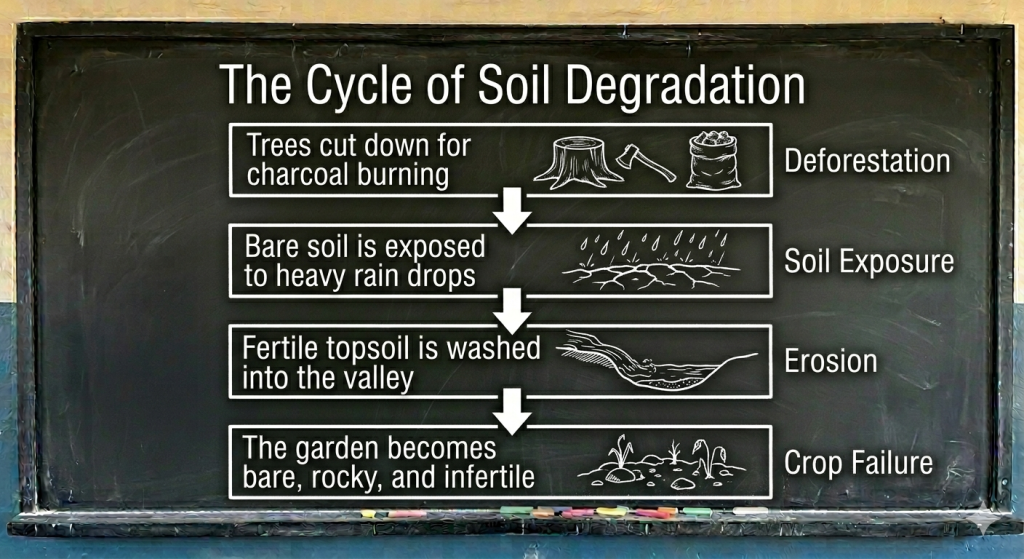
- Soil Erosion: The carrying away of topsoil by natural forces like running water or strong wind.
- Conservation: The careful preservation and protection of natural resources from exploitation or total destruction.
─────────────────────────────────────────
4. DETAILED EXPLANATION OF CONCEPTS
─────────────────────────────────────────
Concept A: Environmental Actions and Consequences
Human actions directly determine the health of our local ecosystems. Positive actions (Conservation) include afforestation, re-afforestation (replanting where trees were cut), mulching, and terracing on hilly slopes. Negative actions (Degradation) include overgrazing local cattle, charcoal burning, dumping polythene bags (kavera), and wetland encroachment.
Concept B: Language Structure — Double Comparatives (“The more…, the more…”)
This structure shows that two variations happen together—where a change in the first action causes a direct parallel change in the second action.
- Formula: The + comparative adjective + clause, the + comparative adjective + clause.
- Example 1: The more trees we cut down, the hotter our local climate becomes.
- Example 2: The more carefully we manage wetlands, the less floods we shall experience in Kampala.
- Alternative adjective use: The greater the destruction, the worse the soil erosion.
Concept C: Language Structure — Advice Protocol (“…should…, if…”)
This conditional pattern links a civic duty or recommendation (should) directly to a specific contextual trigger or problem condition (if).
- Formula: Subject + should + base verb + if + present simple situation.
- Example 1: Citizens should plant cover crops if they want to stop soil erosion on their farms.
- Example 2: The National Environment Management Authority (NEMA) should arrest factory owners if they dump chemical wastes into Lake Victoria.
Comparison Table: Environmental Forces
| Action/Phenomenon | Driving Cause | Long-Term Impact on Uganda | Remedial Solution |
| Deforestation | High demand for charcoal, firewood, and timber. | Loss of rainfall, desertification, soil exposure. | Mass afforestation and using energy-saving stoves. |
| Wetland Encroachment | Building factories, bricklaying, and houses in swamps. | Severe flash floods, contamination of city water supplies. | Strict law enforcement, eviction of illegal developers. |
| Soil Erosion | Farming on steep hills without barriers, overgrazing. | Loss of fertile soil, poor crop yields for farmers. | Terracing, contour ploughing, planting grass strips. |
5. TEACHER DEMONSTRATIONS / PRACTICAL ACTIVITIES
─────────────────────────────────────────
Activity: The Soil Erosion Simulator
- Aim: To discover how plant cover protects soil from erosion and construct descriptive comparative sentences.
- Materials: Two empty plastic soda bottles cut horizontally to create open trays, a jug of water, some dry loose soil, and a piece of uprooted lawn grass with soil attached.
- Procedure:
- Fill Tray 1 with bare loose soil. Place Tray 2 with the grass cover block.
- Tilt both trays slightly downward over two glass cups.
- Pour equal amounts of water onto both trays simultaneously to simulate rainfall.
- Expected Observations: The water running out of Tray 1 (bare soil) will be muddy and full of dark topsoil. The water running out of Tray 2 (grass cover) will be relatively clear because the roots hold the soil firm.
- Conclusion: Vegetative cover protects the soil. Have learners state: “The more grass we plant, the less soil erosion we experience.”
─────────────────────────────────────────
6. LEARNER ACTIVITIES
─────────────────────────────────────────
Classroom Activity 1: Reading Comprehension Analysis (Group Task)
- Objective: Read an environmental report excerpt and answer inquiry questions.
- Task: Read the environment alert below and answer the questions:
NEMA ENVIRONMENT ALERT
The environment in eastern Uganda is under immense pressure. Hilly areas around Mount Elgon have been completely stripped of trees by local charcoal burners. As a direct result, any heavy rain storm causes the loose soil to slide down the mountain, burying whole villages. Local leaders must act fast to enforce tree-planting rules before more lives are lost.
- What human activity has stripped the mountain slopes of their trees?
- Explain the relationship between cutting down trees and the occurrence of mudslides. (Answer using: “The more…, the…”)
- According to the text, what action should local leaders take if they want to protect lives? (Answer using the structure: “…should…, if…”)
Classroom Activity 2: Structural Transformation Drill
- Objective: Manipulate sentences accurately using double comparative rules.
- Task: Rewrite the sentences according to the instructions in brackets:
- If we dump a lot of plastic bags into the soil, our gardens will become very poor. (Rewrite using: The more…)
- Farmers should practice agroforestry. This is necessary if they want to harvest reliable rain. (Combine into one sentence using: …should…, if…)
- As the climate gets hotter, the water levels in our swamps drop faster. (Begin your sentence with: The hotter…)
Formative Assessment
- Spelling Identification: Fix the misspelled conservation words: aforestation, degradashon, incroachmet.
- Grammar Fill: The _________ (careful) a community treats its local forest, the more natural medicine and timber they will harvest.
- Application Design: Your school compound is developing deep gullies because of water running off the classroom roofs. Write three environmental rules using “should” to instruct pupils on how to stop this destruction.
Marking Guide:
- Afforestation, Degradation, Encroachment.
- more carefully
- Award full marks for clear instructions using “should” (e.g., Pupils should avoid walking on grass tracks if it rains. / We should plant grass strips near the classroom walls.)
Further Reading
- Fountain Primary English Pupil’s Book 7, Pages 140-158.
- Mk Primary English Pupil’s Book 7, Unit 7: Environmental Protection.
─────────────────────────────────────────
7. COMMON MISCONCEPTIONS
─────────────────────────────────────────
- Misconception: Using standard superlative adjectives inside double comparative structures (e.g., “The most trees we plant, the best our environment becomes”).
- Correction: This structure requires comparative adjectives, not superlatives (“The more trees we plant, the better our environment becomes”).
- Misconception: Believing that “afforestation” and “re-afforestation” mean exactly the same thing.
- Correction: Afforestation means creating a forest where none existed before; re-afforestation means replanting trees where a forest has been cut down.
─────────────────────────────────────────
8. SUMMARY NOTES FOR PUPILS
─────────────────────────────────────────
- Core Vocabulary: Afforestation, Deforestation, Encroachment, Conservation, Degradation, Siltation, Terracing, Polythene, Wetland.
- Double Comparative Rule: The + Comparative (more/less/better/worse), the + Comparative. Always separate the two clauses with a comma.
- Advice Pattern: Use should + base verb combined with if + present simple to recommend solutions to environmental threats.
─────────────────────────────────────────
9. EXAMINATION FOCUS (UNEB-Style)
─────────────────────────────────────────
a) Sentence Completion Questions
- We must protect our water resources _________ order to avoid outbreaks of waterborne diseases.
- Charcoal burning is a highly _________ (damage) activity that strips our land bare.
- Answers: 1. in, 2. damaging
b) Sentence Transformation Questions (2 Marks Each)
- If a country cuts down its forests rapidly, the desert will expand very fast.
- Begin your sentence with: The more…
- Answer: The more rapidly a country cuts down its forests, the faster the desert expands.
c) Graphic / Poster Interpretation Item
- Read the text displayed on a public awareness signpost: [STOP WETLAND ENCROACHMENT! PROTECT OUR WATER SOURCES — BY NEMA]
- Question: Identify the national organization responsible for authorizing this environmental notice.
- Answer: National Environment Management Authority (NEMA).
d) Composition / Poster Text Drafting (10 Marks)
- Draft an official community awareness notice (60–80 words) to be pinned up at your local village market square. The notice must warn residents against dumping plastic wastes and cutting down trees near the community river. Use the structure “The more…, the…” once and include two “should… if…” sentences to offer solutions.
─────────────────────────────────────────
10. HIGHER ORDER THINKING QUESTIONS
─────────────────────────────────────────
- Analyze: Why do low-income families living in rural parts of Uganda continue to burn wood for charcoal even when they are fully aware that deforestation destroys the local climate? What options do they have?
- Evaluate: If a local developer offers to build a large modern factory that will employ 500 youth in your district, but the proposed site is an important natural wetland, evaluate whether the local council should approve or reject the project.
─────────────────────────────────────────
11. TEACHING TIPS
─────────────────────────────────────────
- Strategy: Conduct a short field walk around the school compound. Have learners look for areas showing soil erosion or plastic littering. Let them practice speaking out solutions using the target grammar structures on the spot.
- Mnemonic Clue: C.C. $\rightarrow$ Cause and effect needs Comparative adjectives on both sides of the comma!
─────────────────────────────────────────
12. GLOSSARY
─────────────────────────────────────────
- Desertification: The process by which fertile land becomes a dry desert, typically as a result of deforestation or drought.
- Ecosystem: A biological community of interacting living organisms and their physical physical environment.
- Siltation: The choking up or pollution of a clean river or lake bed with fine mud or soil particles carried by erosion.
─────────────────────────────────────────
END: KEY TAKEAWAY FOR LEARNERS
─────────────────────────────────────────
The environment is our primary life-support system in Uganda, providing us with the food we eat, the clean water we drink, and the fresh air we breathe. By mastering the language of environmental advocacy and using double comparatives correctly, you can speak up clearly for nature. Remember, the more we protect our trees and wetlands today, the more secure our future will be!
 Introduction to Islamic Religious Education (IRE) – Senior Six Learner’s Guide
 PERFORMING ARTS SENIOR TWO LEARNERS’ GUIDEOrdinary Secondary level
 - PERFORMING ARTS SENIOR TWO TEACHERS’ GUIDEOrdinary Secondary level
 Introduction to Islamic Religious Education (IRE) – Senior Five Learners’ Guide
 NUTRITION AND FOOD TECHNOLOGY SENIOR TWO LEARNERS’ GUIDE
- NUTRITION AND FOOD TECHNOLOGY SENIOR TWO TEACHERS’ GUIDEOrdinary Secondary level
 MATHEMATICS SENIOR TWO LEARNERS’ GUIDEOrdinary Secondary level
 - MATHEMATICS SENIOR TWO TEACHERS’ GUIDEOrdinary Secondary level
 LITERATURE IN ENGLISH SENIOR TWO LEARNERS’ GUIDEOrdinary Secondary level
 - LITERATURE IN ENGLISH SENIOR TWO TEACHERS’ GUIDEOrdinary Secondary level
 Enjoy learning with Yaaka Digital NetworkUncategorized
 Why We Must Accelerate Digital Learning: A Shared Responsibility for Learners, Teachers, Schools, Development Partners and GovernmentUncategorized
 AD3: Three-Dimensional Arts: CarvingUncategorized
 AD3: Drawing and Painting: Still LifeUncategorized
 AD3: Drawing And Painting: PerspectiveUncategorized
- Enjoy learning with Yaaka Digital NetworkUncategorized
- Why We Must Accelerate Digital Learning: A Shared Responsibility for Learners, Teachers, Schools, Development Partners and GovernmentUncategorized
- AD3: Three-Dimensional Arts: CarvingUncategorized
- AD3: Drawing and Painting: Still LifeUncategorized
- AD3: Drawing And Painting: PerspectiveUncategorized
 AD3: Three-Dimensional Arts: Relief SculptureUncategorized
- Topic 2: Electricity and MagnetismUncategorized
- Topic 1: The Muscular-Skeletal SystemUncategorized
- TOPIC 4: ISLAMIC HISTORY AND MUSLIM ORGANISATIONS (UMSC/UMEA)Uncategorized
- TOPIC 3: FIQH (HIJJ AND FORBIDDEN PRACTICES)Uncategorized
Products
-
 Books & Novels
$ 79
Books & Novels
$ 79
-
Whole subject
$ 29
-
Ultimate Plus
$ 999
-
Ultimate
$ 299
-
Gold
$ 99

0 responses on "TOPIC 7: ENVIRONMENTAL PROTECTION"