
─────────────────────────────────────────
- Theme: Language in Use / Communication
- Unit: Topic 1
- Sub-Topic Exactly as Listed: Sub-topic 1A: Holiday Plans
- Syllabus Objectives Addressed: * “The learner describes plans made for holidays.”
- “Uses appropriate language to describe plans made for holidays.”
- “Reads texts related to holiday plans.”
- “Writes texts related to holiday plans.”
- Prerequisite Knowledge: Learners need a basic baseline of the simple future tense (“will”) and familiar vocabulary for family relationships (e.g., aunt, uncle, grandparents) and locations (village, town) covered in Primary Six.
2. TOPIC INTRODUCTION
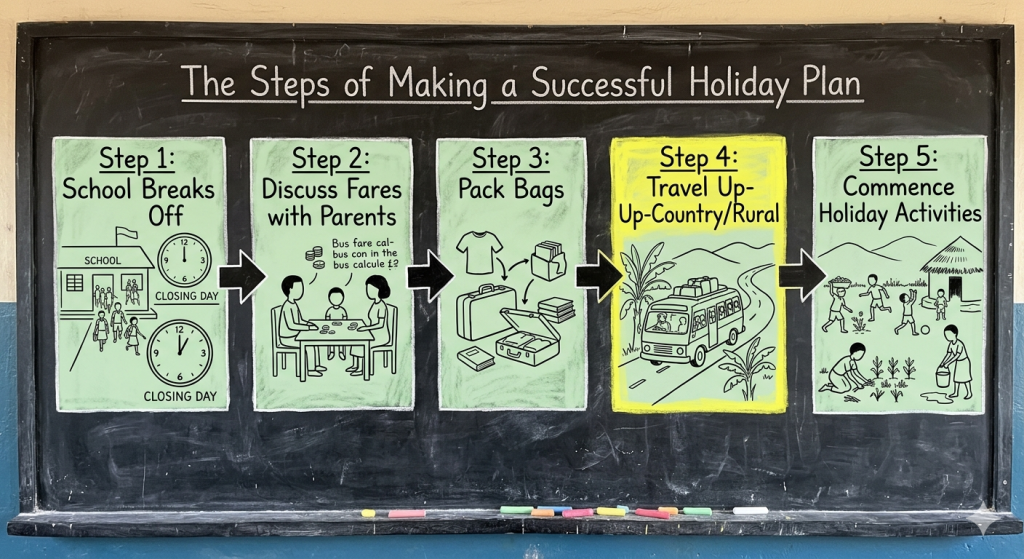
- Definition: A holiday plan is a clear, thought-out arrangement or schedule made before school breaks off, detailing where you will go, whom you will visit, and the constructive activities you intend to do.
- Real-Life Relevance in Uganda: Planning helps families budget for transport fares (e.g., bus or taxi costs from Kampala to up-country places like Jinja or Mbarara). It also helps learners divide time wisely between helping parents with home chores, attending remedial classes, and resting.
- Hook Scenario: “Imagine the closing day of Term Three. The school bell rings for the final assembly, and everyone shouts with joy! You walk out of the school gates with your report card card in hand. But wait—have you thought about what you will do tomorrow morning? Will you be waking up early to weed the garden, traveling on a horizon bus to visit your pen pal up-country, or staying in town to learn a new skill? Let us discover how to talk and write about these exciting future steps using smart English!”
3. LEARNING OBJECTIVES
By the end of this lesson, learners should be able to:
- Identify and spell key vocabulary terms related to holiday planning.
- Describe future vacation plans using the near future structure “…going to…” correctly.
- Construct accurate sentences using appropriate future question tags.
- Distinguish between direct speech and reported speech when sharing holiday messages.
- Write a clear, sequential personal holiday plan for an upcoming vacation period.
─────────────────────────────────────────
4. KEY TERMS AND DEFINITIONS
─────────────────────────────────────────
- Break off: To close school temporarily at the end of a term.
- Analogy: Like a boda-boda rider stopping his engine at the stage after a long journey to rest.
- Vacation: A period of time when schools are closed for holidays.
- Commence: To begin or start something officially.
- Up-country: Rural areas or villages far away from major cities or the capital city, Kampala.
- Pen pal: A distant friend with whom you regularly exchange written letters or electronic messages.
- Remedial classes: Extra holiday lessons arranged to help learners catch up or improve in specific subjects before the next term kicks off.
─────────────────────────────────────────
5. DETAILED EXPLANATION OF CONCEPTS
─────────────────────────────────────────
Concept A: The Near Future Tense (“…going to…”)
When talking about definite, already-decided designs for the upcoming holidays, we use the near future structure: Subject + verb to be (am/is/are) + going to + base verb.
- Example 1: I am going to visit my grandparents in Masaka next week.
- Example 2: Okello is going to attend remedial classes at school.
- Example 3: We are going to travel up-country by bus.
Concept B: Question Tags for Future Plans
Question tags are short questions added to the very end of statements to ask for agreement or confirmation.
- Rule: If the main statement is positive, the question tag must be negative. If the statement is negative, the tag must be positive.
| Positive Statement (+) | Negative Question Tag (-) |
| You will go to the village next week, | won’t you? |
| She is going to pick her pen pal from the taxi park, | isn’t she? |
| We are breaking off this Friday, | aren’t we? |
| Negative Statement (-) | Positive Question Tag (+) |
| They will not travel up-country, | will they? |
| Mukasa is not attending holiday classes, | is he? |
Concept C: Reported Speech for Holiday Plans
Reported speech (indirect speech) is used when we tell someone else what another person said without using their exact words. Notice how pronouns and tenses shift backwards.
- Direct Speech: Akello said, “I am going to prepare for my birthdays.”
- Reported Speech: Akello said that she was going to prepare for her birthdays.
- Direct Speech: “We will board the bus tomorrow,” said the boys.
- Reported Speech: The boys said that they would board the bus the following day.
─────────────────────────────────────────
6. VISUAL LEARNING SUPPORT
─────────────────────────────────────────
─────────────────────────────────────────
7. TEACHER DEMONSTRATIONS / PRACTICAL ACTIVITIES
─────────────────────────────────────────
Activity 1: The Holiday Plan Sentence Auction
- Aim: To discover and master the correct placement of future question tags.
- Materials: Chalkboard, pieces of paper, mock “Uganda Shilling” notes drawn on paper.
- Procedure:
- Write 5 sentences on the board with structural tag choices (e.g., “You will travel to Jinja, won’t you / will you?”).
- Divide the P7 class into small groups and give each group 50,000 mock shillings.
- Let groups bid for what they believe is the perfectly correct sentence.
- Expected Observations: Learners will struggle at first with positive/negative tag harmony, but quickly realize that a positive statement demands a negative tag.
- Conclusion: Future statements with “will” always use the negative tag “won’t you/he/she/they” for affirmation.
─────────────────────────────────────────
8. LEARNER ACTIVITIES
─────────────────────────────────────────
Classroom Activity 1: Inquiry Interview (Pair Work)
- Objective: Conduct a dialogue inquiring about future holiday destinations.
- Materials needed: Exercise books, pens.
- Procedure: One learner acts as an uncle traveling from Kampala, and the other acts as a P7 candidate. They must ask three questions using question tags and record the answers using reported speech format.
- Expected Outcome: Improved oral fluency and correct shift from direct dialogue to written reported sentences.
Classroom Activity 2: Guided Composition Exercise
- Objective: Write a sequential paragraph planning a family vacation trip.
- Task: Fill in the missing vocabulary terms in the paragraph below:
Our school is going to __________ next Friday. My mother has already bought our transport __________ to travel to our __________ home in Kabale. We shall __________ the gate at 6:00 AM to catch the bus. I am very excited to see my rural __________ and play with them during the long __________.
- Answers: break off, fare, up-country/rural, board, relatives, vacation.
Formative Assessment
- Spelling: Correct the misspelled words: vacationn, relativs, comence.
- Grammar: Complete the sentence with an appropriate tag: Mukasa will pick his pen pal from the urban center, ____________?
- Transformation: Change this sentence into reported speech: Juma said, “I am going to attend holiday remedial classes.”
- Application Scenario: Your friend wants to visit you next holiday but does not know how to plan transport. Write two sentences advising them using “…going to…” structures.
Marking Guide:
- Vacation, Relatives, Commence.
- …, won’t he?
- Juma said that he was going to attend holiday remedial classes.
- Award full marks for any accurate future structure (e.g., You are going to buy a bus ticket early.)
Further Reading
- Fountain Primary English Pupil’s Book 7, Pages 2-10.
- Mk Primary English Pupil’s Book 7, Unit 1.
─────────────────────────────────────────
9. COMMON MISCONCEPTIONS
─────────────────────────────────────────
- Misconception: Learners often write “I am going to went to the village.”
- Correction: The near future structure requires the base form of the verb after ‘to’. The correct sentence is “I am going to go to the village.”
- Misconception: Thinking that the tag for “will” is “willn’t”.
- Correction: Explain that “will not” contracts uniquely to become “won’t“.
─────────────────────────────────────────
10. SUMMARY NOTES FOR PUPILS
─────────────────────────────────────────
- Vocabulary to Master: Break off, Vacation, Relative, Up-country, Urban, Pen pal, Commence, Travel.
- Key Structure: Use am/is/are + going to + verb for future adjustments and plans.
- Tag Rule: Positive statements take a negative tag (will $\rightarrow$ won’t you?).
- Reported Speech Change: Present continuous markers change to past continuous (am going $\rightarrow$ was going).
─────────────────────────────────────────
11. EXAMINATION FOCUS (UNEB-Style)
─────────────────────────────────────────
a) Multiple Choice Questions
- School will break ________ for the third term vacation next month. A. out B. off C. down D. away
- You will write a letter to your urban pen pal, ________? A. will you B. won’t you C. isn’t it D. shall you
- Answers: 1 (B) , 2 (B)
b) Structured Short Answer Questions
- Complete the sentence correctly: The primary seven vacation will __________ (commence) as soon as PLE is done.
- Answer: commence
c) Diagram Interpretation Question
- Look at the chalkboard calendar plan: [Monday: Read Books] $\rightarrow$ [Tuesday: Visit Aunt]
- Question: Write one sentence describing what the learner is going to do on Tuesday.
- Answer: The learner is going to visit their aunt on Tuesday.
d) Essay/Composition Question (10 Marks)
- In 50–80 words, write a letter to your up-country relative explaining your holiday plans. Mention when you will break off, how you intend to travel, and the activities you want to do.
- Marking Guide: Address format (2 marks), Correct use of near future tense (3 marks), Flow/Punctuation (3 marks), Vocabulary usage (2 marks).
─────────────────────────────────────────
12. HIGHER ORDER THINKING QUESTIONS
─────────────────────────────────────────
- Analyze: Examine why a learner who fails to draw up a written holiday program is more likely to score poorly in the next term’s entry examinations.
- Evaluate: If your parents change their financial plan and cannot afford the bus fare to travel up-country, how would you adjust your town holiday activities to remain creative and productive?
─────────────────────────────────────────
13. TEACHING TIPS
─────────────────────────────────────────
- Strategy: Use role-playing where one student pretends to be an express bus driver yelling destinations, and others practice booking trips using target structures.
- Mnemonic: Teach P.A.T. (Positive statement $\rightarrow$ Always Takes negative tag) to avoid future slip-ups.
─────────────────────────────────────────
14. GLOSSARY
─────────────────────────────────────────
- Commence: To set in motion or begin an activity.
- Remedial: Intended to correct, improve, or study weak academic areas.
- Urban: Belonging to or relating to a city or busy town center like Kampala or Jinja.
─────────────────────────────────────────
END: KEY TAKEAWAY FOR LEARNERS
───────────────────────────────────────── Making a smart plan is the first step to enjoying a wonderful school holiday break in Uganda. Whether you are staying in a busy urban town or visiting family up-country, using the correct language structures allows you to share your dreams confidently with others. Remember, a bright future belongs to those who plan for it today!
 Introduction to Islamic Religious Education (IRE) – Senior Six Learner’s Guide
 PERFORMING ARTS SENIOR TWO LEARNERS’ GUIDEOrdinary Secondary level
 - PERFORMING ARTS SENIOR TWO TEACHERS’ GUIDEOrdinary Secondary level
 Introduction to Islamic Religious Education (IRE) – Senior Five Learners’ Guide
 NUTRITION AND FOOD TECHNOLOGY SENIOR TWO LEARNERS’ GUIDE
- NUTRITION AND FOOD TECHNOLOGY SENIOR TWO TEACHERS’ GUIDEOrdinary Secondary level
 MATHEMATICS SENIOR TWO LEARNERS’ GUIDEOrdinary Secondary level
 - MATHEMATICS SENIOR TWO TEACHERS’ GUIDEOrdinary Secondary level
 LITERATURE IN ENGLISH SENIOR TWO LEARNERS’ GUIDEOrdinary Secondary level
 - LITERATURE IN ENGLISH SENIOR TWO TEACHERS’ GUIDEOrdinary Secondary level
 Enjoy learning with Yaaka Digital NetworkUncategorized
 Why We Must Accelerate Digital Learning: A Shared Responsibility for Learners, Teachers, Schools, Development Partners and GovernmentUncategorized
 AD3: Three-Dimensional Arts: CarvingUncategorized
 AD3: Drawing and Painting: Still LifeUncategorized
 AD3: Drawing And Painting: PerspectiveUncategorized
- Enjoy learning with Yaaka Digital NetworkUncategorized
- Why We Must Accelerate Digital Learning: A Shared Responsibility for Learners, Teachers, Schools, Development Partners and GovernmentUncategorized
- AD3: Three-Dimensional Arts: CarvingUncategorized
- AD3: Drawing and Painting: Still LifeUncategorized
- AD3: Drawing And Painting: PerspectiveUncategorized
 AD3: Three-Dimensional Arts: Relief SculptureUncategorized
- Topic 2: Electricity and MagnetismUncategorized
- Topic 1: The Muscular-Skeletal SystemUncategorized
- TOPIC 4: ISLAMIC HISTORY AND MUSLIM ORGANISATIONS (UMSC/UMEA)Uncategorized
- TOPIC 3: FIQH (HIJJ AND FORBIDDEN PRACTICES)Uncategorized
Products
-
 Books & Novels
$ 79
Books & Novels
$ 79
-
Whole subject
$ 29
-
Ultimate Plus
$ 999
-
Ultimate
$ 299
-
Gold
$ 99

0 responses on "School holidays"