
TOPIC 5 POST OFFICE
- Theme: Language in Use / Communication and Services
- Unit: Topic 5
- Sub-Topic Exactly as Listed: Sub-topic 5A: Post Office Services & Sub-topic 5B: Postal Documents
- Syllabus Objectives Addressed:
- “The learner uses appropriate vocabulary and language structures related to the post office.”
- “Describes services provided by the post office.”
- “Reads texts, dialogues, and directories related to postal services.”
- “Fills in postal forms (e.g., money orders, registration slips) accurately.”
- Prerequisite Knowledge: Basic understanding of addresses from Topic 2 (Letter Writing) and general knowledge of how letters move from one location to another.
─────────────────────────────────────────
1. TOPIC INTRODUCTION
─────────────────────────────────────────
- Definition: A Post Office is a public department and facility responsible for the sorting, processing, transmission, and delivery of written mail, parcels, and financial resources like money orders.
- Real-Life Relevance in Uganda: Even with the rise of smartphones, the post office (such as Posta Uganda) remains critical. It is used to receive official certificates, passport deliveries, merchandise from overseas, and package distributions to distant districts via regional postal runners and buses.
- Hook Scenario: “Imagine you want to send a delicate birthday gift—a beautiful local wood carving—to your pen pal living in Arua, but you are currently staying in Kampala. You cannot walk all that distance, and a boda-boda would be far too expensive! Where can you securely wrap your package, pay a small standard fee, paste a decorative paper stamp on it, and be 100% sure it will arrive safely? Welcome to the Post Office!”
─────────────────────────────────────────
2. LEARNING OBJECTIVES
─────────────────────────────────────────
By the end of this lesson, learners should be able to:
- Identify and spell key technical vocabulary items related to post office routines and services.
- Construct accurate sentences utilizing the conditional structure “…unless…” to express limitations.
- Apply the structure “…too…to…” to describe constraints in postal delivery situations.
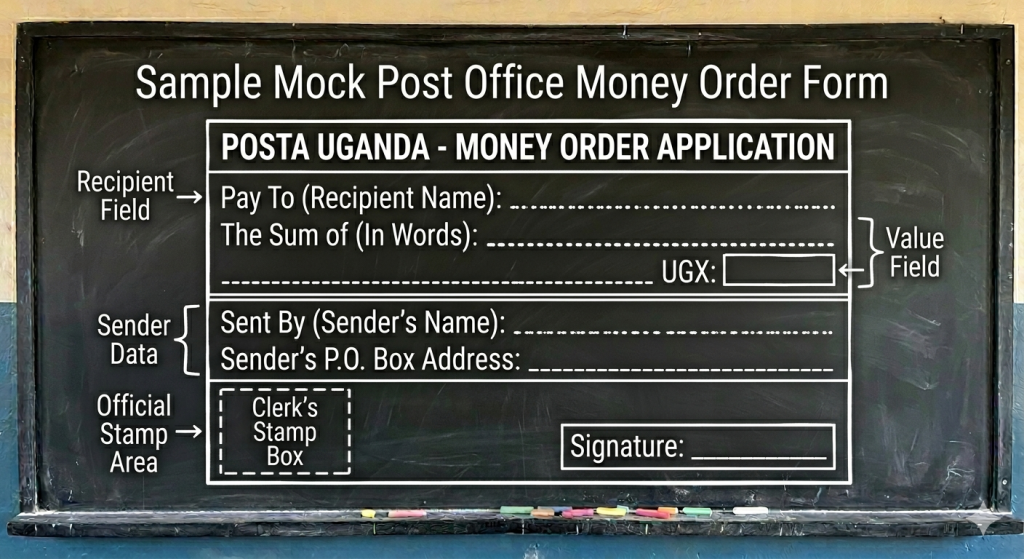
- Interpret a postal rate directory table and accurately fill out a mock money order form.
─────────────────────────────────────────
3. KEY TERMS AND DEFINITIONS
─────────────────────────────────────────
- Postmaster: The official head or chief administrator in charge of a specific post office branch.
- Post Office Box (P.O. Box): A locked, uniquely numbered metal box at a post office station where a person or institution’s incoming mail is kept.
- Postage Stamp: A small adhesive piece of paper issued by the postal authority that is stuck onto an envelope or package to show that the delivery fee has been prepaid.
- Analogy: A stamp acts like a bus ticket for your letter; without it, the letter will not be allowed to travel.
- Parcel: A package or collection of goods wrapped up together and prepared for postal transmission.
- Money Order: A safe, printed document issued by a post office that allows a specified person to receive a fixed amount of cash on demand.
- Mail Van: A specialized secure vehicle used to transport large bundles of letters and packages between towns and regional hubs.
─────────────────────────────────────────
4. DETAILED EXPLANATION OF CONCEPTS
─────────────────────────────────────────
Concept A: Core Postal Services
The post office provides two main types of communication channels:
- Mail Services: Collecting, sorting, and delivering private letters, postcards, and registered mail. For highly valuable items, citizens use Registered Mail, which provides a tracking receipt.
- Financial and Parcel Services: Shipping physical items (parcels) by weight and transferring money through institutional documents like money orders or postal orders.
Concept B: Language Structure — “…unless…”
“Unless” is a negative conditional conjunction that means “if… not”. Because “unless” already contains a negative meaning, we do not use another negative word (like not, don’t, or doesn’t) inside the clause connected to it.
- Formula: Main Action + unless + Positive Present Simple Clause.
- Incorrect: The mail runner will not deliver the letter unless you don’t stick a stamp.
- Correct: The mail runner will not deliver the letter unless you stick a stamp.
- Example 2: * Unless the parcel is weighed, the clerk cannot determine the postage fee.*
Concept C: Language Structure — “…too…to…”
This structure is used to express a negative result because a characteristic is excessive. “Too” is placed before an adjective, and “to” is placed before the base verb.
- Formula: Subject + Verb + too + Adjective + to + Base Verb.
- Example 1: The heavy box was too heavy for the clerk to lift easily.
- Example 2: Musa arrived too late to catch the morning mail van.
Comparison Table: Mail Categories
| Mail Type | Main Purpose | Security Level | Price Basis |
| Ordinary Letter | Casual written communication, postcards. | Standard | Uniform flat rate based on size. |
| Registered Mail | Sending critical documents (e.g., PLE Certificates). | High (Requires signature & receipt) | Higher flat rate + security fee. |
| Parcel Post | Sending physical boxes of food, books, or gifts. | High (Tracked) | Calculated strictly by weight (Kilograms). |
─────────────────────────────────────────
5. TEACHER DEMONSTRATIONS / PRACTICAL ACTIVITIES
─────────────────────────────────────────
Activity: The Parcel Weighing Station Investigation
- Aim: To observe how weight affects postal tariffs and apply the “…too…to…” structure.
- Materials: A simple kitchen weighing scale or a homemade stick balance balance, three boxes filled with varying amounts of soil or stones, and a mock “Postal Rate Card” written on the board.
- Procedure:
- Label the boxes: Parcel A, Parcel B, and Parcel C.
- Have individual pupils act as “Postal Clerks” and place each parcel on the scale.
- If a box exceeds 10kg, declare: “This parcel is too heavy to travel by ordinary delivery.”
- Expected Observations: Learners will see that cost changes with weight. They will practice constructing conditional sentences based on the observed numbers.
- Conclusion: Postal fees increase as a parcel becomes heavier. Heavy items require specialized rates.
─────────────────────────────────────────
6. LEARNER ACTIVITIES
─────────────────────────────────────────
Classroom Activity 1: Directory Reading (Group Work)
- Objective: Read a financial lookup table and answer comprehension questions.
- Task: Study the Posta Uganda tariff table below and answer the inquiry questions:
| Item Weight Range | Destination | Postage Fee Required |
| Up to 500 grams | Within Kampala | 3,000 UGX |
| Up to 500 grams | Up-country (e.g., Gulu) | 5,500 UGX |
| 1kg – 5kg | Anywhere in Uganda | 12,000 UGX |
- How much will you pay to post a 300-gram letter from Kampala to a school box in Gulu?
- Why is it more expensive to send an up-country package than a local one? (Answer using …because…)
- Formulate a sentence with …unless… regarding the payment needed before a letter can be dispatched to Gulu.
Classroom Activity 2: Structural Grammar Transformations
- Objective: Cleanly apply sentence switches under time constraints.
- Task: Rewrite the sentences according to the instructions in brackets:
- If you do not pay for a private box, you will not receive your letters. (Rewrite beginning with: Unless…)
- The letter was very old. It could not be read clearly by the sorter. (Combine using: …too…to…)
- Unless the postmaster signs this money order, it remains invalid. (Rewrite using: If…)
Formative Assessment
- Spelling Rescue: Correct the errors: postmasta, parsel, monie orda.
- Structure Fill: Unless the mail van arrives on time, our packages __________ (not be) delivered today.
- Application Thinking: A customer brings an envelope with no return address or stamp. Explain two distinct reasons why the post office is likely to reject it.
Marking Guide:
- Postmaster, Parcel, Money Order.
- will not be (Ensure the future simple remains logical in the independent main clause).
- First, without a stamp, there is no proof of payment. Second, without a return address, the post office cannot send it back if delivery fails.
Further Reading
- Fountain Primary English Pupil’s Book 7, Pages 95-112.
- Mk Primary English Pupil’s Book 7, Unit 5: Post Office.
─────────────────────────────────────────
7. COMMON MISCONCEPTIONS
─────────────────────────────────────────
- Misconception: Including “not” in the “unless” clause (e.g., “Unless you don’t pay, they will keep the parcel”).
- Correction: “Unless” is already negative. The clause following it must be positive (“Unless you pay, they will keep the parcel”).
- Misconception: Writing “too…that…” instead of “too…to…” (e.g., “The stamp was too sticky that it could not come off”).
- Correction: “Too” pairs with an infinitive “to” verb block (“The stamp was too sticky to come off”).
─────────────────────────────────────────
8. SUMMARY NOTES FOR PUPILS
─────────────────────────────────────────
- Key Vocabulary: Postmaster, Parcel, Postage Stamp, Money Order, P.O. Box, Mail Van, Sorter, Telegram.
- Grammar Rule 1: Unless = If… not. Do not use double negatives in the conditional phrase.
- Grammar Rule 2: Use too + adjective + to + base verb to show an extreme limit that prevents an action.
- Functional Literacy: When filling out postal forms, use clear block letters to avoid mistakes during delivery.
─────────────────────────────────────────
9. EXAMINATION FOCUS (UNEB-Style)
─────────────────────────────────────────
a) Sentence Completion Tasks
- Letters are sorted according to their destinations _________ they are loaded into the mail van.
- The old postman walked _________ slowly to catch up with the delivery truck.
- Answers: 1. before, 2. too
b) Sentence Transformation Questions (2 Marks Each)
- The box of revision books was so heavy that the P7 pupils could not carry it to the classroom.
- Rewrite using: …too…to…
- Answer: The box of revision books was too heavy for the P7 pupils to carry to the classroom.
c) Diagram Interpretation Item
- Look at the sample Money Order form from Section 6.
- Question: Identify the specific field on the form that ensures the clerk pays the exact amount of cash requested without being cheated by an altered number.
- Answer: The Sum of (In Words) field.
d) Composition / Functional Essay (10 Marks)
- Imagine your mother sent you a money order of 50,000 UGX to buy a mathematical set and a uniform for your upcoming PLE mock exams. Write a narrative composition describing your visit to the post office branch. Mention your interaction with the postal clerk, how you presented your identity details, and how you spent the money productively. (Use 80–120 words).
─────────────────────────────────────────
10. HIGHER ORDER THINKING QUESTIONS
─────────────────────────────────────────
- Analyze: Why does the post office charge a much higher fee for Registered Mail than for Ordinary Mail? What extra values are you purchasing?
- Evaluate: With the growth of digital options like mobile money and email communication across Uganda, predict whether physical post offices will disappear completely or modify their services to survive over the next ten years.
─────────────────────────────────────────
11. TEACHING TIPS
─────────────────────────────────────────
- Interactive Strategy: Have pupils create mock stamps out of paper, drawing local icons like the Crested Crane or the Ugandan Flag. They can practice “canceling” them with a mock chalk stamp to show they have been processed.
- Mnemonic Trick: U.P. $\rightarrow$ Unless needs a Positive clause immediately following it!
─────────────────────────────────────────
12. GLOSSARY
─────────────────────────────────────────
- Cancel (Stamp): To mark a postage stamp with ink to prove it has been used and cannot be reused on another letter.
- Directory: A systematic book or list containing addresses, phone contacts, or delivery pricing rules.
- Dispatch: To send off a package or message to its designated destination with speed.
─────────────────────────────────────────
END: KEY TAKEAWAY FOR LEARNERS
─────────────────────────────────────────
The post office is a vital public institution that teaches us the importance of system, order, and clear organization. By writing addresses precisely and mastering structures like unless, you ensure your messages travel across Uganda without getting lost. Understanding postal systems helps you participate in our national communication network
 Introduction to Islamic Religious Education (IRE) – Senior Six Learner’s Guide
 PERFORMING ARTS SENIOR TWO LEARNERS’ GUIDEOrdinary Secondary level
 - PERFORMING ARTS SENIOR TWO TEACHERS’ GUIDEOrdinary Secondary level
 Introduction to Islamic Religious Education (IRE) – Senior Five Learners’ Guide
 NUTRITION AND FOOD TECHNOLOGY SENIOR TWO LEARNERS’ GUIDE
- NUTRITION AND FOOD TECHNOLOGY SENIOR TWO TEACHERS’ GUIDEOrdinary Secondary level
 MATHEMATICS SENIOR TWO LEARNERS’ GUIDEOrdinary Secondary level
 - MATHEMATICS SENIOR TWO TEACHERS’ GUIDEOrdinary Secondary level
 LITERATURE IN ENGLISH SENIOR TWO LEARNERS’ GUIDEOrdinary Secondary level
 - LITERATURE IN ENGLISH SENIOR TWO TEACHERS’ GUIDEOrdinary Secondary level
 Enjoy learning with Yaaka Digital NetworkUncategorized
 Why We Must Accelerate Digital Learning: A Shared Responsibility for Learners, Teachers, Schools, Development Partners and GovernmentUncategorized
 AD3: Three-Dimensional Arts: CarvingUncategorized
 AD3: Drawing and Painting: Still LifeUncategorized
 AD3: Drawing And Painting: PerspectiveUncategorized
- Enjoy learning with Yaaka Digital NetworkUncategorized
- Why We Must Accelerate Digital Learning: A Shared Responsibility for Learners, Teachers, Schools, Development Partners and GovernmentUncategorized
- AD3: Three-Dimensional Arts: CarvingUncategorized
- AD3: Drawing and Painting: Still LifeUncategorized
- AD3: Drawing And Painting: PerspectiveUncategorized
 AD3: Three-Dimensional Arts: Relief SculptureUncategorized
- Topic 2: Electricity and MagnetismUncategorized
- Topic 1: The Muscular-Skeletal SystemUncategorized
- TOPIC 4: ISLAMIC HISTORY AND MUSLIM ORGANISATIONS (UMSC/UMEA)Uncategorized
- TOPIC 3: FIQH (HIJJ AND FORBIDDEN PRACTICES)Uncategorized
Products
-
 Books & Novels
$ 79
Books & Novels
$ 79
-
Whole subject
$ 29
-
Ultimate Plus
$ 999
-
Ultimate
$ 299
-
Gold
$ 99

0 responses on "POST OFFICE"