
TOPIC 3 EXAMINATIONS
- Theme: Language in Use / Communication
- Unit: Topic 3
- Sub-Topic Exactly as Listed: Sub-topic 3A: Preparing for Examinations & Sub-topic 3B: Sitting for Examinations
- Syllabus Objectives Addressed:
- “The learner uses appropriate vocabulary and structures to talk about preparing for examinations.”
- “Describes instructions given during examinations.”
- “Reads texts and dialogues related to examinations.”
- “Fills forms related to registration and examination details.”
- Prerequisite Knowledge: Basic understanding of school regulations, command imperatives (e.g., “Sit down,” “Stop”), and simple future tense actions from lower primary classes.
─────────────────────────────────────────
1. TOPIC INTRODUCTION
─────────────────────────────────────────
- Definition: Examinations are formal, standardized tests used to assess a learner’s knowledge, understanding, and skills in specific subjects. Preparing involves systematic revision and timetable planning, while sitting involves following strict assessment room guidelines.
- Real-Life Relevance in Uganda: As Primary Seven candidates, mastering this topic directly prepares you for the language, rules, and forms you will encounter during the Primary Leaving Examinations (PLE) administered by the Uganda National Examinations Board (UNEB).
- Hook Scenario: “Imagine walking into the examination room on Day One of PLE. Your desk is ready, the room is completely silent, and the invigilator holds a sealed packet of assessment papers. Suddenly, the supervisor says, ‘You have exactly two hours. You must look through your paper before writing. No candidate is allowed to look at another’s work.’ Do you know how to follow these strict rules perfectly without getting confused or disqualified? Let us learn the exact vocabulary and language tools used during examination periods!”
─────────────────────────────────────────
2. LEARNING OBJECTIVES
─────────────────────────────────────────
By the end of this lesson, learners should be able to:
- Identify and correctly spell terms associated with preparing and sitting for examinations.
- Interpret and rewrite sentences using target grammar structures including “…in order to…”, “…so as to…”, and “…no sooner…”.
- Analyze examination timetables and accurately extract structural information.
- Complete a sample examination registration or answer sheet form accurately.
─────────────────────────────────────────
3. KEY TERMS AND DEFINITIONS
─────────────────────────────────────────
- Candidate: A learner who is registered to sit for an official examination (e.g., a P7 pupil sitting for PLE).
- Invigilator: A person appointed to maintain silence and prevent cheating inside the examination room.
- Supervisor: The chief official in charge of managing the entire examination center, timetables, and invigilators.
- Index Number: A unique set of digits and letters assigned to a candidate by UNEB for official tracking.
- Analogy: Like a car license plate; no two candidates share the exact same index number.
- Briefing: A mandatory meeting held before examinations begin where instructions and regulations are read out to candidates.
- Malpractice: Any illegal or dishonest action taken during an examination to get unfair marks (e.g., smuggling notes into the room).
─────────────────────────────────────────
4. DETAILED EXPLANATION OF CONCEPTS
─────────────────────────────────────────
Concept A: Purpose Structures — “…in order to…” and “…so as to…”
When talking about why we prepare for examinations, we express purpose. Both “in order to” and “so as to” are followed immediately by the infinitve/base verb.
- Formula: Action + [in order to / so as to] + base verb.
- Example 1: P7 pupils revise their notes daily in order to pass the PLE.
- Example 2: We must arrive early so as to find our correct desks.
- Negative Form: Use “in order not to” or “so as not to”.
- Example: You should shade carefully so as not to spoil the optical mark reader (OMR) sheet.
Concept B: Instant Action Structure — “No sooner…”
This structure is used to show that one action happened immediately after another during an examination. “No sooner” must always be followed by an auxiliary verb (usually had or did) and must be paired with than.
- Formula: No sooner + had + Subject + past participle verb + than + second action.
- Direct Example: As soon as the bell rang, the candidates opened their booklets.
- Transformed: No sooner had the bell rung than the candidates opened their booklets.
- Note: If you use did, use the base verb: No sooner did the bell ring than…
Concept C: Comparison of Examination Roles
Understanding the hierarchy and roles inside a Ugandan examination center is crucial for reading comprehension passages.
| Role Title | Main Responsibility | Where they work |
| Candidate | Answers questions honestly according to instructions. | Assigned desk inside the room. |
| Invigilator | Walk around the room, monitors candidates, and distributes papers. | Inside one specific examination room. |
| Supervisor | Manages the whole center, checks security seals, collects answer scripts. | Across the entire school compound. |
─────────────────────────────────────────
5. TEACHER DEMONSTRATIONS / PRACTICAL ACTIVITIES
─────────────────────────────────────────
Activity: Mock Briefing Day Simulation
- Aim: To practice interpreting examination instructions and spoken imperatives under pressure.
- Materials: Blank sheets of paper, a bell or small block of wood to tap.
- Procedure:
- Arrange the classroom desks in neat, widely spaced rows like a formal UNEB center.
- Act as the Center Supervisor. Read out strict commands: “Turn over your papers face down,” “Do not write until told,” “Write your index numbers now.”
- Introduce an interruption and require learners to use target structures to describe it.
- Expected Observations: Learners will instinctively start writing before checking instructions. Stop them and emphasize the structural purpose: “We must listen first so as to avoid mistakes.”
─────────────────────────────────────────
6. LEARNER ACTIVITIES
─────────────────────────────────────────
Classroom Activity 1: Inquiry Timetable Study (Group Work)
- Objective: Scan an academic schedule and interpret variables using purpose connectors.
- Task: Study the mock PLE Timetable box below and answer the questions:
| Day & Date | Time | Subject | Duration |
| Monday 2nd Nov | 9:00 AM | Mathematics | 2 hours 30 mins |
| Monday 2nd Nov | 2:00 PM | Social Studies | 2 hours 15 mins |
- Why are candidates given a break between 11:30 AM and 2:00 PM? (Answer using …so as to…)
- What is the total duration of the morning paper?
- Construct a sentence using …in order to… explaining why a candidate needs a functional mathematical set on Monday morning.
Classroom Activity 2: Structural Transformation Drill
- Objective: Apply advanced grammar transformations cleanly under test conditions.
- Task: Rewrite the following sentences according to instructions:
- The supervisor opened the question paper box. Immediately, the electricity went off. (Begin: No sooner…)
- She revised her Science textbooks because she didn’t want to fail the mock exams. (Use: …so as not to…)
Formative Assessment
- Spelling Rescue: Fix the mistakes: invigilater, supavizor, mulpractice.
- Structure Fill: No sooner had the invigilator distributed the ink pens __________ the morning clock struck nine. (then / than / when).
- Functional Application: Your friend Musa wants to smuggle a small notebook into the examination hall. Write two caution lines explaining why he should avoid malpractice.
Marking Guide:
- Invigilator, Supervisor, Malpractice.
- than
- Award full marks if sentences use appropriate future expectations or purpose structures (e.g., You should not cheat in order to avoid getting disqualified.)
Further Reading
- Fountain Primary English Pupil’s Book 7, Pages 45-60.
- Mk Primary English Pupil’s Book 7, Unit 3: Examinations.
─────────────────────────────────────────
7. COMMON MISCONCEPTIONS
─────────────────────────────────────────
- Misconception: Using “when” or “then” instead of “than” with the “No sooner” structure.
- Correction: No sooner is a comparative structure and must always pair with than. (No sooner had he sat down than the paper started.)
- Misconception: Believing that an invigilator is the head of the whole examination school.
- Correction: Clarify that the Supervisor manages the school center, while Invigilators manage single rooms.
─────────────────────────────────────────
8. SUMMARY NOTES FOR PUPILS
─────────────────────────────────────────
- Core Vocabulary: Candidate, Invigilator, Supervisor, Index Number, Briefing, Malpractice, Timetable.
- Purpose Tools: Use in order to / so as to + basic action verb to explain the reason for doing something.
- Timing Sentence Rule: No sooner + had + subject + past participle verb + than + past action.
─────────────────────────────────────────
9. EXAMINATION FOCUS (UNEB-Style)
─────────────────────────────────────────
a) Sentence Completion & Tense Adjustments
- No sooner had the candidate _________ (receive) the answer booklet than he wrote his index number.
- Candidates are briefed before the exams _________ as to understand the rules.
- Answers: 1. received, 2. so
b) Sentence Transformation Questions (2 Marks Each)
- The candidates stood up immediately after the national anthem was played.
- Begin: No sooner…
- Answer: No sooner had the national anthem been played than the candidates stood up.
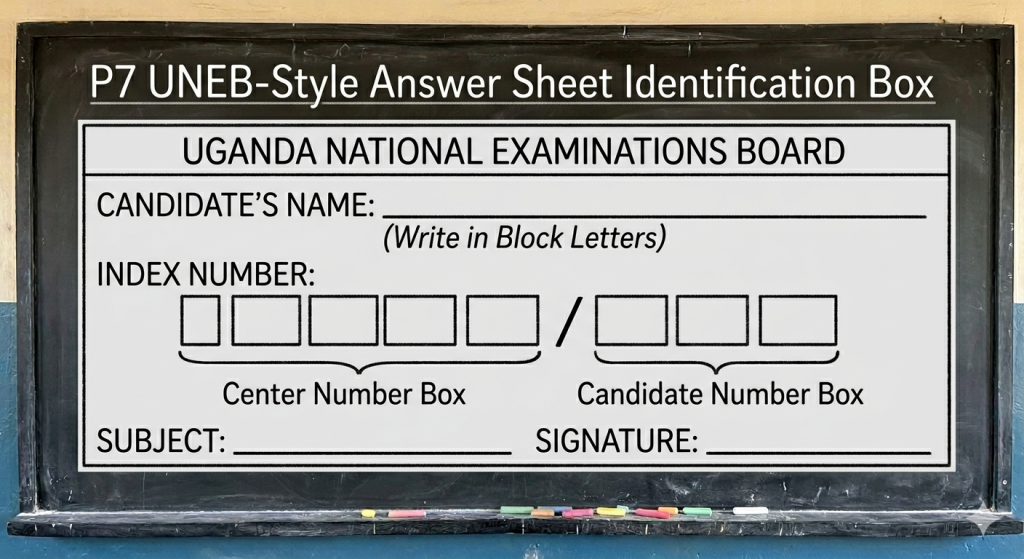
c) Form/Diagram Filling Task
- Study the following candidate data: Name: Sarah Namubiru, School: Kampala Primary School (Center U2200), Candidate Number: 054. Fill out the UNEB identification box layout correctly.
- Answer Guide: Verify that Namubiru is in uppercase, Center Number field says U2200, and Candidate Number field reads 054.
d) Essay / Dialogue Writing Question (10 Marks)
- Write a dialogue between a P7 candidate who is anxious about the upcoming PLE and a helpful teacher. The teacher must give three pieces of advice on preparation using “in order to” and explain two room rules using “so as not to”. Include at least 6 structural exchanges.
─────────────────────────────────────────
10. HIGHER ORDER THINKING QUESTIONS
─────────────────────────────────────────
- Analyze: Why does UNEB print strict instructions on the cover page of an examination booklet before candidates even read the questions inside?
- Evaluate: If a candidate discovers that a classmate has smuggled study notes into the room during a final paper, what choices do they have, and how do those choices impact the integrity of the whole school’s results?
─────────────────────────────────────────
11. TEACHING TIPS
─────────────────────────────────────────
- Strategy: Print out old, real UNEB cover sheets. Let learners practice tracking and shading mock boxes with a pencil until their speed and accuracy match examination standards.
- Mnemonic Aid: N.S.T. $\rightarrow$ No Sooner goes with Than. (Never mix with when).
─────────────────────────────────────────
12. GLOSSARY
─────────────────────────────────────────
- Disqualified: Declared ineligible or forbidden from continuing an activity due to breaking a rule.
- Imperative: A command or direct order that must be obeyed immediately.
- Standardized: Designed to be uniform and identical for everyone to ensure absolute fairness.
─────────────────────────────────────────
END: KEY TAKEAWAY FOR LEARNERS
─────────────────────────────────────────
Excelling in your Primary Leaving Examinations requires more than just knowing academic facts; it demands the clarity to read, understand, and follow instructions perfectly. By mastering purpose structures and learning how to navigate standard assessment regulations, you remove fear and build the confidence needed to succeed. Stay honest, prepare early, and read every instruction carefully!
 Introduction to Islamic Religious Education (IRE) – Senior Six Learner’s Guide
 PERFORMING ARTS SENIOR TWO LEARNERS’ GUIDEOrdinary Secondary level
 - PERFORMING ARTS SENIOR TWO TEACHERS’ GUIDEOrdinary Secondary level
 Introduction to Islamic Religious Education (IRE) – Senior Five Learners’ Guide
 NUTRITION AND FOOD TECHNOLOGY SENIOR TWO LEARNERS’ GUIDE
- NUTRITION AND FOOD TECHNOLOGY SENIOR TWO TEACHERS’ GUIDEOrdinary Secondary level
 MATHEMATICS SENIOR TWO LEARNERS’ GUIDEOrdinary Secondary level
 - MATHEMATICS SENIOR TWO TEACHERS’ GUIDEOrdinary Secondary level
 LITERATURE IN ENGLISH SENIOR TWO LEARNERS’ GUIDEOrdinary Secondary level
 - LITERATURE IN ENGLISH SENIOR TWO TEACHERS’ GUIDEOrdinary Secondary level
 Enjoy learning with Yaaka Digital NetworkUncategorized
 Why We Must Accelerate Digital Learning: A Shared Responsibility for Learners, Teachers, Schools, Development Partners and GovernmentUncategorized
 AD3: Three-Dimensional Arts: CarvingUncategorized
 AD3: Drawing and Painting: Still LifeUncategorized
 AD3: Drawing And Painting: PerspectiveUncategorized
- Enjoy learning with Yaaka Digital NetworkUncategorized
- Why We Must Accelerate Digital Learning: A Shared Responsibility for Learners, Teachers, Schools, Development Partners and GovernmentUncategorized
- AD3: Three-Dimensional Arts: CarvingUncategorized
- AD3: Drawing and Painting: Still LifeUncategorized
- AD3: Drawing And Painting: PerspectiveUncategorized
 AD3: Three-Dimensional Arts: Relief SculptureUncategorized
- Topic 2: Electricity and MagnetismUncategorized
- Topic 1: The Muscular-Skeletal SystemUncategorized
- TOPIC 4: ISLAMIC HISTORY AND MUSLIM ORGANISATIONS (UMSC/UMEA)Uncategorized
- TOPIC 3: FIQH (HIJJ AND FORBIDDEN PRACTICES)Uncategorized
Products
-
 Books & Novels
$ 79
Books & Novels
$ 79
-
Whole subject
$ 29
-
Ultimate Plus
$ 999
-
Ultimate
$ 299
-
Gold
$ 99

0 responses on "EXAMINATIONS"