
TOPIC 4 ELECTRONIC MEDIA
- Theme: Language in Use / Information and Communication
- Unit: Topic 4
- Sub-Topic Exactly as Listed: Sub-topic 4A: Radio and Television & Sub-topic 4B: Newspapers
- Syllabus Objectives Addressed:
- “The learner uses appropriate vocabulary and structures related to electronic and print media.”
- “Reads and interprets news broadcasts, articles, and program schedules.”
- “Expresses opinions about programs and advertisements on radio and TV.”
- “Writes simple media notices and announcements.”
- Prerequisite Knowledge: Basic understanding of listening to news from lower primary classes, and awareness of local media outlets like UBC, Radio Uganda, or local community loudspeakers.
─────────────────────────────────────────
1. TOPIC INTRODUCTION
─────────────────────────────────────────
- Definition: Electronic media refers to communication channels that use electronics or electromechanical energy for the end-user to access the content (e.g., radio, television). Print media relies on physical printed material (e.g., newspapers).
- Real-Life Relevance in Uganda: Media literacy helps Primary Seven learners think critically about advertisements they hear on stations like CBS, Radio West, or Akaboozi. It also equips them to find useful educational programs, weather forecasts for farming, and read The New Vision or Daily Monitor newspapers to track national updates.
- Hook Scenario: “Have you ever sat near a small radio set in the evening and heard the presenter say, ‘We are interrupting our music program to bring you a live announcement from Parliament’? Or have you watched a football match broadcast live on a television screen in your trading center? How does that voice or moving picture travel from Kampala across hills and rivers to reach your village instantly? Let us tune in and explore the language patterns behind the news!”
─────────────────────────────────────────
2. LEARNING OBJECTIVES
─────────────────────────────────────────
By the end of this lesson, learners should be able to:
- Identify and define key vocabulary words related to broadcasting and journalism.
- Construct grammatically correct sentences using the conditional structures “…as long as…” and “…provided…”.
- Analyze and interpret a radio/TV program schedule to extract specific timing information.
- Draft a clear, concise announcement suitable for broadcasting on a local community radio station.
─────────────────────────────────────────
3. KEY TERMS AND DEFINITIONS
─────────────────────────────────────────
- Broadcast: To send out programs on radio or television.
- Analogy: Like a farmer scattering seeds widely across a garden; a broadcast scatters information widely through the air.
- Presenter / Broadcaster: A person who introduces and hosts programs on radio or television.
- Viewer: A person who watches television programs.
- Listener: A person who tunes in and listens to radio broadcasts.
- Editor: The person in charge of checking, correcting, and deciding which stories are published in a newspaper or broadcast on news bulletins.
- Commercial Advertisement: A short paid announcement on radio, TV, or newspaper meant to persuade people to buy a product or service (e.g., a telecommunication company promoting a new airtime bundle).
─────────────────────────────────────────
4. DETAILED EXPLANATION OF CONCEPTS
─────────────────────────────────────────
Concept A: Media Channels and Roles
Information is collected by journalists / reporters, checked by an editor, and then shared via two main streams:
- Audio/Visual (Electronic Media): Radio relies purely on sound (audio) signals transmitted by waves, making it accessible even in remote villages without electricity via battery-powered pockets. Television combines sound with moving pictures (video).
- Print Media: Newspapers and magazines present information through written text and photographs.
Concept B: Conditional Structure — “…as long as…”
The structure “…as long as…” is used to state a condition that must be met for something else to happen. It shares a similar meaning with “if”.
- Formula: Main Action + as long as + Present Simple Condition.
- Example 1: Grandfather will listen to the 8:00 PM news bulletin as long as his radio has functional dry cells.
- Example 2: As long as the reporter writes the truth, the editor will publish the story.
Concept C: Conditional Structure — “…provided…” / “…provided that…”
“Provided” operates exactly like “as long as” to show a strong condition. It is also followed by a verb in the present simple tense when referencing future expectations.
- Formula: Future Action + provided + Present Simple Condition.
- Example 1: The technician will repair the television screen provided you pay for the spare parts.
- Example 2: Provided that the signal transmitter is working, we shall watch the educational broadcast clearly.
Comparison Table: Media Formats
| Feature | Radio Broadcast | Television Broadcast | Newspaper |
| Primary Sense Used | Hearing (Auditory) | Hearing & Seeing (Visual) | Seeing / Reading (Visual Text) |
| Target Audience | Listeners | Viewers | Readers |
| Power Requirement | Low (Dry cells/solar) | Moderate to High (Mains electricity) | None (Requires physical light to read) |
─────────────────────────────────────────
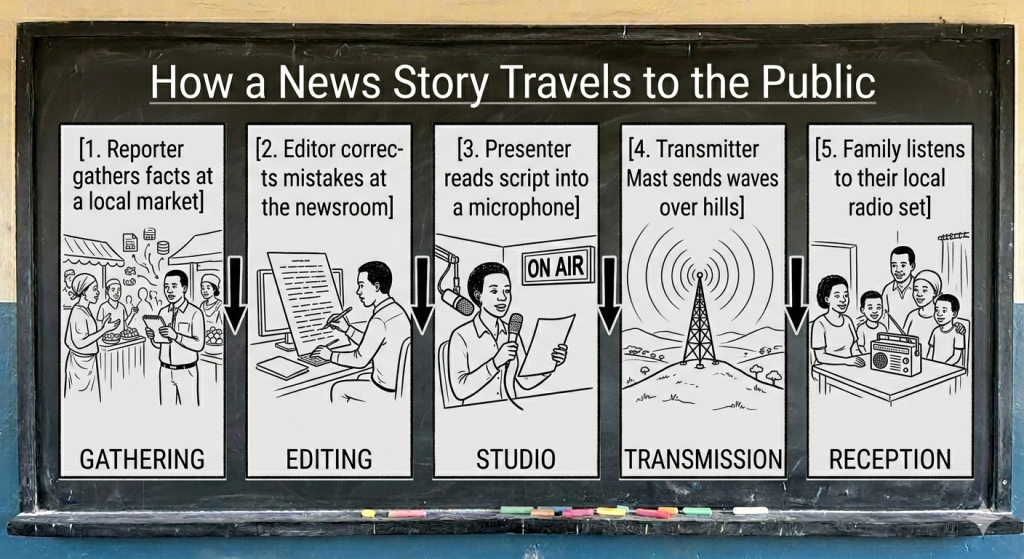
5. TEACHER DEMONSTRATIONS / PRACTICAL ACTIVITIES
─────────────────────────────────────────
Activity: The Live Studio Broadcast Simulation
- Aim: To practice speaking clearly like a professional presenter and using conditional structures orally.
- Materials: A hollow rolled-up piece of cardboard or an empty plastic bottle to act as a mock “microphone”.
- Procedure:
- Set up a desk at the front of the classroom as the “Broadcasting Studio Desk”.
- Select individual learners to act as News Anchors.
- Give them a script that includes a blank condition: “The weather tomorrow will be sunny in Mbarara ____________ (use ‘provided’) it doesn’t rain tonight.”
- Have them read it out loud using a clear, standard pronunciation tone.
- Expected Observations: Learners may rush or stumble over punctuation marks. Guide them to take short pauses at commas and full stops to keep their speech rhythmic and understandable for listeners.
─────────────────────────────────────────
6. LEARNER ACTIVITIES
─────────────────────────────────────────
Classroom Activity 1: Schedule Analysis (Group Task)
- Objective: Read and extract specific facts from a modern media program schedule.
- Task: Study the TV schedule box below and answer the inquiry questions:
| Time | Program Title | Target Audience |
| 5:00 PM – 6:00 PM | Children’s Learning Zone | Primary School Pupils |
| 6:00 PM – 7:00 PM | Agribusiness Today | Local Farmers |
| 7:00 PM – 8:00 PM | National News Bulletin | General Public |
- At what time does the program meant for primary school pupils end?
- Which program is likely to discuss cassava planting and cattle diseases?
- Construct a sentence using …as long as… explaining when a farmer can watch “Agribusiness Today”.
Classroom Activity 2: Structural Transformation Exercise
- Objective: Rewrite sentences accurately using target conditional conjunctions.
- Task: Rewrite the following sentences according to the instructions in brackets:
- If you switch on the radio generator, you will hear the music. (Rewrite using: …as long as…)
- The newspaper will be printed on time if the power supply does not fail. (Rewrite using: …provided…)
- The TV presenter will host the show if she recovers from her cold. (Begin: Provided…)
Formative Assessment
- Spelling Correction: Identify and fix the misspelled words: brodcaster, advertisment, vewer.
- Sentence Completion: We shall watch the sports program provided that the television ____________ (be) connected to solar power.
- Functional Application Scenario: A valuable goat has gone missing from your school farm. Draft a short, 30-word radio announcement notice requesting anyone who sees it to report to the headteacher.
Marking Guide:
- Broadcaster, Advertisement, Viewer.
- is (Ensure the present simple form matches the singular subject).
- Award full marks if the notice includes: Description of the goat, location lost, clear contact entity (Headteacher), and concise layout.
Further Reading
- Fountain Primary English Pupil’s Book 7, Pages 72-88.
- Mk Primary English Pupil’s Book 7, Unit 4: Electronic Media.
─────────────────────────────────────────
7. COMMON MISCONCEPTIONS
─────────────────────────────────────────
- Misconception: Using past tense verbs after conditional words like provided or as long as when describing future outcomes (e.g., “We shall watch the news provided the power came back”).
- Correction: Always use the present simple tense for the conditional clause when talking about a possible future event (“…provided the power comes back”).
- Misconception: Believing that an editor is the person who reads the news live on television.
- Correction: The editor works behind the scenes preparing the text. The person who reads it live is called a news anchor or presenter.
─────────────────────────────────────────
8. SUMMARY NOTES FOR PUPILS
─────────────────────────────────────────
- Vocabulary Focus: Broadcast, Presenter, Viewer, Listener, Editor, Journalist, Column, Advertisement, Program.
- Grammar Key 1: Use …as long as… to tie an event to an active condition.
- Grammar Key 2: Use …provided… or …provided that… followed by the present simple tense for mandatory terms.
- Media Distinction: Radio appeals to the ears (audio), television appeals to ears and eyes (audio-visual), and newspapers appeal to eyes (print literacy).
─────────────────────────────────────────
9. EXAMINATION FOCUS (UNEB-Style)
─────────────────────────────────────────
a) Sentence Completion Questions
- No journalist is allowed to publish a story _________ the chief editor gives permission.
- The listeners were very angry _________ the rude presenter who insulted them on air.
- Answers: 1. unless / until, 2. with
b) Sentence Transformation Questions (2 Marks Each)
- If you read the daily newspapers regularly, you will improve your English vocabulary.
- Begin: As long as…
- Answer: As long as you read the daily newspapers regularly, you will improve your English vocabulary.
c) Graphic Information Extraction
- Look at a typical newspaper front page layout showing: [HEADLINE: NEW ROADS OPENED] and a big picture of a bridge below it.
- Question: What do we call the written title of a lead story that appears in large, bold letters on the front page of a newspaper?
- Answer: Headline
d) Composition Writing Question (10 Marks)
- Imagine you attended a marvelous music and drama festival at your district headquarters last term. Write an article for your school magazine describing the event. Mention the schools that participated, the best performances, and why you think such events should be broadcast live on television. (Use 60–100 words).
─────────────────────────────────────────
10. HIGHER ORDER THINKING QUESTIONS
─────────────────────────────────────────
- Analyze: Why do commercial business owners pay large amounts of money to buy advertisement slots during prime-time news hours rather than early in the morning?
- Evaluate: If a community lacks electricity and cannot buy printed newspapers due to high transport costs, investigate how a community megaphone speaker system can fill the gap to keep citizens informed about health programs like vaccination drives.
─────────────────────────────────────────
11. TEACHING TIPS
─────────────────────────────────────────
- Strategy: Cut out short articles from local newspapers. Have pupils circle structural connectors like provided and as long as to see how real-world writers use them.
- Memory Aid: Tell learners that Provided and As long as are linguistic twins—they look different but do exactly the same work as a positive conditional clause.
─────────────────────────────────────────
12. GLOSSARY
─────────────────────────────────────────
- Bulletin: A short, official public statement or summary of news handed out for immediate transmission.
- Journalist: A professional trained to collect, write, and distribute news stories objectively.
- Prime-time: The block of time when the largest number of viewers or listeners are tuned in to media channels.
─────────────────────────────────────────
END: KEY TAKEAWAY FOR LEARNERS
─────────────────────────────────────────
Media houses play an invaluable role in keeping our communities in Uganda united, informed, and educated. By understanding how to read program timetables and master structures like provided, you become a smart, active consumer of news. Use electronic and print media responsibly to boost your knowledge and learn more about the world around you
 Introduction to Islamic Religious Education (IRE) – Senior Six Learner’s Guide
 PERFORMING ARTS SENIOR TWO LEARNERS’ GUIDEOrdinary Secondary level
 - PERFORMING ARTS SENIOR TWO TEACHERS’ GUIDEOrdinary Secondary level
 Introduction to Islamic Religious Education (IRE) – Senior Five Learners’ Guide
 NUTRITION AND FOOD TECHNOLOGY SENIOR TWO LEARNERS’ GUIDE
- NUTRITION AND FOOD TECHNOLOGY SENIOR TWO TEACHERS’ GUIDEOrdinary Secondary level
 MATHEMATICS SENIOR TWO LEARNERS’ GUIDEOrdinary Secondary level
 - MATHEMATICS SENIOR TWO TEACHERS’ GUIDEOrdinary Secondary level
 LITERATURE IN ENGLISH SENIOR TWO LEARNERS’ GUIDEOrdinary Secondary level
 - LITERATURE IN ENGLISH SENIOR TWO TEACHERS’ GUIDEOrdinary Secondary level
 Enjoy learning with Yaaka Digital NetworkUncategorized
 Why We Must Accelerate Digital Learning: A Shared Responsibility for Learners, Teachers, Schools, Development Partners and GovernmentUncategorized
 AD3: Three-Dimensional Arts: CarvingUncategorized
 AD3: Drawing and Painting: Still LifeUncategorized
 AD3: Drawing And Painting: PerspectiveUncategorized
- Enjoy learning with Yaaka Digital NetworkUncategorized
- Why We Must Accelerate Digital Learning: A Shared Responsibility for Learners, Teachers, Schools, Development Partners and GovernmentUncategorized
- AD3: Three-Dimensional Arts: CarvingUncategorized
- AD3: Drawing and Painting: Still LifeUncategorized
- AD3: Drawing And Painting: PerspectiveUncategorized
 AD3: Three-Dimensional Arts: Relief SculptureUncategorized
- Topic 2: Electricity and MagnetismUncategorized
- Topic 1: The Muscular-Skeletal SystemUncategorized
- TOPIC 4: ISLAMIC HISTORY AND MUSLIM ORGANISATIONS (UMSC/UMEA)Uncategorized
- TOPIC 3: FIQH (HIJJ AND FORBIDDEN PRACTICES)Uncategorized
Products
-
 Books & Novels
$ 79
Books & Novels
$ 79
-
Whole subject
$ 29
-
Ultimate Plus
$ 999
-
Ultimate
$ 299
-
Gold
$ 99

0 responses on "ELECTRONIC MEDIA"