
─────────────────────────────────────────
- Theme: Functional Language Usage
- Unit: Topic 2
- Sub-Topic Exactly as Listed: Sub-Topic 2A: Informal Letters & Sub-Topic 2B: Formal Letters
- Syllabus Objectives Addressed: * “The learner writes informal and formal letters using the appropriate format.”
- “Identifies components of an informal letter and a formal letter.”
- “Identifies the difference between a formal and an informal letter.”
- “Interprets and answers comprehension questions about letters.”
- Prerequisite Knowledge: Standard punctuation conventions, sentence structures, and a foundational exposure to letter writing from Primary Five.
─────────────────────────────────────────
1. TOPIC INTRODUCTION
─────────────────────────────────────────
- Definition: Letter writing is an important functional use of written language where a sender transmits a targeted written message to a recipient. This communication divides into Informal Letters (personal correspondence to friends or family) and Formal Letters (official correspondence to business entities, schools, or public offices).
- Real-Life Relevance in Uganda: Mastery of letter formatting enables Primary Seven candidates to effectively apply for secondary school admissions, correspond productively with up-country relatives, and navigate professional communication as they move closer to the world of work.
- Hook Scenario: “Imagine you find an advertisement in The New Vision newspaper detailing a fully-funded scholarship for your dream secondary school in Kampala. The requirement? You must write an immediate application letter to the Headteacher. If your layout looks like a casual text message to your classmate, your application will land straight in the dustbin! Let us master the structural math of professional layouts so your letters always open doors.”
─────────────────────────────────────────
2. LEARNING OBJECTIVES
─────────────────────────────────────────
By the end of this lesson, learners should be able to:
- Identify and differentiate all structural parts of informal and formal letters.
- Apply the distinct tone, punctuation, and structural layouts required for official and personal recipients.
- Construct complex sentences utilizing target grammar structures such as “…is likely to…” and “…hardly…”.
- Draft a structurally flawless informal and formal letter conforming to National Curriculum Development Centre (NCDC) guidelines.
─────────────────────────────────────────
3. KEY TERMS AND DEFINITIONS
─────────────────────────────────────────
- Informal letter: A personal letter written to people you know intimately, such as relatives, friends, and classmates.
- Formal letter: An official or business letter written to professional entities, administrators, or institutions.
- Salutation: The formal opening or greeting at the start of a letter (e.g., Dear Patrick, or Dear Sir/Madam,).
- Subscription: The closing phrase of a letter before signing off (e.g., Yours affectionately, or Yours faithfully,).
- Recipient: The person or institution intended to receive the written letter.
─────────────────────────────────────────
4. DETAILED EXPLANATION OF CONCEPTS
─────────────────────────────────────────
Concept A: Structural Anatomy of Letters
The layout forms the backbone of score allocation in Primary Leaving Examinations (PLE).
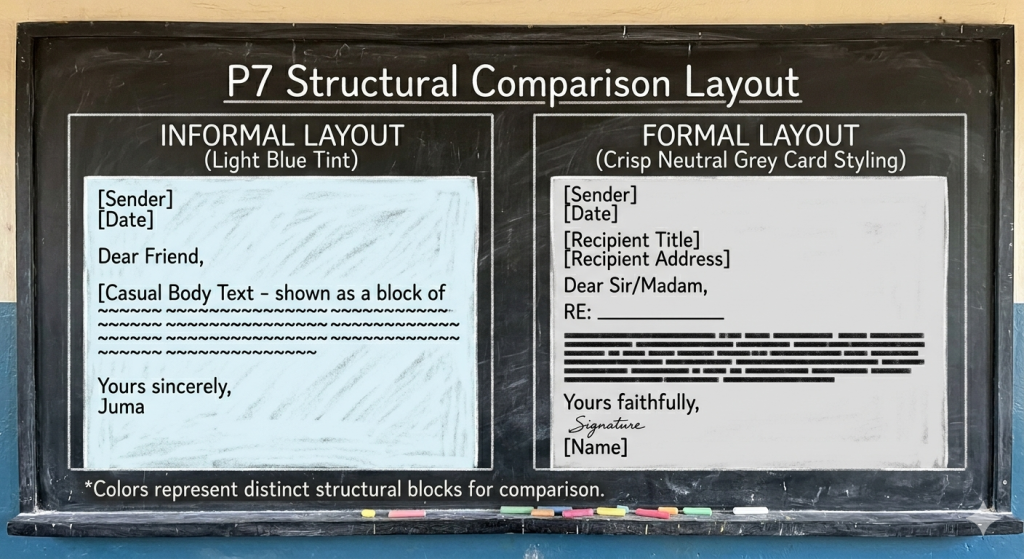
- Informal Letters (One Address Layout): Contains only the sender’s address and date in the top right-hand corner. It features a casual salutation, an informal introduction, the body, and an affectionate subscription.
- Formal Letters (Two Addresses Layout): Contains the sender’s address and date on the top right-hand side, followed by the recipient’s official title and address on the left-hand side. It includes a formal salutation, a bold subject line (RE:), the structural body text, a formal subscription, and a signature line.
Concept B: Language Structure — “…is likely to…”
This structure conveys high probability or a strong expectation of an event occurring in the near future.
- Formula: Subject + verb to be (am/is/are) + likely to + base verb.
- Informal context: My classmate is likely to reply to my letter next week.
- Formal context: The Headteacher is likely to grant us permission to hold the debate.
Concept C: Language Structure — “…hardly…”
“Hardly” functions as a negative adverb meaning “scarcely” or “almost not at all.” Because it is already negative, it cannot be paired with another negative word like not or doesn’t.
- Incorrect: There isn’t hardly anyone who replied.
- Correct: There is hardly anyone who has bothered to reply.
- Example: The clerk could hardly read the messy handwriting on the envelope.
─────────────────────────────────────────
─────────────────────────────────────────
─────────────────────────────────────────
5. TEACHER DEMONSTRATIONS / PRACTICAL ACTIVITIES
─────────────────────────────────────────
Activity: Structural Component Sorting Game
- Aim: To clarify structural differences between formal and informal components.
- Materials: Flashcards with phrases like “Dear Sir,”, “Yours affectionately,”, “RE: Application for Admission”, “Yours faithfully,”, and “Dear Uncle Opio,”.
- Procedure:
- Draw two large pillars on the chalkboard labeled Formal and Informal.
- Hand out flashcards randomly to learners.
- Have learners walk to the front and pin their component card under the correct pillar (a Gallery Walk style).
- Expected Observations: Learners often misplace “Yours sincerely,” under formal or stumble on where to put the subject line. Correct them instantly by clarifying that “Yours faithfully” is strictly reserved for formal letters where the recipient’s name is unknown.
─────────────────────────────────────────
6. LEARNER ACTIVITIES
─────────────────────────────────────────
Classroom Activity 1: Comprehensive Analysis (Reading & Interpretation)
- Objective: Read a sample letter text and answer target extraction questions.
- Task: Read the snippet below and complete the tasks:
Greenhill Primary Academy,
P. O. Box 7044,
Kampala.
22nd May, 2026.
The District Education Officer,
Kampala Capital City Authority,
P. O. Box 7010, Kampala.
Dear Sir,
RE: INVITATION TO BE THE GUEST OF HONOR
…
- What type of letter is displayed above? Give a structural reason.
- Identify the recipient of this letter.
- Re-write the subject line using the structure “…is likely to…” to show that the officer will visit.
Classroom Activity 2: Guided Composition — Error Spotting
- Objective: Identify layout and structural flaws within a letter format.
- Task: Correct the following mock informal letter segment written by a P7 pupil:
Hey Auntie, I am writing from Kampala on 22-05-26. There isn’t hardly any food left at school. Yours faithfully, Mukasa.
- Corrections needed: Moving the date/address block to the top right corner, eliminating the double negative (isn’t hardly $\rightarrow$ there is hardly), and changing the subscription to an informal closing like Your affectionate nephew or Yours sincerely.
Formative Assessment
- Transform into a negative structure using “hardly”: Almost no pupil remembered to stick a stamp on the envelope.
- Combine using “…likely to…”: The Postmaster will launch new postal stamps. It is highly expected.
- Punctuation Execution: Write down the correct punctuation for the subscription line of a formal letter addressed to a manager whose name you do not know.
Marking Guide:
- There was hardly any pupil who remembered to stick a stamp on the envelope. (Ensure no negative helping verb is included).
- The Postmaster is likely to launch new postal stamps.
- Yours faithfully, (Note the capital ‘Y’, lowercase ‘f’, and the trailing comma).
Further Reading
- Fountain Primary English Pupil’s Book 7, Pages 18-32.
- Mk Primary English Pupil’s Book 7, Unit 2: Letter Writing.
─────────────────────────────────────────
7. COMMON MISCONCEPTIONS
─────────────────────────────────────────
- Misconception: Writing a subject line (RE:) in an informal letter to a friend.
- Correction: Subject lines are exclusive functional elements of formal letters to ensure quick processing in busy office settings.
- Misconception: Mixing up the subscriptions “Yours faithfully” and “Yours sincerely.”
- Correction: Use “Yours faithfully” when you open with Dear Sir/Madam (recipient unknown). Use “Yours sincerely” in an informal letter or a formal letter where you know the recipient’s surname (e.g., Dear Mr. Okello).
─────────────────────────────────────────
8. SUMMARY NOTES FOR PUPILS
─────────────────────────────────────────
- Informal Letters: Sent to friends/family. Contain 1 address, casual greetings, and warm sign-offs.
- Formal Letters: Sent to officials. Contain 2 addresses, a clear subject line (RE:), precise language, and formal subscriptions.
- Grammar Rule: Never mix hardly with not/never.
- Grammar Rule: Use is/are/am + likely to + base verb for predictable future scenarios.
─────────────────────────────────────────
9. EXAMINATION FOCUS (UNEB-Style)
─────────────────────────────────────────
a) Sentence Transformation Questions
- Rewrite the sentence using: …hardly…
- Joan searched for the letter everywhere but she found almost nothing.
- Answer: Joan hardly found anything though she searched for the letter everywhere.
- Rewrite the sentence using: …likely to…
- Perhaps the school mail runner will deliver the package today.
- Answer: The school mail runner is likely to deliver the package today.
b) Structured Short Answer Questions
- Give one word for the following group of words: A paper cover used to enclose a letter for posting.
- Answer: Envelope
c) Functional Writing / Composition Question (10 Marks)
- The primary seven class has been experiencing a shortage of revision textbooks as they prepare for the Primary Leaving Examination. As the Class Monitor or Monitress, write an official letter to the Headteacher applying for a delivery of extra reading materials. Use your school address.
- Marking Guide: * Top right address & date layout (2 marks)
- Left side recipient address format (2 marks)
- Salutation and Subject Line placement (2 marks)
- Body structure using precise, formal tone (2 marks)
- Subscription and Signature formatting (2 marks)
─────────────────────────────────────────
10. HIGHER ORDER THINKING QUESTIONS
─────────────────────────────────────────
- Analyze: Why does an organization prioritize processing letters that contain a clear, bolded subject line over letters that jump straight into narrative prose?
- Evaluate: Suppose an emergency arises at school and you need immediate financial assistance from your guardian up-country. Contrast the efficiency and formatting adjustments required if you write an informal letter versus sending a modern digital text message.
─────────────────────────────────────────
11. TEACHING TIPS
─────────────────────────────────────────
- Strategy: Bring real, stamped envelopes to class. Let learners physically write addresses on them so they grasp how margins correspond to actual structural boundaries.
- Mnemonic: Remember S.S.B.S. for formal letters: Salutation $\rightarrow$ Subject $\rightarrow$ Body $\rightarrow$ Subscription.
─────────────────────────────────────────
12. GLOSSARY
─────────────────────────────────────────
- Affectionately: In a way that displays fondness, tenderness, or close personal warmth.
- Anatomy: The structural makeup or framework of a document layout.
- Faithfully: Used in a formal business letter closing when the writer does not know the recipient’s name.
─────────────────────────────────────────
END: KEY TAKEAWAY FOR LEARNERS
───────────────────────────────────────── Whether you are writing a warm letter to an old friend or a professional application to a school board, your letter’s layout acts as your visual introduction. Proper structure, careful grammar like the clean application of hardly, and distinct addressing are tools that show your discipline and academic maturity.
 Introduction to Islamic Religious Education (IRE) – Senior Six Learner’s Guide
 PERFORMING ARTS SENIOR TWO LEARNERS’ GUIDEOrdinary Secondary level
 - PERFORMING ARTS SENIOR TWO TEACHERS’ GUIDEOrdinary Secondary level
 Introduction to Islamic Religious Education (IRE) – Senior Five Learners’ Guide
 NUTRITION AND FOOD TECHNOLOGY SENIOR TWO LEARNERS’ GUIDE
- NUTRITION AND FOOD TECHNOLOGY SENIOR TWO TEACHERS’ GUIDEOrdinary Secondary level
 MATHEMATICS SENIOR TWO LEARNERS’ GUIDEOrdinary Secondary level
 - MATHEMATICS SENIOR TWO TEACHERS’ GUIDEOrdinary Secondary level
 LITERATURE IN ENGLISH SENIOR TWO LEARNERS’ GUIDEOrdinary Secondary level
 - LITERATURE IN ENGLISH SENIOR TWO TEACHERS’ GUIDEOrdinary Secondary level
 Enjoy learning with Yaaka Digital NetworkUncategorized
 Why We Must Accelerate Digital Learning: A Shared Responsibility for Learners, Teachers, Schools, Development Partners and GovernmentUncategorized
 AD3: Three-Dimensional Arts: CarvingUncategorized
 AD3: Drawing and Painting: Still LifeUncategorized
 AD3: Drawing And Painting: PerspectiveUncategorized
- Enjoy learning with Yaaka Digital NetworkUncategorized
- Why We Must Accelerate Digital Learning: A Shared Responsibility for Learners, Teachers, Schools, Development Partners and GovernmentUncategorized
- AD3: Three-Dimensional Arts: CarvingUncategorized
- AD3: Drawing and Painting: Still LifeUncategorized
- AD3: Drawing And Painting: PerspectiveUncategorized
 AD3: Three-Dimensional Arts: Relief SculptureUncategorized
- Topic 2: Electricity and MagnetismUncategorized
- Topic 1: The Muscular-Skeletal SystemUncategorized
- TOPIC 4: ISLAMIC HISTORY AND MUSLIM ORGANISATIONS (UMSC/UMEA)Uncategorized
- TOPIC 3: FIQH (HIJJ AND FORBIDDEN PRACTICES)Uncategorized
Products
-
 Books & Novels
$ 79
Books & Novels
$ 79
-
Whole subject
$ 29
-
Ultimate Plus
$ 999
-
Ultimate
$ 299
-
Gold
$ 99

0 responses on "LETTER WRITING"