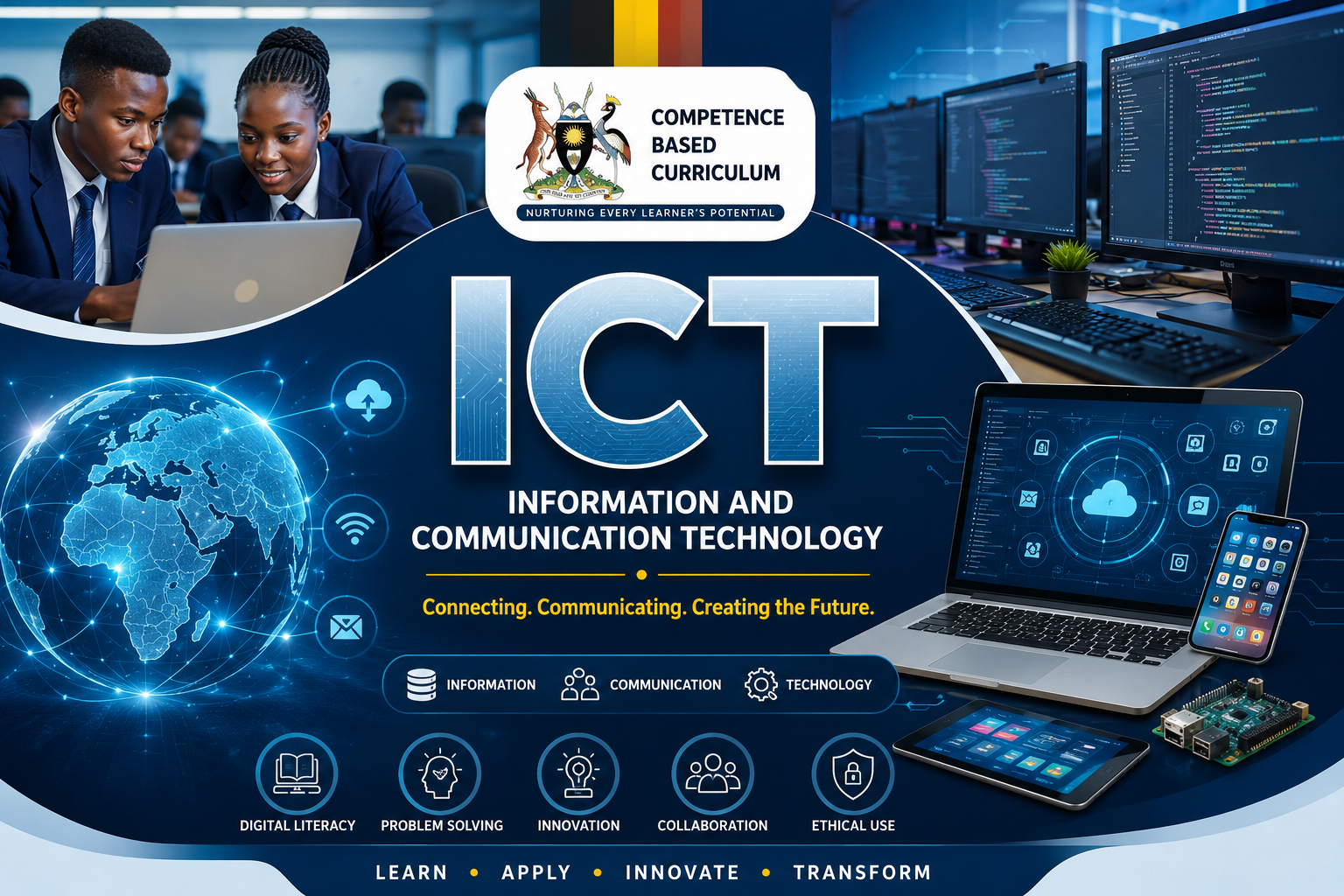
Imagine waking up in the morning and finding that there are no mobile phones, no internet, no computers, no television, no ATMs, no online banking, no digital classrooms, and no social media. How would you communicate with your friends? How would businesses operate? How would hospitals manage patient records? How would schools teach and assess learners?
Today, Information and Communication Technology (ICT) has become an essential part of everyday life. It influences how we learn, communicate, work, conduct business, access government services, solve problems, and create new opportunities. From smartphones and computers to artificial intelligence, cloud computing, robotics, and the Internet of Things (IoT), ICT continues to transform the world at an unprecedented pace.
In Uganda, ICT is a key driver of national development. It supports education through digital learning platforms, improves healthcare through electronic medical records and telemedicine, promotes financial inclusion through mobile money, enhances agriculture through digital advisory services, creates employment for young people, and enables innovation and entrepreneurship. As Uganda advances towards a knowledge-based and digitally connected economy, ICT skills are becoming increasingly important for every citizen.
The Advanced Level ICT curriculum is designed to equip learners with the knowledge, practical skills, values, and attitudes needed to use technology effectively, responsibly, and creatively. Throughout this course, learners will not only study computer systems and digital technologies but will also develop critical thinking, problem-solving, collaboration, communication, creativity, and innovation skills that are essential in the 21st century.
Learning ICT is more than mastering computers—it is about understanding how technology can be used to solve real-life problems within our communities and beyond. You will investigate authentic challenges, design practical digital solutions, develop computational thinking skills, and appreciate the ethical, legal, and social responsibilities associated with the use of technology.
By the end of this course, you should be able to use ICT confidently to create, innovate, communicate, analyse information, and contribute meaningfully to Uganda's social and economic transformation.
Guiding Question
"How can ICT be used to improve the quality of life, solve community problems, and create sustainable opportunities for national development?"
As you begin this exciting journey, remember that the future belongs to those who can think creatively, adapt continuously, and use technology responsibly to make a positive difference in society.