Basic
Basic subscription for premium downloads, upto 24 premium downloads per month
20 / day · 24 / week · 24 / month
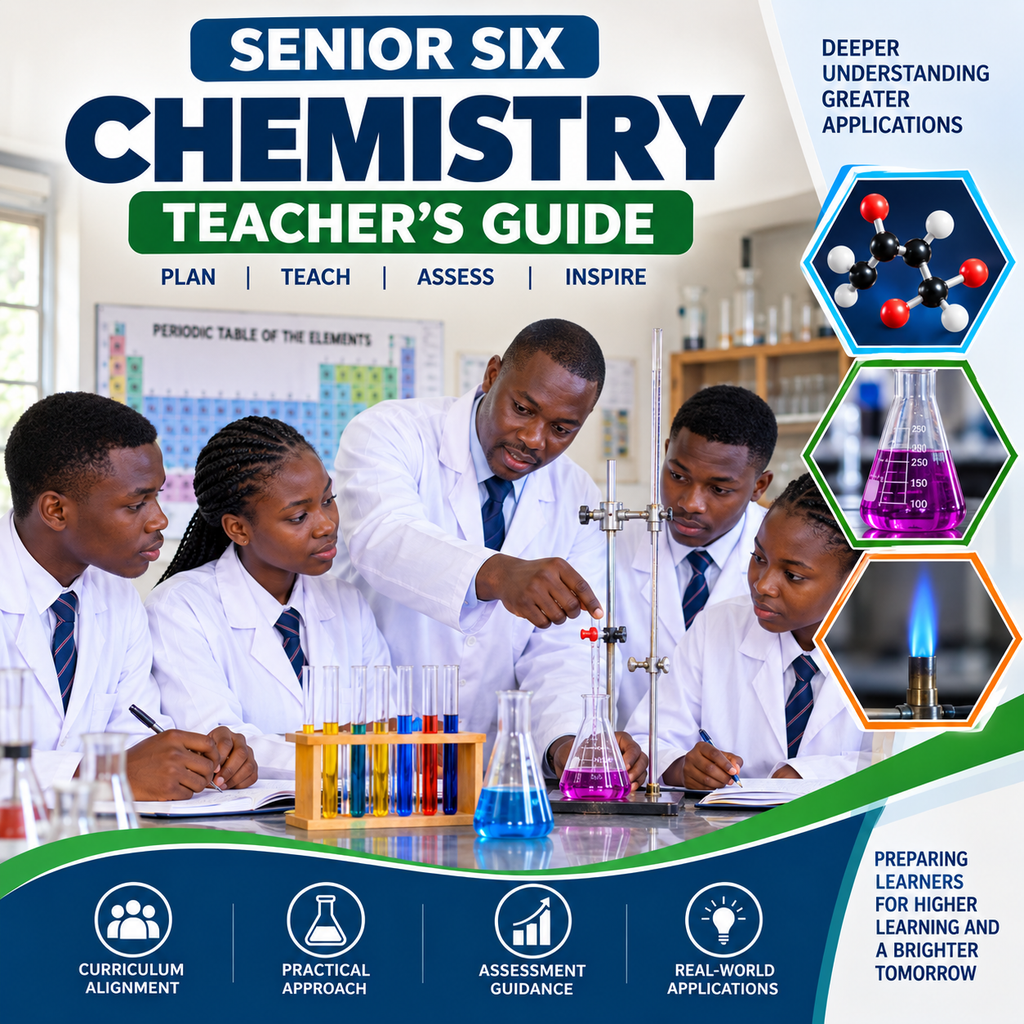
The Senior Six Chemistry Teacher’s Guide is designed to support teachers in effectively facilitating the final stage of Advanced Level Chemistry. It provides guidance for delivering engaging, learner-centred and competency-based lessons that deepen learners’ understanding of chemical principles while strengthening their ability to apply knowledge, conduct investigations, analyse evidence and solve problems.
At Senior Six, learners build on the knowledge, skills and competencies developed in Senior Five. The subject demands greater depth of understanding, accuracy in scientific reasoning, confidence in practical work and the ability to connect concepts across different areas of Chemistry. Teachers should therefore guide learners beyond memorising facts and equations towards explaining, predicting, analysing, evaluating and applying chemical principles in both familiar and unfamiliar situations.
The teaching of Chemistry should remain strongly learner-centred and inquiry-based. Learners should be actively involved through experiments, demonstrations, discussions, research, collaborative problem-solving, data analysis and activities of integration. Teachers are encouraged to create opportunities for learners to ask questions, formulate explanations, test ideas, interpret observations and communicate their findings using appropriate scientific language.
Practical Chemistry remains central to learning at this level. Learners should progressively develop competence in selecting and using apparatus, handling chemicals safely, following experimental procedures, making accurate observations and measurements, recording results, analysing data, identifying sources of error and drawing evidence-based conclusions. Laboratory safety, responsible chemical handling and appropriate waste management should be emphasised throughout all practical activities.
Teachers should also connect Chemistry to real-life situations and the Ugandan context. Relevant examples may be drawn from agriculture, health, medicine, food processing, water treatment, mining, energy, manufacturing, environmental conservation and other areas where chemical knowledge contributes to national development. Such connections enable learners to recognise Chemistry as an important tool for understanding and responding to challenges within their communities and the wider world.
Assessment should be integrated continuously into the teaching and learning process. Teachers should use questioning, written exercises, practical investigations, projects, presentations, collaborative activities and activities of integration to determine learners’ progress. Feedback should help learners recognise areas of strength, address misconceptions and progressively improve their scientific knowledge and competencies. Appropriate attention should also be given to preparing learners to demonstrate their knowledge, practical skills and reasoning effectively in Advanced Level assessment.
The teacher should recognise differences in learners’ abilities, experiences and learning needs and provide appropriate support so that all learners can participate meaningfully. Where possible, teaching and learning resources should be adapted to the local environment, and learners should be encouraged to work collaboratively while developing independence, responsibility and confidence in scientific inquiry.
Ultimately, this Teacher’s Guide aims to support the teacher in developing learners who can think scientifically, investigate systematically, solve problems, communicate chemical ideas clearly and apply Chemistry responsibly. By the end of Senior Six, learners should be better prepared for further education, scientific and technological careers, entrepreneurship and responsible participation in society.


Sign in without leaving this document. You will return here automatically.

Yaaka Digital Network Prime
https://soma.yaaka.cc
Basic subscription for premium downloads, upto 24 premium downloads per month
20 / day · 24 / week · 24 / month
Subscription to download books and novels upto 200 downloads per month/ per year
40 / day · 80 / week · 160 / month · 200 / year
Gold subscription for premium downloads, upto 500 premium downloads per year
120 / day · 180 / week · 250 / month · 500 / year
Platinum subscription for premium downloads, upto 240 premium downloads per year
58 / day · 98 / week · 120 / month · 240 / year
Pro subscription for premium downloads, upto 78 premium downloads per quarter
24 / day · 48 / week · 78 / month
Ultimate subscription for unlimited premium downloads for a year
Unlimited downloads
Ultimate plus subscription for unlimited premium downloads for lifetime
Unlimited downloads
Whole subject content downloads for utpo 12 subjects i.e per class full subject downloads
12 / day · 12 / week · 12 / month · 12 / year
Yaaka Digital Network Prime
https://soma.yaaka.cc
Continue directly to this store’s secure WooCommerce checkout.
Earn direct and team commission with personal links, campaign creatives, discount coupons and transparent reporting.