Basic
Basic subscription for premium downloads, upto 24 premium downloads per month
20 / day · 24 / week · 24 / month
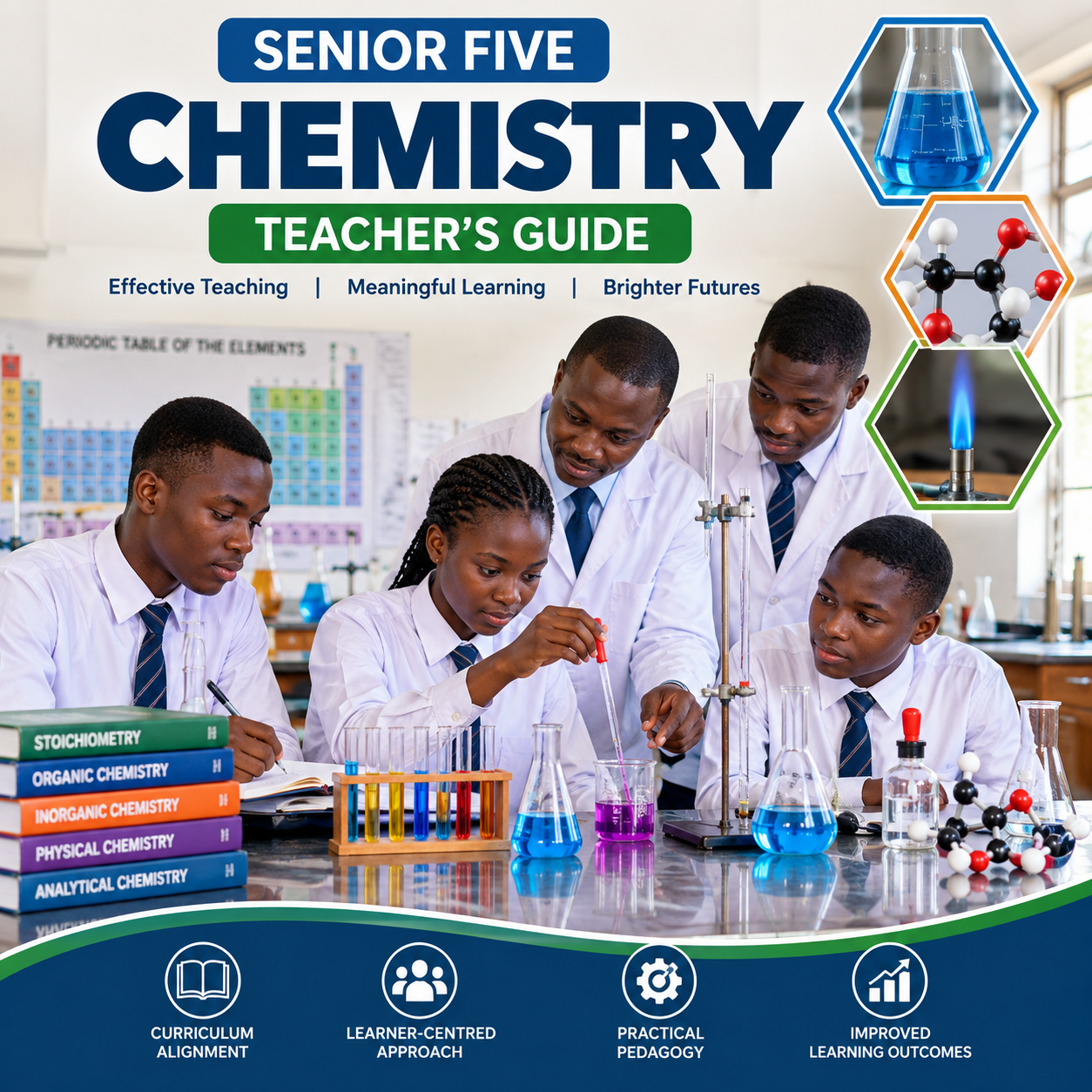
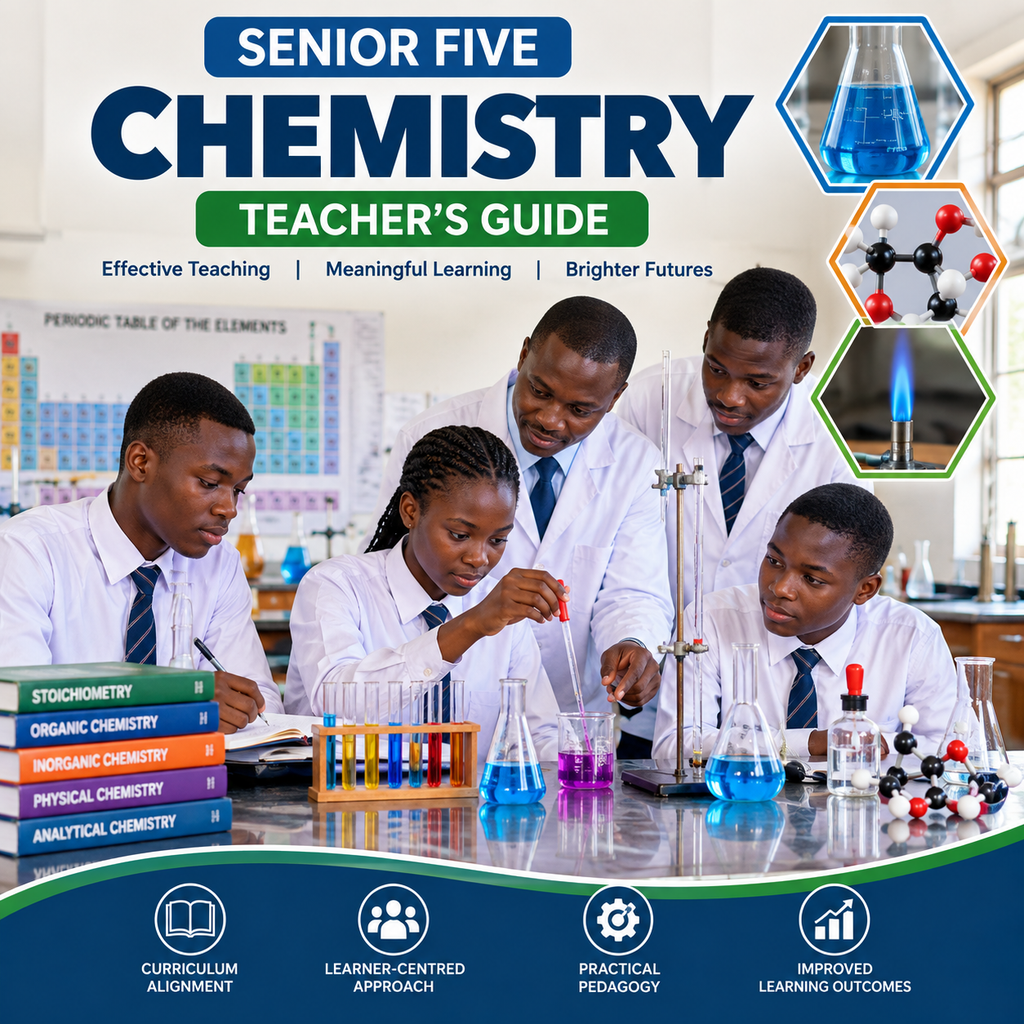
This Senior Five Chemistry Teacher’s Guide is designed to support teachers in delivering Chemistry effectively under the competency-based curriculum. It provides practical guidance for creating engaging, learner-centred lessons that enable learners to understand chemical concepts, develop scientific skills, and apply Chemistry to situations encountered in everyday life.
At Senior Five, Chemistry builds on knowledge and skills acquired at lower levels while introducing learners to more advanced concepts, practical investigations, quantitative reasoning, and scientific problem-solving. The teacher therefore plays an important role in helping learners connect theory with experimentation, observation, interpretation, and real-life application.
The guide emphasises active learning. Teachers are encouraged to involve learners in laboratory investigations, demonstrations, discussions, collaborative tasks, research, problem-solving activities, and interpretation of experimental evidence. Particular attention should be given to developing competencies such as critical thinking, creativity, communication, collaboration, numerical skills, scientific inquiry, and responsible decision-making.
Chemistry should also be taught within meaningful contexts. Wherever appropriate, teachers should relate concepts to Ugandan homes, schools, agriculture, industry, health, environmental management, energy, water treatment, materials, and other familiar situations. Such connections help learners appreciate Chemistry not simply as a collection of facts and equations, but as a science that contributes to understanding and solving real-world problems.
Practical work is an essential part of the subject. Teachers should provide opportunities for learners to observe, measure, manipulate apparatus, record results, analyse data, draw conclusions, and evaluate experimental procedures. Appropriate laboratory safety practices, responsible handling of chemicals, proper waste disposal, and care for the environment should be reinforced throughout the learning process.
Assessment should be integrated into teaching and learning. Teachers should use a variety of approaches—including questioning, observation, practical activities, written exercises, projects, presentations, and activities of integration—to identify learners’ progress and provide constructive feedback. Assessment should focus not only on what learners know, but also on what they can do with the knowledge and skills they acquire.
Ultimately, this Teacher’s Guide aims to help teachers create a Chemistry classroom in which learners investigate, question, experiment, reason, collaborate, and discover. Through effective teaching and meaningful learning experiences, learners can develop the knowledge, competencies, scientific attitudes, and confidence required for further study, the world of work, and responsible participation in society.


Sign in without leaving this document. You will return here automatically.

Yaaka Digital Network Prime
https://soma.yaaka.cc
Basic subscription for premium downloads, upto 24 premium downloads per month
20 / day · 24 / week · 24 / month
Subscription to download books and novels upto 200 downloads per month/ per year
40 / day · 80 / week · 160 / month · 200 / year
Gold subscription for premium downloads, upto 500 premium downloads per year
120 / day · 180 / week · 250 / month · 500 / year
Platinum subscription for premium downloads, upto 240 premium downloads per year
58 / day · 98 / week · 120 / month · 240 / year
Pro subscription for premium downloads, upto 78 premium downloads per quarter
24 / day · 48 / week · 78 / month
Ultimate subscription for unlimited premium downloads for a year
Unlimited downloads
Ultimate plus subscription for unlimited premium downloads for lifetime
Unlimited downloads
Whole subject content downloads for utpo 12 subjects i.e per class full subject downloads
12 / day · 12 / week · 12 / month · 12 / year
Yaaka Digital Network Prime
https://soma.yaaka.cc
Continue directly to this store’s secure WooCommerce checkout.
Earn direct and team commission with personal links, campaign creatives, discount coupons and transparent reporting.